


















Lesson 42 of 47 · Projects and Practice
Practice: Case Formulation with the Five-P Model
Practice building a case formulation with the five-P model on three fictional vignettes, and learn to update hypotheses as new evidence arrives.
Diagnosis labels a pattern. Formulation explains a person: why this problem, why now, what keeps it going, and what can help. Good formulations are short, tentative, and built from evidence, and they guide treatment choices more directly than a label can.
In this lesson you will practice the widely used five-P model on three fictional vignettes, and then learn to reason about uncertainty by updating the probability of a hypothesis as evidence arrives. The people described here are invented composites, not real cases, and nothing here is a diagnosis.
Educational information only. These vignettes are fictional teaching examples. Real formulations need an in-person assessment, consent and supervision. Do not use them to label anyone.
What you will learn
- Describe the five Ps and write a one-paragraph formulation.
- Generate and rank several hypotheses instead of jumping to one label.
- Choose sensible next steps for assessment.
- Update a hypothesis with likelihood ratios.
Key terms
- Formulation: a hypothesis-based explanation of a person's difficulties that guides treatment.
- Differential diagnosis: a list of possible explanations that need to be considered and tested.
- Likelihood ratio (LR): how much more likely a finding is in people with a condition than in people without it.
- Prior probability: your estimate before seeing the new evidence.
- Posterior probability: your updated estimate after the evidence.
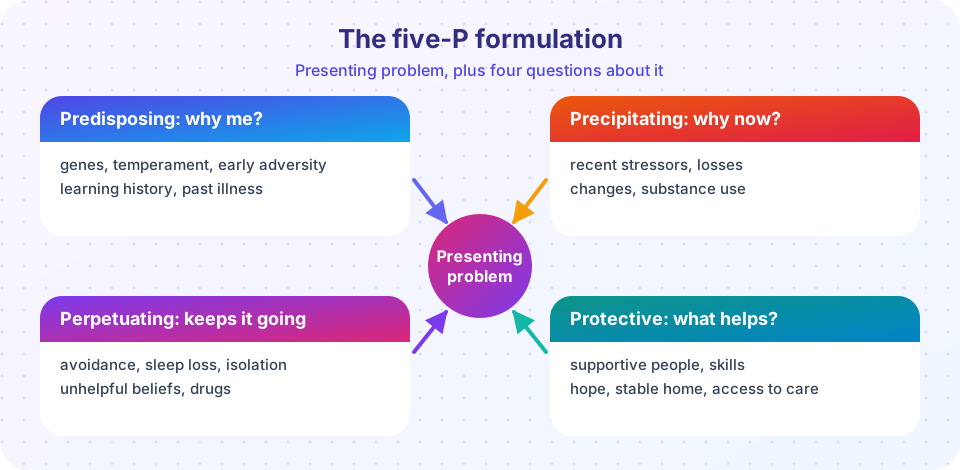
The five Ps
- Presenting problem. What brought the person in, in their own words, with its duration and impact.
- Predisposing factors. Background that raised vulnerability: family history, temperament, early experiences, past illnesses.
- Precipitating factors. Recent triggers: losses, stress, substance use, changes.
- Perpetuating factors. What keeps it going: avoidance, isolation, sleep loss, unhelpful beliefs, substances, a stressful environment.
- Protective factors. Strengths, relationships, skills and services that help.
Add hypotheses (what might be going on, ranked) and next steps (what to assess, who to involve, how to keep the person safe).
Three fictional vignettes
Vignette A: Sam, 19. Sam started university eight months ago. Over time he has withdrawn from friends and sleeps in the day. He says a voice sometimes comments on what he is doing and that neighbors are "keeping watch". His mother's brother had a psychotic illness. Sam smokes strong cannabis most evenings and says it "calms things down". He has missed most lectures and is worried about money. His older sister calls every week, and he says he does want to feel better.
Vignette B: Priya, 16. After a team-mate's comment about her body at the start of the season, Priya began avoiding certain foods and training more. Her parents notice she skips family meals, has become irritable and tired, and is very upset if routines change. She is a top student and says she "can't stop" thinking about food and shape. She dreads gaining weight and is proud of her self-control. Her friends are worried, and her parents are keen to help.
Vignette C: Marcus, 8. Since preschool Marcus has been very active and impulsive: he blurts out answers, leaves his seat, loses belongings and has trouble finishing homework. Reports are similar at school and at home. His father says he was the same as a child. Marcus sleeps well, has friends and is kind, but is frustrated and starting to say he is "bad at school".
Worked example: Vignette A
- Presenting problem: eight months of withdrawal, a commenting voice and suspicious ideas, missed classes.
- Predisposing: family history of psychosis; late-teen age at the peak risk window; heavy cannabis exposure (which may be both a risk and a way of coping).
- Precipitating: transition to university, isolation, financial stress.
- Perpetuating: daily cannabis, sleep reversal, social withdrawal, fear of telling anyone.
- Protective: engaged sister, wish to get better, no reported harm to self or others (to be checked).
- Hypotheses: (1) a first episode of a psychotic disorder; (2) a substance-induced psychotic disorder; (3) a mood disorder with psychotic features; (4) a medical cause. Ranking them needs more information.
- Next steps: a full assessment including a safety check; cannabis history and timing of symptoms relative to use; screening for mood symptoms and medical causes; early intervention in psychosis service; involve family with Sam's consent; plan for sleep and cannabis reduction.
Now try writing your own five-P notes for Priya and Marcus before reading on. Think about differential possibilities: for Priya, a restrictive eating disorder, but also medical causes and mood or anxiety problems, with urgent medical review in any case; for Marcus, ADHD, but also hearing or vision problems, sleep issues, anxiety, a specific learning disorder or the school environment. An important step for Marcus would be gathering information from several settings.
Thinking in probabilities
When evidence is uncertain, clinicians weigh it. Suppose that among young adults who come to a clinic reporting unusual experiences, 10 percent (a made-up figure) have a psychotic disorder. Each new piece of evidence changes the odds by its likelihood ratio. A finding with LR 3 makes the condition three times more likely (in odds terms); an LR below 1 makes it less likely. The code below applies the arithmetic to Sam's case with invented likelihood ratios.
Common misconceptions
"A formulation is the same as a diagnosis." A formulation explains why a person struggles; a diagnosis names a pattern.
"The first hypothesis is the right one." Anchoring on one explanation is a common error; keep several in mind.
"More information always means more certainty." Evidence can point in different directions, and a good formulation expresses that honestly.
Try it
The first demonstration builds a formulation as structured text from a dictionary, which is a useful habit for keeping notes organized. The second updates a hypothesis step by step with invented likelihood ratios.
Press Run (or Ctrl + Enter) to see the result here.
Program input · what you'd type while the program runs
Type the answers before you press Run, one per line. Each time the program reads a line (with input()), it gets the next line from this box.
Press Run (or Ctrl + Enter) to see the result here.
Program input · what you'd type while the program runs
Type the answers before you press Run, one per line. Each time the program reads a line (with input()), it gets the next line from this box.
Check your understanding
Quick check · 4 questions
of 4 answered You scored / 4 · perfect!
-
1. Which of the five Ps answers the question 'why now?'
Precipitating factors are recent triggers that tipped the balance. -
2. Which is a perpetuating factor in the vignette of Sam?
Daily cannabis and sleep reversal keep problems going; the sister is protective and family history is predisposing. -
3. What is the main reason to keep several hypotheses in mind?
Considering alternatives reduces diagnostic errors. -
4. A finding with a likelihood ratio below 1 will...
An LR below 1 means the finding is more common in people without the condition.
Summary
- The five-P model organizes a formulation: presenting problem, predisposing, precipitating, perpetuating and protective factors.
- A formulation explains and guides; a diagnosis labels.
- Keep several hypotheses and update them as evidence arrives, using likelihood ratios.
- Next steps should include assessment, safety, family involvement with consent and suitable services.
Track your progress
Create a free account to tick off lessons and pick up where you left off on any device.
of Abnormal and Clinical Psychology lessons completed