


















Lesson 47 of 47 · Projects and Practice
Further Study: Where to Go Next in Clinical Psychology
Plan your next steps after this course: related tracks on psychology, neuroscience, research methods and statistics, training routes and critical reading tips.
You have covered a lot of ground: the major families of mental disorders, how clinicians assess and treat them, and how prevention, ethics and health systems shape care. This is a foundation, not a finish line. Clinical psychology draws on many neighboring fields, and the best next step depends on what caught your interest.
This lesson suggests directions, outlines common training routes, and ends with a checklist for reading research critically, which may be the most useful skill you carry forward.
Educational information only. This course does not train you to diagnose or treat anyone. Professional practice requires formal education, supervised training and licensing that vary by country.
What you will learn
- Choose related tracks to deepen the topics you enjoyed.
- Describe typical routes into mental health professions.
- Use a checklist to read a research paper critically.
Key terms
- Scientist-practitioner model: training that combines research skills with clinical practice.
- Supervised practice: clinical work done under the guidance of an experienced professional.
- Peer support worker: a person with lived experience who supports others.
- Replication: repeating a study to see whether its results hold.
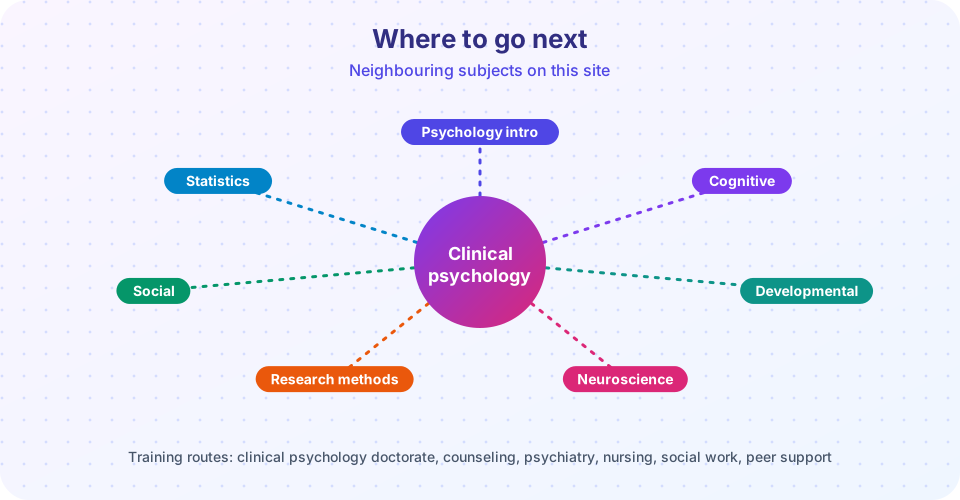
Where to go next on this site
- If you want the big picture of psychology: Introduction to Psychology covers history, perspectives, learning, memory, motivation and more, and revisits several ideas you met here from a general viewpoint.
- If the brain fascinated you: Neuroscience explains neurons, circuits, neurotransmitters and brain regions, which underpin the chapters on psychosis, dopamine and stimulation treatments.
- If you liked thinking, learning and memory: Cognitive Psychology goes deeper into attention, memory, decision-making and thinking errors, the mental processes that cognitive therapy targets.
- If you were drawn to early life: Developmental Psychology covers attachment, childhood development and adolescence, which are essential for understanding neurodevelopmental conditions and prevention.
- If group life and relationships interest you: Social Psychology explores attitudes, conformity, prejudice and stigma, and Sociology looks at inequality, institutions and health from the viewpoint of society.
- If you want to judge evidence: Research Methods in Psychology teaches designs, sampling and ethics, and Probability and Statistics builds the tools behind effect sizes, confidence intervals and power, which featured in the project lessons.
Training routes
Routes vary widely between countries, so check local requirements. Typical patterns include:
- Clinical psychologist. Usually a bachelor's degree in psychology, research or clinical experience, then a doctoral-level program (a PhD, PsyD or in some countries a clinical doctorate) with supervised placements, and registration or licensing.
- Counselor or psychotherapist. A master's degree or accredited training in counseling or a specific therapy model, with supervised practice and registration.
- Psychiatrist. A medical degree followed by specialist training in psychiatry; psychiatrists can prescribe medicine and manage physical aspects of care.
- Psychiatric nurse, social worker or occupational therapist. Professional degrees in nursing, social work or occupational therapy with mental health specialization.
- Peer support worker or community health worker. Short training combined with lived experience or local knowledge, as in the Friendship Bench model.
- Researcher. A research master's or PhD in psychology, neuroscience, epidemiology, statistics or a related field.
Most routes require personal resilience as well as knowledge, so look for programs with good supervision and attention to well-being.
How to read a research paper critically
When you read about a new finding, ask:
- Who were the participants, and do they resemble the people you care about?
- What was the comparison? Waiting list, placebo, another treatment?
- Were people assigned at random, and were assessors blind to the group?
- How large was the effect, not only whether it was significant? Is there an NNT or a confidence interval?
- How big was the sample? Small studies are noisy and often exaggerate effects.
- Were outcomes and analyses preregistered?
- Has it been replicated? One study is a hint, many studies are evidence.
- Who funded it, and who might gain from the result?
- What did participants from different groups experience? Look for fairness and generalizability.
Common misconceptions
"You need to know everything before you start helping." Peers, volunteers and friends can offer valuable support, and professional training builds skill over years.
"Clinical psychology is only about therapy." Research, assessment, prevention, teaching, policy and consultation are central parts of the field.
"One study settles a question." Findings become convincing when replicated across settings and methods.
Try it
The first demonstration suggests tracks based on your interests; extend the lists as you explore the site. The second turns the reading checklist into a short quiz-style function.
Press Run (or Ctrl + Enter) to see the console output here.
No output.
Press Run (or Ctrl + Enter) to see the console output here.
No output.
Check your understanding
Quick check · 3 questions
of 3 answered You scored / 3 · perfect!
-
1. Which track on this site would you choose to learn more about effect sizes and power?
Probability and Statistics builds the tools behind effect sizes, intervals and power. -
2. Which profession typically requires a medical degree and specialist training?
Psychiatrists are physicians who specialize in mental health and can prescribe medicine. -
3. Why does replication matter when reading research?
Single studies can be noisy or biased, and repeated findings strengthen confidence.
Summary
- Choose neighboring tracks to deepen the parts of clinical psychology that interest you most.
- Training routes differ by profession and country, but all involve supervised practice.
- Critical reading of research, including comparison groups, effect sizes, sample sizes and replication, is a lifelong skill.
- Return to the course home page any time to revisit lessons.
Track your progress
Create a free account to tick off lessons and pick up where you left off on any device.
of Abnormal and Clinical Psychology lessons completed