


















Lesson 4 of 47 · Getting Started
Causal Models: Biopsychosocial and Diathesis-Stress
Learn the major explanations for why mental disorders arise, the biopsychosocial and diathesis-stress models, and why no single cause explains a disorder.
Why does one person develop depression after a loss while another grieves and recovers? A single cause rarely explains it. Over the past century, researchers proposed one big theory after another: the brain, the unconscious, learning, thinking, society. Each captured something real, and each was incomplete. Modern clinical psychology uses integrative models that combine several kinds of causes. This lesson explains the main perspectives and the two models you will meet in nearly every later chapter.
What you will learn
- The biological, psychological and sociocultural perspectives and what each emphasizes.
- The biopsychosocial model and the diathesis-stress model.
- Why different causes can lead to the same disorder (equifinality) and the same cause to different outcomes (multifinality).
- Why a famous gene-by-stress finding became a lesson about replication.
Key terms
Diathesis: a predisposition or vulnerability, such as a genetic risk or fragile coping style.
Stressor: an event or condition that taxes a person's coping.
Equifinality: different pathways can lead to the same outcome.
Multifinality: the same starting point can lead to different outcomes.
Epigenetics: chemical changes that affect how genes are switched on or off without changing the DNA sequence.
The biological perspective
The biological view looks at genes, brain structure and function, neurotransmitters, hormones and physical health. Twin studies show that genes contribute to nearly all major disorders. Large genome-wide studies show that risk is spread across thousands of small-effect gene variants, not a single "depression gene". Brain imaging finds average differences between groups, for example in the way the amygdala responds to threat in anxiety, but these differences are small and overlap heavily with the general population, so scans cannot diagnose an individual. Biological treatments include medication, brain stimulation and attention to sleep, exercise and illness.
The psychological perspectives
- Psychodynamic: Freud and successors emphasize unconscious conflict, early relationships and defense mechanisms. Attachment theory (Bowlby, Ainsworth) is a better-supported descendant.
- Behavioral: abnormal behavior is learned through conditioning. Watson and Rayner's 1920 "Little Albert" study is the classic illustration of conditioned fear, although it is small, poorly documented and ethically troubling by modern standards.
- Cognitive: distorted thinking maintains problems. Aaron Beck's work on depression and Albert Ellis's rational-emotive approach led to cognitive therapy.
- Humanistic: Carl Rogers and Abraham Maslow stress growth, meaning and a supportive relationship.
Cognitive and behavioral ideas merged into cognitive behavioral therapy (CBT), one of the best-studied treatments (Chapter 7).
The sociocultural perspective
Social factors include poverty, discrimination, neighborhood, family, school and work, migration, and culture. The sociologists Hollingshead and Redlich (1958) found a link between social class and diagnosis, and large studies worldwide still show that poverty, trauma, isolation and unemployment raise risk. In Social Origins of Depression (1978), George Brown and Tirril Harris found that working-class women in London's Camberwell who faced severe life events were more likely to develop depression, and that vulnerability factors such as lack of a confiding relationship raised the risk. Culture also shapes how distress is expressed and understood (Chapter 2).
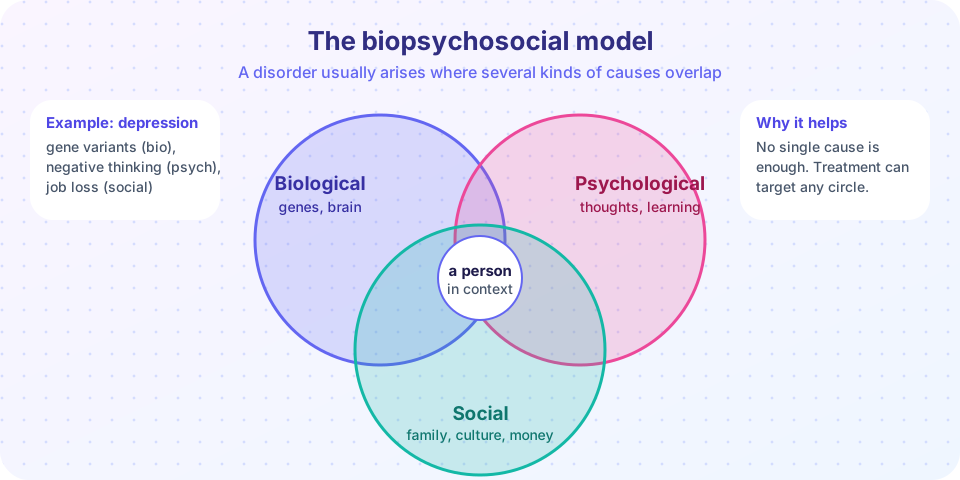
The biopsychosocial model
In 1977 the physician George Engel argued that medicine should consider biology, psychology and social context together. In clinical psychology the biopsychosocial model says disorders arise from interacting biological, psychological and social factors. It guides case formulation: a clinician asks, for this person, what are the biological risks (family history, illness, sleep), psychological factors (thinking style, coping, learning history) and social factors (relationships, money, culture)? Each suggests a target for help. Critics say the model is so broad that it can explain anything and sometimes fails to say how the factors interact. Its value is practical: it prevents tunnel vision.
The diathesis-stress model
The diathesis-stress model is a specific, testable version. A person carries some level of vulnerability (diathesis), and life brings stress. A disorder emerges when the combination passes a threshold. High vulnerability needs only mild stress; low vulnerability can tolerate a great deal.
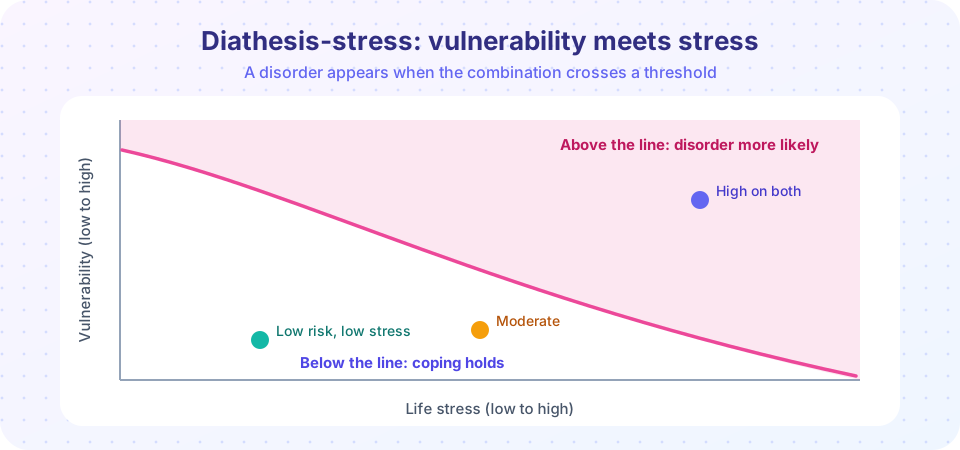
The model explains why identical twins, who share genes, are not always both affected (the second twin may not meet the stress), and why an adversity affects people differently. Variants add protective factors such as supportive relationships, and differential susceptibility, the idea that some people are more sensitive to both bad and good environments.
A cautionary tale: the serotonin transporter study
In 2003 Avshalom Caspi and colleagues published a famous result from the Dunedin study: people with a short version of the serotonin transporter gene (5-HTTLPR) who experienced many stressful life events were more likely to be depressed. It looked like a perfect gene-by-stress example. But later large meta-analyses and genetic studies, including by Risch and colleagues (2009) and a major 2019 analysis by Border and colleagues, found little support for it. The episode is now a standard lesson: small early studies of candidate genes often fail to replicate, and mental disorders are influenced by many genes with tiny effects. The diathesis-stress idea survives, but individual gene claims need caution.
Equifinality, multifinality and development
Different roads can lead to the same condition (equifinality): one person becomes depressed after bereavement, another after chronic illness. And the same starting point can lead to different outcomes (multifinality): childhood adversity raises the risk of many disorders, not one. Developmental psychopathology studies this trajectory, noting that timing matters: early adversity can affect brain systems for stress. Epigenetics offers one possible biological route by which experience leaves a mark, though the human evidence is still developing.
Common misconceptions
"It is either nature or nurture." The two interact constantly, and the question "how much of each" is a poor fit for most disorders.
"A genetic cause means nothing can be done." Risk is not destiny. Treatments work for people with high genetic risk.
"A chemical imbalance causes depression." This popular slogan oversimplifies decades of research. Neurotransmitters matter, but no simple imbalance has been shown (see Chapter 4).
"The biopsychosocial model is just three lists." The point is interaction: biology shapes how stress is felt, and thoughts and relationships change biology.
Try it
Set a person's vulnerability and stress with the sliders. The model is a teaching illustration with an arbitrary threshold, not a clinical tool.
The second demonstration plots the threshold curve and a few illustrative people.
Press Run (or Ctrl + Enter) to see the result here.
Program input · what you'd type while the program runs
Type the answers before you press Run, one per line. Each time the program reads a line (with input()), it gets the next line from this box.
Check your understanding
Quick check · 5 questions
of 5 answered You scored / 5 · perfect!
-
1. In the diathesis-stress model, a disorder is most likely when
Neither vulnerability nor stress alone is the whole story; their combination matters. -
2. What does equifinality mean?
Equifinality is many roads to one outcome. -
3. What did later research conclude about the 2003 serotonin transporter by stress finding?
Risch et al. (2009) and Border et al. (2019) are examples of failures to find consistent support. -
4. Which is a strength of the biopsychosocial model?
It guides case formulation across several domains, though critics say it can be vague. -
5. Brown and Harris (1978) found that depression in a London sample was linked to
Their work showed how social context interacts with vulnerability.
Summary
- Biological, psychological and sociocultural perspectives each capture part of the truth.
- The biopsychosocial model combines them; the diathesis-stress model adds a vulnerability-by-stress threshold.
- Equifinality and multifinality warn against simple one-to-one cause stories.
- The 5-HTTLPR episode shows why replication matters.
Next: Chapter 1 Review
Track your progress
Create a free account to tick off lessons and pick up where you left off on any device.
of Abnormal and Clinical Psychology lessons completed