


















Lesson 41 of 47 · Prevention, Ethics and Mental Health Systems
Chapter 8 Review: Prevention, Ethics and Mental Health Systems
Review chapter 8 with a one-picture summary, a recap table and ten mixed questions on prevention, risk and resilience, ethics, confidentiality and care systems.
This chapter widened the lens from the individual to the population and the profession. Use this review to pull the pieces together before the final chapter of projects and practice: first a one-page picture, then a table of key facts, then ten mixed questions.
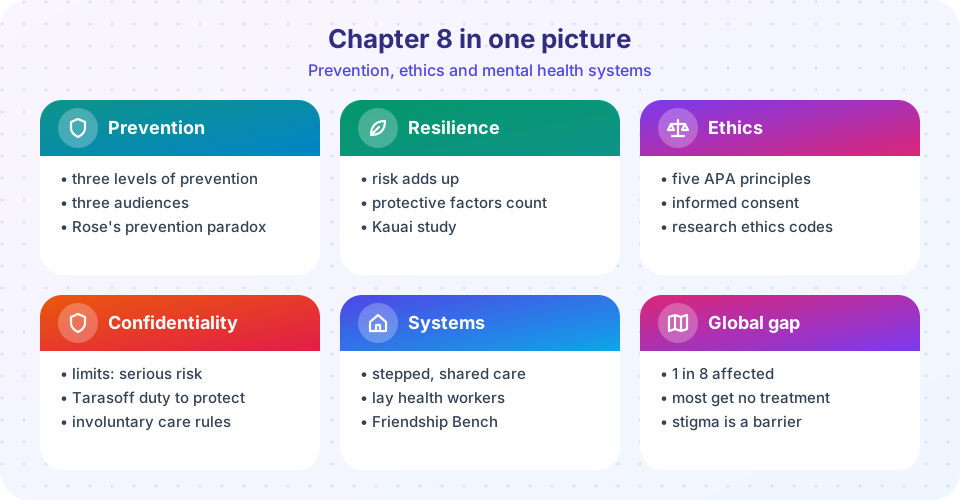
Recap table
| Topic | Key facts | Landmark names |
|---|---|---|
| Levels of prevention | Primary prevents new cases, secondary finds problems early, tertiary reduces harm and relapse | Caplan |
| Audiences | Universal (everyone), selective (at-risk groups), indicated (early signs) | Institute of Medicine |
| Risk and adversity | Risk adds up; more ACEs, more problems later | Felitti and Anda |
| Resilience | About a third of high-risk children did well; caring adults help | Werner and Smith (Kauai) |
| Suicide prevention | Means restriction, safety planning, treatment, crisis lines, media guidelines | Kreitman, Gunnell, Stanley and Brown |
| Prevention paradox | Many people at modest risk produce most cases | Rose |
| Ethics | Five principles; informed consent needs information, voluntariness, capacity | APA code |
| Confidentiality | Limits: serious risk, mandated reporting, court orders, consent; duty to protect | Tarasoff (1976) |
| Research ethics | Voluntary consent, ethics review, minimizing harm | Nuremberg, Helsinki, Belmont |
| Systems | Stepped care, collaborative care, task sharing, community services | IAPT, IMPACT, Friendship Bench |
| Global gap | About 1 in 8 people have a disorder; low spending and few workers | WHO |
Try it
A helpful skill in prevention research is to convert an effect reported as a relative reduction into the number of cases actually prevented. The calculator below does this for a program, so you can compare a universal program (small effect, many people) with an indicated one (large effect, few people).
Press Run (or Ctrl + Enter) to see the console output here.
No output.
Check your understanding
Quick check · 10 questions
of 10 answered You scored / 10 · perfect!
-
1. A school-wide program that teaches coping skills to every pupil is best described as...
It targets everyone and aims to prevent new cases. -
2. What did Kreitman's study of domestic gas show?
It is a classic example of means restriction. -
3. What did the Kauai study find?
Resilience was common and linked to temperament, caring adults and community support. -
4. What is Rose's prevention paradox?
A small shift across everyone can prevent more cases than intensive help for a few, though each person gains little. -
5. Which are three of the five APA general principles?
The five are beneficence and nonmaleficence, fidelity and responsibility, integrity, justice, and respect for people's rights and dignity. -
6. Informed consent requires which three things?
A person must understand the information, agree freely and have the capacity to decide. -
7. The Tarasoff decision concerns...
The California Supreme Court recognized a duty to use reasonable care to protect an intended victim. -
8. What are the three principles of the Belmont Report?
They underlie modern research ethics. -
9. What does stepped care do?
It matches intensity to need and reviews progress. -
10. Which statement best describes the global treatment gap?
Low funding, few workers and stigma leave a large share of people without adequate care.
Summary
- Prevention works at three levels and for three audiences, and population-wide shifts can prevent many cases.
- Risk adds up and protection counts, so resilience can be built.
- Ethics rests on five principles, consent, and confidentiality with clear limits.
- Systems such as stepped care, collaborative care and task sharing aim to close the treatment gap.
Track your progress
Create a free account to tick off lessons and pick up where you left off on any device.
of Abnormal and Clinical Psychology lessons completed