


















Lesson 24 of 47 · Psychotic and Neurodevelopmental Disorders
ADHD and Autism: Neurodevelopmental Conditions
Compare ADHD and autism spectrum disorder: DSM-5 criteria, heritability, key theories, what helps, the vaccine myth and the neurodiversity debate.
Neurodevelopmental conditions begin early, usually before a child starts school, and they affect how skills such as attention, communication and learning develop. DSM-5 groups several together: intellectual disability, communication disorders, specific learning disorder, motor and tic disorders, attention-deficit/hyperactivity disorder (ADHD) and autism spectrum disorder (ASD).
This lesson focuses on the last two, which are the best known and the most discussed. They overlap, they are both highly heritable, and both have been the subject of public debate about diagnosis, medication and identity. We will separate what research shows from what is merely claimed.
Educational information only. Only a qualified professional can assess whether a person has ADHD or autism. The demonstration in this lesson is not a test.
What you will learn
- State the DSM-5 core features of ADHD and of autism.
- Explain heritability and how twin studies estimate it.
- Describe the main theories: executive function, theory of mind, central coherence, double empathy.
- Summarize what interventions do and do not show, including the MTA study.
- Explain why vaccines do not cause autism and what the neurodiversity view adds.
Key terms
- Executive functions: mental skills for planning, holding information in mind, switching tasks and holding back impulses.
- Theory of mind: the ability to understand that other people have beliefs and wishes that differ from yours.
- Comorbidity: having two or more conditions at the same time.
- Neurodiversity: the idea that neurological differences are part of normal human variation.
- Stimulant medication: drugs such as methylphenidate and amphetamine salts used for ADHD.
ADHD
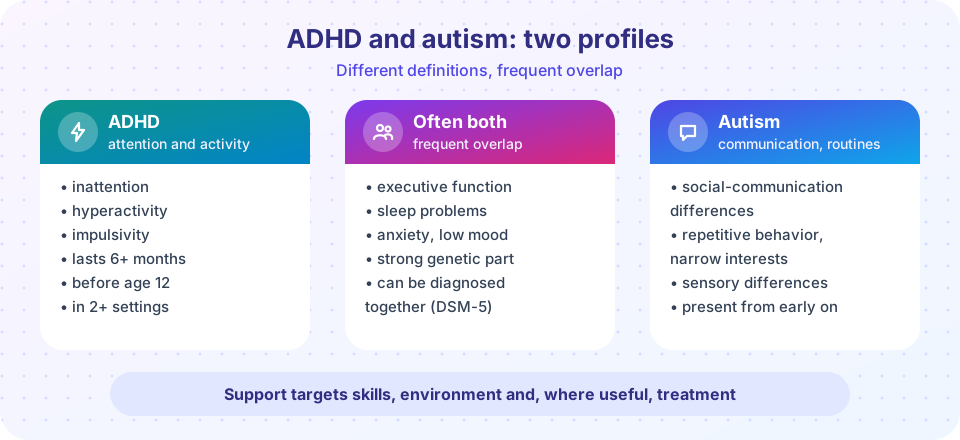
DSM-5 describes two symptom clusters: inattention (careless mistakes, difficulty sustaining attention, losing things, being easily distracted) and hyperactivity-impulsivity (fidgeting, difficulty staying seated, talking excessively, interrupting). Children need six or more symptoms in a cluster, adolescents over 16 and adults five or more. Symptoms must last at least six months, appear in two or more settings, be present before age 12 (several of them) and clearly interfere with functioning. Three presentations are recognized: predominantly inattentive, predominantly hyperactive-impulsive and combined.
About 5 percent of children and about 2.5 percent of adults meet criteria. Boys are diagnosed more often than girls, partly because girls more often show the quieter inattentive form and are overlooked.
Causes. Twin studies put heritability near 70 to 75 percent (Stephen Faraone and colleagues, 2005). Many genes of small effect are involved. Prenatal exposures, very preterm birth and low birth weight add risk, whereas parenting style and sugar do not cause ADHD. Imaging shows that the cortex of children with ADHD matures on average a few years later than in peers, according to a 2007 study by Philip Shaw and colleagues, and differences in networks for attention and reward are common.
Theories. Russell Barkley (1997) argued that the core problem is weak behavioral inhibition that disrupts executive functions. Edmund Sonuga-Barke added delay aversion, a strong dislike of waiting for rewards. No single theory explains everyone.
What helps. Stimulant medication reduces symptoms in most children and adults in short-term studies; non-stimulants such as atomoxetine and guanfacine are alternatives. Side effects include reduced appetite, sleep problems and raised heart rate, so monitoring matters. Behavioral parent training and classroom strategies also help. The large MTA study (1999) randomized 579 children aged 7 to 9. After 14 months, careful medication management (alone or combined with behavioral treatment) beat behavioral treatment alone and routine community care. By three years the differences between groups had largely faded, and later follow-ups raised questions about long-term benefit. Good support often means school accommodations, routines and coaching in addition to medication.
Autism spectrum disorder
In 2013 DSM-5 merged autistic disorder, Asperger's disorder and related labels into one diagnosis. It requires two things:
- Persistent differences in social communication and interaction across contexts, including back-and-forth conversation, nonverbal communication and building relationships.
- Restricted, repetitive patterns of behavior, interests or activities, such as repetitive movements, insistence on sameness, intense narrow interests, and unusual responses to sensory input (for example distress at certain sounds).
Symptoms appear in early development (though they may be masked until demands exceed abilities) and cause impairment. A severity rating of level 1, 2 or 3 reflects how much support is needed.
Surveillance by the US Centers for Disease Control found about 1 in 36 eight-year-olds identified with autism in 2020. Rising numbers largely reflect wider definitions, better recognition and more services rather than a proven rise in underlying cases, though this is still studied. Boys are identified about three to four times as often as girls, and some autistic girls and women are missed because they camouflage ("mask") their differences.
Causes. Twin studies suggest heritability of around 80 percent, with hundreds of genes and some rare gene changes of larger effect. Advanced parental age and some prenatal factors add small risks.
The vaccine myth. In 1998 Andrew Wakefield and colleagues published a small paper in The Lancet suggesting a link between the MMR vaccine and autism. The paper was found to be based on misrepresented data, the journal retracted it in 2010, and Wakefield lost his medical license. Studies of hundreds of thousands of children, such as a 2019 Danish study of more than 650,000 children by Anders Hviid and colleagues, found no increased risk after vaccination.
Theories. Several accounts capture parts of the picture:
- Theory of mind. In the Sally-Anne test (Baron-Cohen, Leslie and Frith, 1985), a child watches a doll hide a marble and must say where another doll will look for it. Most typical four-year-olds and children with Down syndrome passed, but most autistic children in that sample did not. The finding sparked decades of work, though many autistic people pass such tasks and the idea does not explain repetitive behavior.
- Weak central coherence (Uta Frith) and enhanced perceptual functioning (Laurent Mottron) describe a detail-focused style.
- Executive function differences explain some difficulties with switching and planning.
- The double empathy problem (Damian Milton, 2012) proposes that communication breakdowns between autistic and non-autistic people are mutual, as two people with different ways of understanding the world struggle to read each other. Studies where autistic people share information with other autistic people suggest that communication can flow as well as in non-autistic pairs.
What helps. No medicine treats the core features, though risperidone and aripiprazole are licensed for irritability. Early intensive behavioral interventions, which grew from Ivar Lovaas (1987), reported large gains, but that study had no random assignment and used methods now widely criticized. Newer developmental approaches, such as the Early Start Denver Model (a 2010 trial showed gains in language and IQ) and parent-mediated communication programs such as PACT, emphasize play and communication and show lasting benefits on interaction. Many autistic adults argue that goals should be well-being and communication, not appearing non-autistic, because masking is linked to exhaustion and poorer mental health.
Neurodiversity
The term was popularized by the sociologist Judy Singer in the late 1990s. The neurodiversity view says autism, ADHD, dyslexia and similar differences are natural variations, and that disability often arises from mismatches between people and environments. Critics, including many families of people with high support needs, point out that this must not minimize genuine suffering, intellectual disability or the need for care. A balanced view accepts both: celebrate strengths, adjust environments and provide treatment or support where the person wants and needs it.
Common misconceptions
"ADHD is caused by bad parenting or too much sugar." Heritability is high and controlled trials show sugar does not cause hyperactivity.
"Autistic people lack empathy." Many feel strongly for others; differences are often in expressing or reading signals, and the double empathy view says the difficulty is two-way.
"Everyone with autism has a special talent." Savant skills occur in a minority.
"Vaccines cause autism." Large studies find no link.
Try it
Try a mini continuous performance task, a style of test used in ADHD research. This is a demonstration of the task format, not a diagnostic tool; real tests are longer and compared with age norms. The second demonstration shows how twin correlations can be turned into rough shares of variation (with made-up numbers).
Press Run (or Ctrl + Enter) to see the result here.
Program input · what you'd type while the program runs
Type the answers before you press Run, one per line. Each time the program reads a line (with input()), it gets the next line from this box.
Check your understanding
Quick check · 5 questions
of 5 answered You scored / 5 · perfect!
-
1. Which is required for an ADHD diagnosis in DSM-5?
DSM-5 requires several symptoms before age 12, in two or more settings, with clear impairment. Brain scans are not diagnostic. -
2. What did the MTA study find at the end of 14 months?
Medication-based groups did better at 14 months, but differences between groups mostly faded by three years. -
3. The two core domains of autism in DSM-5 are...
Both domains must be present, and they must appear in early development. -
4. Why do researchers reject the claim that the MMR vaccine causes autism?
The paper was retracted in 2010 and large studies including a Danish study of more than 650,000 children found no increase in risk. -
5. What does the double empathy problem propose?
Damian Milton argued that mutual difficulty arises from different ways of understanding the world, not only from a deficit in one side.
Summary
- ADHD combines inattention and hyperactivity-impulsivity, starts in childhood, appears across settings and is highly heritable.
- Stimulants help many people in the short term, and behavioral and school supports are important parts of care.
- Autism involves social-communication differences plus restricted, repetitive patterns present from early development.
- Vaccines do not cause autism; heritability is high.
- Theories (executive function, theory of mind, central coherence, double empathy) each explain part of the picture.
- Neurodiversity highlights strengths and environment, while recognizing real support needs.
Next: Chapter review
Track your progress
Create a free account to tick off lessons and pick up where you left off on any device.
of Abnormal and Clinical Psychology lessons completed