


















Lesson 1 of 47 · Getting Started
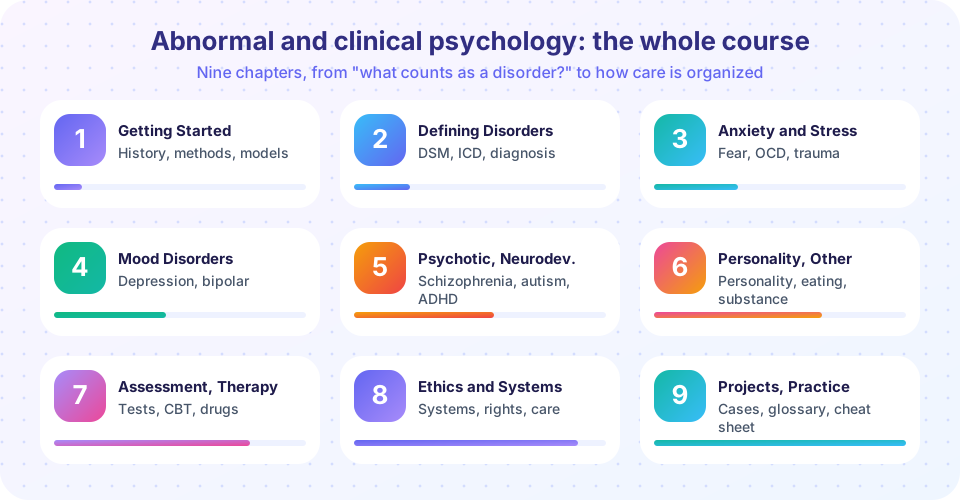
Course Map: Abnormal and Clinical Psychology
Meet the nine chapters of this abnormal and clinical psychology course, learn how to study sensitive topics well, and test common myths about mental illness.
Why do some people feel terror in a crowded train while others feel nothing? Why can a sad week be ordinary, while a sad year can take over a life? Abnormal psychology is the scientific study of unusual, distressing and impairing patterns of thought, emotion and behavior. Clinical psychology is the profession that assesses and treats them. Together they ask the oldest question in the field: when does a human experience become a problem that needs help, and what actually helps?
This course is a complete introduction for learners of about 16 and up, and for adults who want a clear, evidence-based refresher. It follows the common core of international introductory courses (Cambridge, IB and US AP-style psychology options) and the first-year university sequence, without being tied to one exam board. You need no medical background. A little arithmetic helps when we meet percentages and a simple correlation.
Educational information only. This course teaches how researchers and clinicians think. It cannot diagnose you or anyone else, and nothing here is treatment advice. If you are worried about your own mental health or someone else's, talk to a doctor, a counselor or another qualified professional. If you or someone you know may be in danger, contact your local emergency number or crisis line right away.
What you will learn
- What abnormal and clinical psychology study, and how the nine chapters fit together.
- How to read about disorders without "diagnosing" yourself or your friends.
- Why careful, person-first language matters.
- A study routine that suits emotionally heavy material.
Key terms
Psychopathology: the study of mental disorders, including their symptoms, causes and course.
Clinical psychologist: a trained professional who assesses and treats psychological problems, usually with a doctorate and supervised practice.
Psychiatrist: a medical doctor who specializes in mental illness and can prescribe medication.
Symptom: a sign of a problem that a person reports or that others observe.
Evidence-based practice: choosing assessments and treatments that research supports.
The nine chapters
Foundations
- Getting Started
- Defining Disorders
- Anxiety and Stress
The disorders
- Mood
- Psychotic and Neurodevelopmental
- Personality and Other
Helping
- Assessment and Therapy
- Prevention and Ethics
- Projects and Practice
Chapter 1 gives you the history of how societies explained and treated mental illness, the research methods used to study it, and the main causal models. Chapter 2 asks what "abnormal" means and how the DSM and ICD sort experiences into categories. Chapters 3 and 4 cover the most common conditions worldwide: anxiety, trauma, stress, depression and bipolar disorder. Chapters 5 and 6 cover psychosis, neurodevelopmental conditions, personality, eating and substance use disorders. Chapters 7 and 8 explain assessment, therapies, medication, prevention, ethics and how mental health care is organized. Chapter 9 is practice: case studies, a glossary and a cheat sheet.
How common is this, really?
The World Health Organization estimated that in 2019 about one in eight people worldwide, roughly 970 million, were living with a mental disorder, with anxiety and depressive disorders the most common. Whatever the exact number, the point is simple: mental health problems are not rare, and they are not a sign of weakness. You almost certainly know someone affected, and you may be someone affected. That is why this course treats the topic seriously and respectfully.
How to study sensitive material
Learn the criteria, not the labels for people. Reading a list of symptoms and thinking "that sounds like me" is so common among students that it has a nickname, "medical student syndrome". Most symptoms are exaggerated versions of normal experiences. A diagnosis needs duration, severity, impairment and a trained assessment.
Use person-first language. Say "a person with schizophrenia", not "a schizophrenic". Say "died by suicide", not "committed suicide". Words shape stigma, and stigma keeps people from seeking help.
Pace yourself. Some lessons touch on trauma, self-harm or suicide. Take a break when you need one. If a topic hits close to home, that is a good moment to talk to someone you trust.
Test yourself. After reading a lesson, close it and write what you remember. Retrieval practice beats rereading. The quizzes are built for this: answer first, read the explanation second.
Three questions for every claim in this course. What was measured, in whom, and how sure can we be? Clinical psychology has famous findings and famous failures to replicate. Asking those three questions is the real skill you are here to learn.
Common misconceptions
"Mental illness is just being weak or lazy." Disorders involve brain, body, mind and environment together. Willpower alone does not remove them, just as it does not cure diabetes.
"This course will let me diagnose people." Diagnosis takes training, supervised practice and a full assessment. This course teaches the ideas behind it.
"People with a disorder are fundamentally different from everyone else." Most symptoms lie on a continuum with ordinary experience. Everyone has worries, low days and odd thoughts.
Try it
The first demonstration checks a few common beliefs. It is a learning exercise, not a test of anything about you.
The second demonstration prints a nine-week study plan. Change startWeek or the topics and run it again.
Press Run (or Ctrl + Enter) to see the console output here.
No output.
Check your understanding
Quick check · 4 questions
of 4 answered You scored / 4 · perfect!
-
1. What is the difference between a psychiatrist and a clinical psychologist?
A psychiatrist is a physician with specialist training and can prescribe. A clinical psychologist typically holds a psychology doctorate and focuses on assessment and psychological treatment, though practices vary by country. -
2. Which phrase is an example of person-first language?
Person-first language puts the person before the condition and reduces stigma. -
3. You read the symptoms of a disorder and recognize a few of them in yourself. What is the sensible conclusion?
Recognizing symptoms is common. A diagnosis requires a trained assessment. -
4. Roughly how common were mental disorders worldwide in 2019, according to the WHO?
The WHO estimated about 970 million people, roughly one in eight, lived with a mental disorder.
Summary
- Abnormal psychology studies disorders; clinical psychology assesses and treats them.
- The course has nine chapters: foundations, the disorders, and helping.
- Mental disorders are common, and recovery is common too.
- Use criteria to learn, not to label yourself or others; use person-first language.
- Ask of every claim: what was measured, in whom, and how sure are we?
Track your progress
Create a free account to tick off lessons and pick up where you left off on any device.
of Abnormal and Clinical Psychology lessons completed