


















Lesson 10 of 47 · Defining and Classifying Disorders
Chapter 2 Review: Defining and Classifying Disorders
Review what counts as abnormal, how DSM-5-TR and ICD-11 classify disorders, and reliability, validity and labelling, with a recap table, flashcards and a ten-question quiz.
This chapter was about boundaries: where ordinary variation ends and disorder begins, how experts agree to describe the territory, and how we test whether their maps are any good. Use this review to check that you can explain each idea in your own words before moving to the individual disorders.
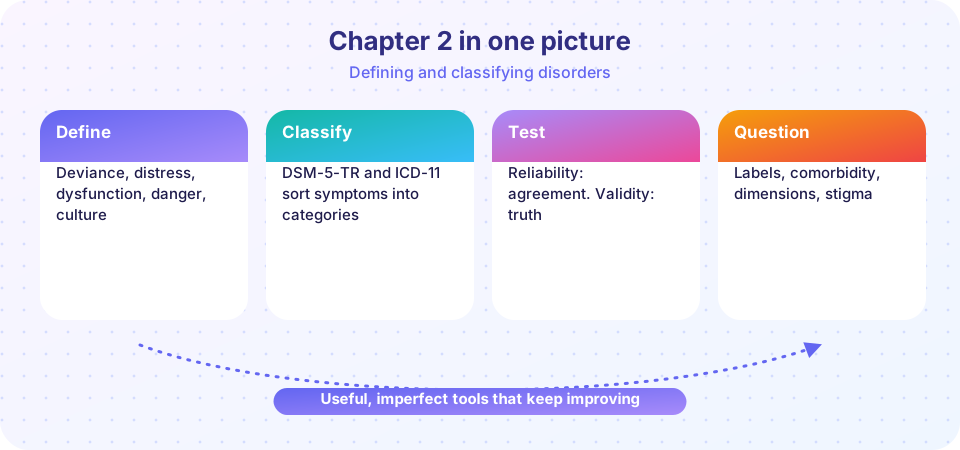
What you will review
- The four definitions of abnormality and the four Ds.
- The history and structure of the DSM and ICD.
- Reliability, validity, kappa, comorbidity and labelling.
Recap table
| Topic | Key ideas | Names and numbers |
|---|---|---|
| Defining abnormality | Statistical infrequency, social norms, failure to function, ideal mental health; the four Ds | Rosenhan and Seligman (1989), Jahoda (1958), Wakefield |
| Culture | Norms and expression vary; severe conditions occur everywhere; WEIRD samples | Henrich et al. (2010), Cultural Formulation Interview |
| Classification | DSM (APA) and ICD (WHO); explicit criteria; polythetic rules; specifiers | DSM-III 1980, DSM-5 2013, DSM-5-TR 2022, ICD-11 2022 |
| Alternatives | Dimensional models | HiTOP, RDoC |
| Quality of diagnosis | Reliability, validity, kappa, comorbidity, heterogeneity | Rosenhan 1973, Spitzer 1975, Cahalan 2019, Robins and Guze 1970 |
| Labels | Benefits and stigma; person-first language | Goffman (1963) |
Try it
Use the flashcards: say the answer aloud, then reveal it.
Check your understanding
Quick check · 10 questions
of 10 answered You scored / 10 · perfect!
-
1. A person is extremely talented and statistically rare, but happy and functioning well. Which conclusion is best?
Rarity is not harm. -
2. Which pair shows the definition problems of social norms?
These are historical examples where norms were used to pathologize. -
3. Wakefield's harmful dysfunction requires
It mixes a factual and a value component. -
4. Which edition introduced explicit criteria?
DSM-III (1980) did, to improve reliability. -
5. ICD-11 came into effect in
It was approved in 2019 and took effect from 1 January 2022. -
6. What problem does Cohen's kappa solve?
Kappa subtracts chance agreement. -
7. A diagnosis is reliable but not valid. What does that mean?
Consistency does not guarantee meaning. -
8. Which critique of Rosenhan (1973) is accurate?
Critics include Spitzer (1975) and Cahalan (2019). -
9. Why does comorbidity encourage dimensional models such as HiTOP?
Overlap suggests broader spectra. -
10. Which is the best use of a diagnostic label?
Labels help but never replace understanding the individual.
Summary
- Abnormality is defined by combining criteria and context, not by one rule.
- The DSM and ICD organize symptoms into categories; critics ask for more dimensions.
- Reliability and validity are separate; kappa corrects for chance.
- Labels help and harm; use them thoughtfully.
- Chapter 3 begins the tour of the disorders with anxiety, trauma and stress.
Track your progress
Create a free account to tick off lessons and pick up where you left off on any device.
of Abnormal and Clinical Psychology lessons completed