


















Lesson 44 of 47 · Projects and Practice
Practice: Vignette Drill and Trial Planning
Practice sorting short fictional vignettes into condition families, then plan a small therapy trial by simulating statistical power and sample size.
Expertise in clinical psychology has two sides. One is pattern recognition: reading a short description and seeing which family of conditions it points toward, while staying open to alternatives. The other is evidence literacy: knowing how studies are designed and how large they must be to give a trustworthy answer.
This lesson gives you a drill for each. First, a twelve-item sorting exercise using short, invented vignettes. Then a small trial-planning exercise in which you simulate statistical power, the chance that a study detects a real effect.
Educational information only. The vignettes are fictional and deliberately short. Real clinical decisions need full assessment, and several conditions can look alike. The drill is for studying, not for diagnosing.
What you will learn
- Use a simple question sequence as a first-pass sorting guide.
- Recognize typical patterns in short vignettes from chapters 5 and 6.
- Explain what statistical power is and why small trials mislead.
- Estimate the sample size a therapy trial needs.
- List the planning steps of a well-designed trial.
Key terms
- Statistical power: the probability that a study will detect an effect of a given size if it really exists.
- Type II error: missing a real effect.
- Preregistration: publicly recording hypotheses, design and analysis plan before collecting data.
- Randomization: assigning participants to groups by chance.
- CONSORT: a reporting guideline for randomized trials.
Part 1: the vignette drill
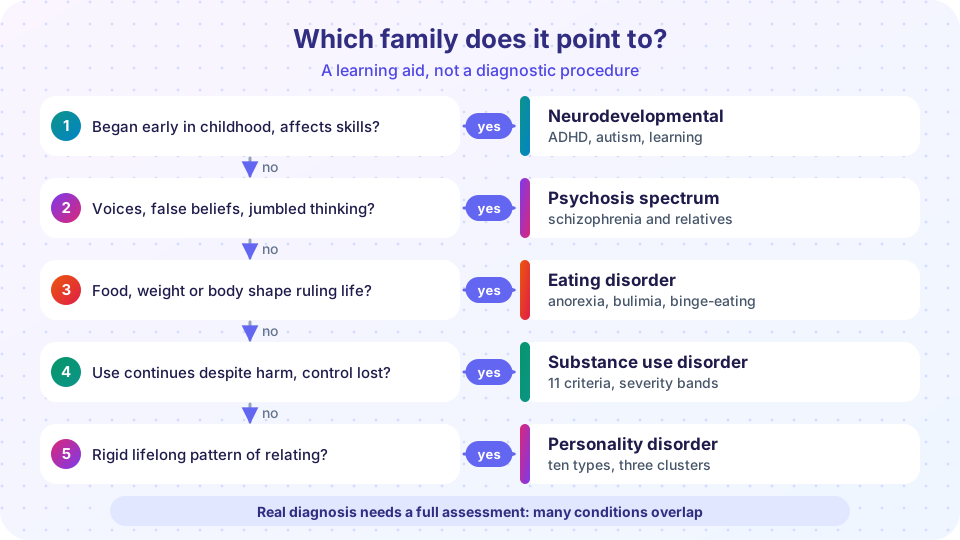
Use the sorting guide above as a rough first pass, then check yourself with the drill below. Some vignettes belong to chapters outside this slice (a mood vignette is included to remind you that not everything is psychosis, eating or substance use). After each answer you get a short explanation. Aim to give a reason, not just a label.
Part 2: plan a small therapy trial
Imagine you want to test whether a new eight-session skills program reduces anxiety scores compared with a waiting list. A well-planned trial involves these steps:
- Question and outcome. Decide on one primary outcome (for example a validated anxiety scale at 12 weeks) before you start.
- Comparison. A waiting list, usual care or an active treatment. The choice affects the size of the effect you can expect.
- Randomization and blinding. Randomly assign people; blind the assessors if you can (participants cannot be blind to therapy).
- Sample size. Calculate how many people you need, as below.
- Ethics and consent. Seek ethics approval, obtain informed consent and plan for safety.
- Preregistration and reporting. Record your plan in a public registry and report according to CONSORT. Preregistration helps against selective reporting, a factor in the replication problems seen across psychology.
Power depends on the true effect size, the sample size and the significance level. A rule of thumb for comparing two groups with a two-sided test at the 5 percent level and 80 percent power is n per group = 2 x (1.96 + 0.84)² / d². For a small-to-medium effect of d = 0.3 that is about 175 people in each group. Many early therapy trials are far smaller, so they either miss real effects or, when they happen to find one, exaggerate it.
Try it
Simulate the trial many times to measure the power rather than only calculate it. For each sample size, we generate pretend data for two groups that differ by a true effect size d, run a t-test, and count how often the result is significant.
Press Run (or Ctrl + Enter) to see the result here.
Program input · what you'd type while the program runs
Type the answers before you press Run, one per line. Each time the program reads a line (with input()), it gets the next line from this box.
Check your understanding
Quick check · 4 questions
of 4 answered You scored / 4 · perfect!
-
1. What does statistical power measure?
Power is the probability that a study will find a significant result when the effect truly exists. -
2. About how many people per group are needed to detect d = 0.3 with 80% power at the 5% level?
n = 2 x (1.96 + 0.84)^2 / 0.3^2, which is about 175. -
3. Why preregister a trial?
A public plan makes it harder to change outcomes after seeing the data. -
4. Which vignette feature most strongly suggests a neurodevelopmental condition?
Early onset in the developmental period is the defining feature of this family.
Summary
- A question sequence gives a first-pass sorting of vignettes, but real diagnosis needs a full assessment and differential reasoning.
- Statistical power depends on effect size and sample size; small trials miss real effects and exaggerate the ones they find.
- A well-planned trial has a primary outcome, a fair comparison, randomization, adequate sample size, ethics approval and preregistration.
Next: Glossary
Track your progress
Create a free account to tick off lessons and pick up where you left off on any device.
of Abnormal and Clinical Psychology lessons completed