


















Lesson 18 of 47 · Mood Disorders
Bipolar Disorders: Mania, Hypomania and Depression
Learn the features of mania, hypomania and depression, how bipolar I, bipolar II and cyclothymic disorder differ, and the evidence for lithium, therapy and long-term care.
Bipolar disorders involve episodes of abnormally high, energized or irritable mood alongside episodes of depression. In a manic episode a person may sleep three hours and feel fresh, talk fast, pour money into a plan, and feel certain they have special powers. After that a crash into depression may follow. The condition is serious, strongly genetic, often misdiagnosed for years, and highly treatable with the right long-term care. Many people with bipolar disorder work, study, create and parent successfully.
Educational information only. This lesson cannot diagnose or treat. Bipolar disorder needs careful assessment by a qualified professional. If someone is in crisis or in danger, contact your local emergency number or a crisis line.
What you will learn
- How mania and hypomania are defined and how they differ.
- Bipolar I, bipolar II and cyclothymic disorder.
- Common features: mixed features, rapid cycling, risk.
- Evidence-based long-term care: lithium, other medicines and psychological therapies.
Key terms
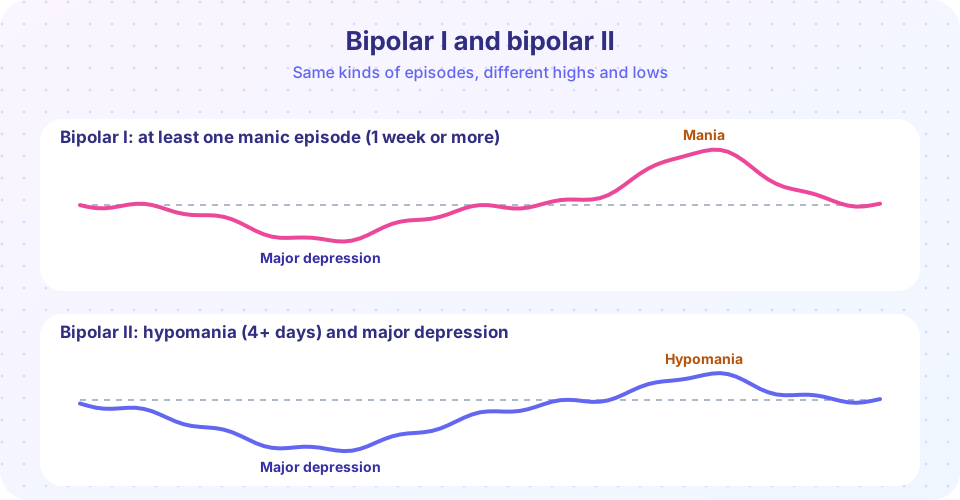
Manic episode: a period of at least one week (or any length if hospitalization is needed) of abnormally elevated, expansive or irritable mood with increased energy.
Hypomanic episode: a similar period of at least four days that is observable but not severe enough to cause marked impairment or require hospitalization.
Mixed features: symptoms of the opposite pole occurring during an episode.
Rapid cycling: four or more mood episodes in 12 months.
Mood stabilizer: a medication, such as lithium, used to prevent episodes.
Mania
A manic episode needs abnormally and persistently elevated, expansive or irritable mood and increased energy for at least a week, plus at least three of these seven (four if mood is only irritable):
- Inflated self-esteem or grandiosity.
- Decreased need for sleep.
- More talkative than usual or pressured speech.
- Flight of ideas or racing thoughts.
- Distractibility.
- Increased goal-directed activity or psychomotor agitation.
- Excessive involvement in risky pleasurable activities (spending sprees, reckless driving, unwise sexual behavior or investments).
The episode must be severe enough to cause marked impairment or hospitalization, or include psychosis such as delusions of special powers. In mania people often lack insight and may feel better than ever, which is one reason treatment can be delayed. Consequences, such as debts, damaged relationships and lost jobs, can be hard to undo.
Hypomania shares the symptoms but lasts at least four days, is clearly different from usual behavior, but does not cause marked impairment, require hospitalization or include psychosis. It may even feel productive, and families may notice before the person does.
The bipolar and related disorders
- Bipolar I disorder: at least one manic episode. Major depressive episodes are common but not required. It affects roughly 1 percent of people in many surveys.
- Bipolar II disorder: at least one hypomanic episode and at least one major depressive episode, with no manic episode ever. It is not a "milder" form: depression in bipolar II can be long and disabling, and suicide risk is high.
- Cyclothymic disorder: at least two years (one in children) of numerous hypomanic and depressive symptoms that do not meet criteria for an episode, with no more than two months symptom-free.
- Substance- or medication-induced bipolar disorder and bipolar disorder due to another medical condition (for example, after a stroke or with some drugs) are also classified.
Specifiers include with mixed features, with anxious distress, with rapid cycling and with seasonal pattern. Broader "bipolar spectrum" ideas suggest a larger group with milder patterns, but the evidence for the exact boundaries is debated.
Course, risk and lived experience
Bipolar disorder often begins in late adolescence or early adulthood. Many people are first diagnosed with depression and wait several years before mania or hypomania is recognized; this matters because antidepressants given alone can in some people trigger a switch to mania. Depressive episodes tend to be more frequent and longer than manic ones over a lifetime. The risk of suicide is substantially higher than average, which is why careful, ongoing care and a safety plan are essential. Alcohol and drug use, anxiety disorders and physical health problems such as cardiovascular disease are common alongside.
Lived-experience accounts convey what statistics cannot. The psychologist Kay Redfield Jamison, a leading researcher who has bipolar disorder herself, describes both the exhilaration and the devastation in An Unquiet Mind (1995). Links with creativity have been discussed for centuries. Some studies find modestly higher creative achievement in people with bipolar spectrum traits or in their relatives, but the evidence is mixed and does not mean the illness should be left untreated.
Causes in brief
Bipolar disorder is one of the most heritable mental disorders: twin studies estimate heritability at roughly 60 to 85 percent, and risk is much higher for close relatives. Yet no single gene is responsible: hundreds of variants each add a little. Biological rhythm disruption matters: sleep loss can trigger mania in vulnerable people. Psychological theories highlight a sensitive reward system (the "behavioral approach system" hypothesis developed by researchers such as Lauren Alloy and Sheri Johnson). Stress, especially events that disrupt routines, can trigger episodes. We return to causes in the next lesson.
Treatment
Bipolar disorder is a long-term condition, and treatment aims at treating episodes and preventing new ones.
- Lithium is the classic mood stabilizer. The Australian psychiatrist John Cade reported its effect on mania in 1949, and Mogens Schou in Denmark showed that it prevents episodes. It reduces relapse and suicide risk, but it needs blood tests because the safe range is narrow and it can affect kidneys and thyroid.
- Other medications: valproate, lamotrigine (mainly for preventing depression), carbamazepine and several antipsychotics (such as quetiapine, olanzapine, lurasidone) are used in acute episodes and for prevention.
- Psychological therapies as an addition: psychoeducation (learning about the illness and early warning signs), family-focused therapy, cognitive behavioral therapy, and interpersonal and social rhythm therapy (Ellen Frank), which stabilizes sleep and daily routines.
- Self-management: regular sleep and routines, avoiding alcohol and drugs, mood charts, a relapse-prevention plan agreed with family and clinicians, and an advance statement for crises.
- Hospital care may be necessary in severe episodes for safety.
Many people achieve long periods of stability, though sticking to treatment can be hard, especially when high mood feels good. Collaborative, non-judgmental care helps.
Common misconceptions
"Bipolar disorder is just mood swings." Episodes last days to months and include changes in sleep, energy, thinking and behavior, with serious consequences.
"Bipolar II is mild." Depression in bipolar II can be severe and long-lasting.
"People with bipolar disorder cannot live normal lives." With treatment and support, many do well at work, in relationships and in creative life.
"Antidepressants are always safe for bipolar depression." Used alone they may trigger mania in some people, so prescribers are cautious.
Try it
The first demonstration is a mood-chart analyzer. It reads a synthetic 60-day mood chart, finds runs of elevated days and labels them hypomanic (4 to 6 days) or manic-length (7 or more) by the duration rule. It teaches how duration defines episodes. It is a simulation, not a diagnostic tool.
Press Run (or Ctrl + Enter) to see the result here.
Program input · what you'd type while the program runs
Type the answers before you press Run, one per line. Each time the program reads a line (with input()), it gets the next line from this box.
The second demonstration is a quick classification exercise. Read the fictional description and choose the best label. It practices the duration and severity rules.
Check your understanding
Quick check · 5 questions
of 5 answered You scored / 5 · perfect!
-
1. What is the minimum duration of a manic episode, unless hospitalization is needed?
Mania needs at least a week; hypomania needs at least four days. -
2. Which pattern defines bipolar II disorder?
Bipolar II is not just milder: the depressive phases can be severe. -
3. Which medicine did John Cade report as effective for mania in 1949?
Cade's lithium work began modern mood-stabilizer treatment; Schou later showed prevention. -
4. Why can antidepressants alone be risky in bipolar disorder?
Mood stabilizers are usually added or used first. -
5. Which is a common feature of mania that makes treatment hard?
Reduced insight delays help-seeking.
Summary
- Bipolar I needs a manic episode (one week or more); bipolar II needs hypomania (four days or more) and major depression; cyclothymia is a chronic milder pattern (two years).
- Mania involves reduced need for sleep, grandiosity, racing thoughts and risk-taking, often with little insight.
- Heritability is high but many genes are involved; sleep and routine disruption can trigger episodes.
- Long-term care combines mood stabilizers (lithium and others), psychoeducation and therapy, and self-management.
Track your progress
Create a free account to tick off lessons and pick up where you left off on any device.
of Abnormal and Clinical Psychology lessons completed