


















Lesson 40 of 47 · Prevention, Ethics and Mental Health Systems
Mental Health Care Systems: Access, Stepped Care and Global Models
Explore the global treatment gap, stepped and collaborative care, England's IAPT, the Friendship Bench, task sharing, deinstitutionalization and digital tools.
A good treatment is of little use if nobody can reach it. Around the world, most people with mental disorders never receive adequate care, and the reasons range from cost and distance to stigma and a shortage of trained professionals. Mental health systems are the networks of services, workers, laws and funding that decide who gets help and how.
This lesson looks at the size of the treatment gap, the main models that try to close it, and what history teaches about caring for people in the community instead of in large institutions.
Educational information only. Services differ greatly between countries. If you need help now, look for your local crisis line or health service. In an emergency, contact emergency services.
What you will learn
- Describe the treatment gap and its main causes.
- Explain stepped care and collaborative care, with examples.
- Describe the Friendship Bench and the idea of task sharing.
- Summarize the history of deinstitutionalization and its lessons.
- Evaluate what digital tools can and cannot do.
Key terms
- Treatment gap: the share of people who need care but do not receive it.
- Stepped care: a system that offers the least intensive effective treatment first and steps up when needed.
- Collaborative care: a team model in which primary care providers, care managers and specialists work together.
- Task sharing: training non-specialists, such as lay health workers, to deliver parts of care.
- Deinstitutionalization: the move from long-stay psychiatric hospitals to community care.
The size of the gap
The World Health Organization estimated that about 970 million people were living with a mental disorder in 2019, around one in eight people. Yet governments spend a very small share of health budgets on mental health, a median of about 2 percent in WHO's Mental Health Atlas. The median number of mental health workers is roughly 13 per 100,000 people worldwide, and far fewer in low-income countries. The World Mental Health Surveys (Philip Wang and colleagues, 2007) found that in many countries most people with serious disorders received no treatment in the previous year, and that those who did often received it years after onset.
The causes of the gap include shortage of workers, concentration of services in cities, cost, stigma, lack of awareness and fragmented systems. Economists estimate that depression and anxiety cost the world economy on the order of a trillion US dollars a year in lost productivity, and that scaled-up treatment can yield a positive return on investment (Dan Chisholm and colleagues, 2016).
Stepped care
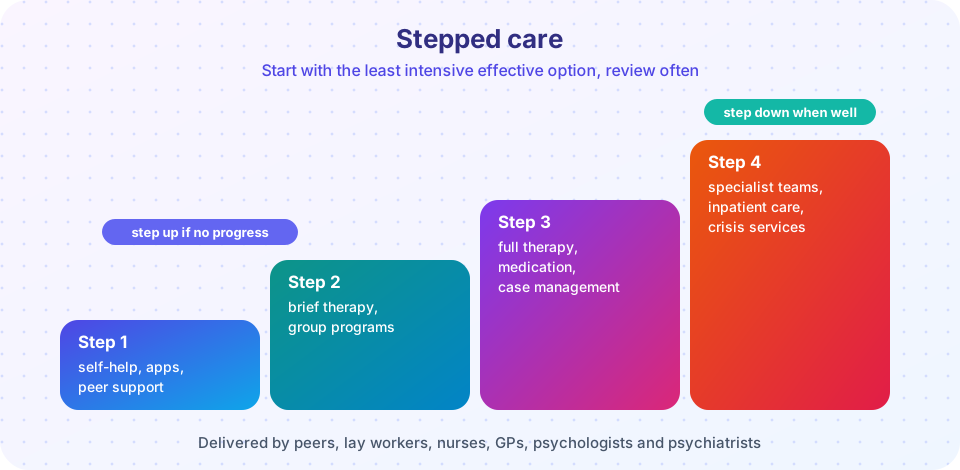
In stepped care, people begin with the least intensive option expected to help, for example guided self-help or a brief group program, and move to more intensive treatment such as full psychotherapy, medication or specialist care only if they do not improve. Progress is monitored, and people can step down when they are well. The approach saves scarce specialist time for those who most need it, and is built into guidelines such as those of England's NICE.
The best-known national program is Improving Access to Psychological Therapies (IAPT) in England, launched in 2008 following the advocacy of economist Richard Layard and clinical psychologist David Clark. It trained thousands of therapists to deliver evidence-based therapy for depression and anxiety, and measured outcomes at every session. It now operates as NHS Talking Therapies and has set a recovery target of around 50 percent of people who finish treatment. Critics note that recovery figures depend on who is counted and that people with severe or complex problems are poorly served.
Collaborative care
Most people first seek help in primary care. In collaborative care, a care manager works with the primary care doctor and a psychiatric consultant, tracks symptoms and adjusts treatment. In the IMPACT trial (Jürgen Unützer and colleagues, 2002) with older adults with depression, more than twice as many people in collaborative care had a substantial reduction in depression after a year compared with usual care. Dozens of later trials have supported the model for depression and anxiety.
Task sharing and global models
Where there are almost no psychiatrists, trained non-specialists can deliver effective care.
- The Friendship Bench in Zimbabwe, developed by psychiatrist Dixon Chibanda, trains lay health workers (often grandmothers) to offer problem-solving therapy on a bench at a local clinic. In a 2016 trial in Harare with 573 participants with common mental disorders, symptoms were lower after six months than with enhanced usual care.
- The Healthy Activity Program in India, tested by Vikram Patel and colleagues, uses lay counselors to deliver behavioral activation, and trials found benefits for depression.
- The WHO's mhGAP program (2008) provides guidance for non-specialist health workers in low- and middle-income countries.
Task sharing is not a cheap substitute for specialists. It requires training, supervision, referral routes and respect for the workers.
From asylums to communities
In the nineteenth century, large asylums housed many people for long periods. After the discovery of antipsychotics in the 1950s, and amid exposés of poor conditions, many countries began deinstitutionalization. In the USA, the Community Mental Health Act (1963) promised community centers, but funding fell far short, and many people ended up homeless, in poor housing or in prisons, sometimes called "transinstitutionalization". In Italy, the Basaglia Law (1978) began closing asylums and was accompanied by a network of community services. The lesson is that closing hospitals works only if community services, housing and support are actually built.
Modern community models include assertive community treatment, crisis resolution teams, supported employment (Individual Placement and Support, which has strong evidence), Housing First for people who are homeless, and peer support workers with lived experience. The recovery movement emphasizes hope, choice and a meaningful life beyond symptoms.
Digital mental health
Internet-delivered CBT, apps and video therapy can extend reach. Meta-analyses (for example Gerhard Andersson and Pim Cuijpers, 2009) show that guided internet CBT can be about as effective as face-to-face therapy for several conditions, whereas unguided programs have smaller effects and high dropout. Telehealth expanded greatly after 2020. The cautions: many apps lack evidence, privacy is a concern, people without devices or internet are left out, and digital tools are not suitable for every problem, such as acute crisis.
Insurance and policy
In the USA, the Mental Health Parity and Addiction Equity Act (2008) requires many insurers that cover mental health to do so on terms no more restrictive than for physical health, though enforcement has been uneven. Elsewhere, public systems vary from comprehensive to nearly absent. Policy levers include funding, workforce training, integration with primary care, legal rights and anti-stigma efforts.
Common misconceptions
"Closing asylums was a mistake in itself." The problem was closing hospitals without building community support.
"Lay health workers cannot deliver effective therapy." Trials show good results with training and supervision.
"An app can replace a therapist." Some apps help, especially with guidance, but many are untested, and complex or risky problems need human care.
Try it
The first demonstration is a toy queue model: when more people join a waiting list each week than a service can treat, the list grows without limit. The second is an illustrative funnel (numbers made up) that shows how people drop out along the path from having a problem to recovery.
Press Run (or Ctrl + Enter) to see the result here.
Program input · what you'd type while the program runs
Type the answers before you press Run, one per line. Each time the program reads a line (with input()), it gets the next line from this box.
Press Run (or Ctrl + Enter) to see the result here.
Program input · what you'd type while the program runs
Type the answers before you press Run, one per line. Each time the program reads a line (with input()), it gets the next line from this box.
Check your understanding
Quick check · 5 questions
of 5 answered You scored / 5 · perfect!
-
1. What is stepped care?
Stepped care matches intensity to need and saves specialist time for those who need it most. -
2. What is the Friendship Bench?
Developed by Dixon Chibanda in Zimbabwe, it has been tested in a randomized trial. -
3. What was a main lesson of deinstitutionalization?
In the USA, funding for community care fell short, which contributed to homelessness and imprisonment for some people. -
4. Which statement about digital CBT is best supported?
Meta-analyses suggest guided internet CBT can approach face-to-face effectiveness, while unguided programs have smaller effects and more dropout. -
5. In the waiting-list model, what happens when weekly capacity is below weekly referrals?
If arrivals exceed capacity, the queue keeps growing.
Summary
- The treatment gap is large worldwide: low funding, few workers and stigma keep people from care.
- Stepped care and collaborative care match treatment intensity to need and integrate with primary care.
- Task sharing, as with the Friendship Bench, extends care where specialists are scarce.
- Deinstitutionalization needs real community services to succeed.
- Digital tools can widen access, especially when guided, but evidence varies and not everyone can use them.
Next: Chapter review
Track your progress
Create a free account to tick off lessons and pick up where you left off on any device.
of Abnormal and Clinical Psychology lessons completed