


















Lesson 34 of 47 · Assessment and Therapy Approaches
Psychodynamic, Humanistic and Systemic Therapies and Common Factors
Explore psychodynamic, humanistic, systemic and interpersonal therapy, the common factors that unite them and the dodo bird debate about equal effectiveness.
CBT is not the only game in town. Over more than a century, clinicians have developed other ways of understanding and treating distress. Some start from the idea that hidden conflicts shape behavior, some from the belief that people grow when they feel deeply understood, and some from the observation that problems live between people, not just inside them.
This lesson surveys these families briefly, then asks a puzzling question that has shaped the field: if very different therapies work about equally well, what is actually doing the work?
Educational information only. Which therapy suits a person depends on the problem, their preferences and what is available. A qualified clinician can help you decide.
What you will learn
- Describe the main ideas and techniques of psychodynamic, humanistic, systemic and interpersonal therapy.
- Name key figures and what they contributed.
- Explain the common factors view and the dodo bird verdict.
- Interpret an effect size as "percent of controls outscored".
- Describe what research says about the therapeutic alliance.
Key terms
- Transference: feelings from past relationships that a client directs at the therapist.
- Defense mechanism: an unconscious strategy for reducing anxiety, such as denial or displacement.
- Unconditional positive regard: accepting a person's worth without conditions.
- Genogram: a family-tree diagram of relationships and patterns across generations.
- Therapeutic alliance: the collaborative bond between client and therapist, with agreed goals and tasks.
Psychodynamic therapy
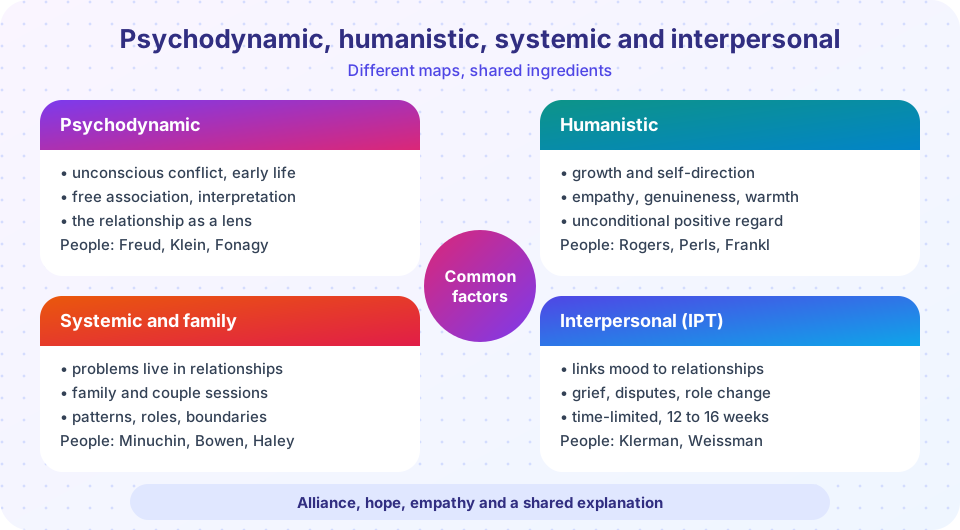
Sigmund Freud founded psychoanalysis in the 1890s. His techniques included free association (saying whatever comes to mind), dream interpretation and the analysis of transference and resistance. His daughter Anna Freud described the ego's defense mechanisms, and later thinkers such as Melanie Klein, John Bowlby (attachment) and Peter Fonagy (mentalizing) revised the theory.
Modern psychodynamic therapy is far briefer than classic analysis (often 12 to 40 sessions) and more interactive. It helps clients notice repeating relationship patterns, understand how early experience shaped them and put feelings into words. Short-term psychodynamic therapies have shown benefits for depression, anxiety and personality problems. Jonathan Shedler (2010) summarized evidence that effects are comparable to other treatments and may continue to grow after therapy ends, though critics point to variable study quality. Freud's grander claims, such as universal stages of psychosexual development, are not supported by evidence.
Humanistic and existential therapy
In the 1940s and 50s Carl Rogers developed client-centered (person-centered) therapy. He argued that people have a built-in drive to grow, and that therapy helps when the therapist offers three conditions: empathy, congruence (genuineness) and unconditional positive regard. Rogers was also an early pioneer in recording sessions and testing therapy with research. Fritz Perls created Gestalt therapy, with experiential techniques such as the "empty chair". Viktor Frankl (logotherapy) and Irvin Yalom (existential therapy) addressed meaning, freedom and mortality. Humanistic work has been important for how therapists relate to clients. Evidence shows that empathy predicts better outcomes, though pure person-centered therapy has often been tested less than CBT.
Systemic and family therapy
Systemic therapists treat a family or couple as a system in which each member's behavior affects the others. Salvador Minuchin (structural family therapy) examined boundaries and roles, for instance an over-involved parent and a distant one. Murray Bowen described the "differentiation of self" and multigenerational patterns, often mapped on a genogram. Jay Haley developed strategic approaches. Michael White and David Epston created narrative therapy, which "externalizes" a problem ("the anxiety got hold of you") and helps people re-author their story. John Gottman's couples research identified four warning signs for relationships, often called the "four horsemen": criticism, contempt, defensiveness and stonewalling. Family-based treatment for anorexia in adolescents (see the eating disorders lesson) is a systemic approach with strong trial evidence.
Interpersonal therapy (IPT)
Gerald Klerman and Myrna Weissman developed IPT in the 1970s and 80s as a time-limited (usually 12 to 16 sessions) treatment for depression. It links mood to current relationships and focuses on one of four areas: grief, role disputes, role transitions (such as becoming a parent or retiring) and interpersonal deficits. Trials have found IPT about as effective as medication and CBT for many depressed adults, and adapted versions are used by lay counselors in low-income countries.
Do all therapies work equally well?
The first big meta-analysis of therapy outcome was by Mary Lee Smith and Gene Glass (1977). They pooled 375 studies and found an average effect size of about 0.68, meaning the average treated person ended up better off than about 75 percent of untreated people. Later work agreed that therapy works, though sometimes with smaller effects.
When different approaches were compared head to head, differences were often small. The pattern became known as the dodo bird verdict, after the Dodo in Alice in Wonderland who declares "everybody has won and all must have prizes" (a quote used by Saul Rosenzweig in 1936 and later by Lester Luborsky). The common factors view, associated with Bruce Wampold, holds that shared ingredients explain much of therapy's benefit: a trusting relationship, a believable explanation, hope and expectation of improvement, and a new way of acting or thinking.
The best-studied common factor is the therapeutic alliance. A meta-analysis of nearly 300 studies by Christoph Flückiger and colleagues (2018) found a modest but reliable correlation of about 0.28 between alliance and outcome. That is not huge, and it may partly reflect that clients who are improving also feel better about the therapist, but it is consistent across therapy types.
Critics of the dodo bird view note that for specific problems, such as OCD, specific phobias and PTSD, exposure-based treatments have an edge, so technique does matter in some cases. A balanced view: common factors and specific techniques both contribute.
Common misconceptions
"Therapy means lying on a couch for years." Most modern therapy is time-limited and active.
"The therapist's technique is all that matters." Alliance, client engagement and fit matter a lot.
"If all therapies are equal, none works." The dodo bird verdict is about equivalence between approaches, not about all being useless, since each beats no treatment on average.
Try it
The first demonstration turns an effect size into the percentage of an untreated group that the average treated person outperforms. The second simulates how a correlation of about 0.28 between alliance and improvement looks in a scatter plot, using made-up data.
Press Run (or Ctrl + Enter) to see the result here.
Program input · what you'd type while the program runs
Type the answers before you press Run, one per line. Each time the program reads a line (with input()), it gets the next line from this box.
Press Run (or Ctrl + Enter) to see the result here.
Program input · what you'd type while the program runs
Type the answers before you press Run, one per line. Each time the program reads a line (with input()), it gets the next line from this box.
Check your understanding
Quick check · 5 questions
of 5 answered You scored / 5 · perfect!
-
1. Which three conditions did Carl Rogers emphasize?
Rogers argued that a therapist who is empathic, genuine and accepting creates conditions for growth. -
2. What is transference?
In psychodynamic therapy, transference gives clues about relationship patterns. -
3. Interpersonal therapy focuses on which areas?
IPT picks one of four relationship-related problem areas for a 12 to 16 session treatment. -
4. What does an effect size of 0.68 mean in the Smith and Glass study?
Converting d = 0.68 gives about 75 percent of controls outscored. -
5. What is the dodo bird verdict?
It describes approximate equivalence between established therapies, not their uselessness.
Summary
- Psychodynamic therapy explores hidden patterns and relationships; modern versions are shorter and interactive.
- Humanistic therapy stresses empathy, genuineness and acceptance; systemic therapy treats problems as patterns within relationships; IPT targets depression through relationships.
- Therapies often show similar average outcomes, and common factors such as the alliance explain part of that.
- Technique still matters for specific problems such as OCD, phobias and PTSD.
Next: Biological treatments
Track your progress
Create a free account to tick off lessons and pick up where you left off on any device.
of Abnormal and Clinical Psychology lessons completed