


















Lesson 2 of 45 · Getting Started
Why Semiconductors? Conductors, Insulators and In Between
See why semiconductors matter: compare resistivity of metals, insulators and silicon, learn the conductivity formula, and watch temperature change each.
Copper wire carries electricity almost without complaint. Glass and rubber stop it. A third group of materials, the semiconductors, can do either, depending on how you treat them. A thin slice of silicon can be nearly an insulator, or conduct about as well as a poor metal, depending on a trace of added atoms. This lesson shows what that statement means in numbers.
The numbers matter because a device is a deliberate arrangement of regions with different conductivity. If conductivity could not be tuned, we could build only resistors.
What you will learn
- How resistivity and conductivity are defined and which units are used.
- The typical resistivity ranges of metals, semiconductors and insulators.
- Why the conductivity of a material is the product of carrier density, charge and mobility.
- Why temperature pushes metals and semiconductors in opposite directions.
Key terms
- Resistivity ρ: a material property, in Ω·cm (or Ω·m), that sets how strongly it resists current.
- Conductivity σ: the inverse, σ = 1/ρ, in S/cm.
- Carrier density: the number of mobile charges per cubic centimeter, written n or p.
- Mobility μ: how fast a carrier drifts per unit electric field, in cm²/(V·s).
Resistivity: a property of the material
A resistor's resistance depends on its shape. A long thin wire resists more than a short thick one. Resistivity removes the shape. For a bar of length L and cross-sectional area A:
R = ρ · L / A
If L is in cm and A in cm², then ρ is in Ω·cm. Semiconductor engineers prefer Ω·cm because device dimensions are small and carrier densities are quoted per cm³. The SI unit is Ω·m, and 1 Ω·m = 100 Ω·cm.
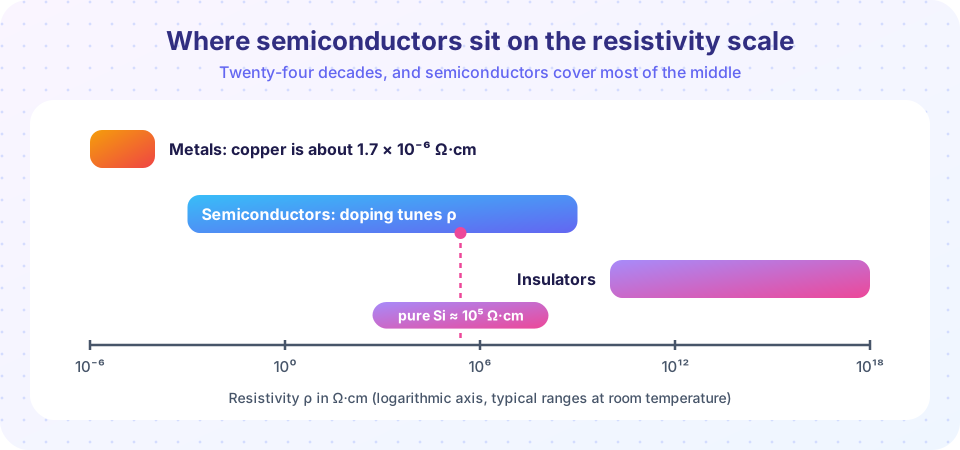
Here are the ranges at room temperature, rounded to orders of magnitude.
| Class | Typical ρ (Ω·cm) | Example |
|---|---|---|
| Metal | 10⁻⁶ to 10⁻⁴ | Copper ≈ 1.7 × 10⁻⁶ |
| Semiconductor | 10⁻³ to 10⁹ (tunable) | Pure silicon ≈ 10⁵ |
| Insulator | 10¹⁰ and above | Glass, diamond, quartz |
The semiconductor row is not one value. It is a range you pick by design. The pure silicon number is only the starting point.
Why the conductivity has three factors
Current is charge in motion. Inside a conductor, mobile carriers of charge q move with an average drift velocity proportional to the electric field E:
v = μ · E
The current density is the carrier density times the charge times the velocity: J = n q v = n q μ E. Since Ohm's law in local form is J = σ E, we get:
σ = q · n · μ          (one carrier type)
σ = q · (n·μn + p·μp)  (electrons and holes)
This formula is the engine of the course. Three levers set conductivity: how many carriers there are (n and p), their charge (always ±q = 1.602 × 10⁻¹⁹ C), and how freely they move (μ).
Metals have an enormous n, about 10²³ per cm³, and a modest mobility. Pure silicon has n of only about 10¹⁰ per cm³ at room temperature, thirteen orders of magnitude fewer. That one fact explains the gap in the picture above. Doping will raise n from 10¹⁰ to as much as 10²⁰ without changing the crystal much, which is the tunability.
Worked example
Estimate the resistivity of pure silicon. Take n = p = 1.0 × 10¹⁰ cm⁻³, μn = 1400 cm²/(V·s) and μp = 450 cm²/(V·s).
σ = 1.602e-19 × 1.0e10 × (1400 + 450)
  = 1.602e-19 × 1.0e10 × 1850
  ≈ 2.96e-6 S/cm
ρ = 1/σ ≈ 3.4e5 Ω·cm
That matches the "about 10⁵ Ω·cm" marker on the scale. Different sources quote a slightly different intrinsic carrier density, so you will see numbers from 2 × 10⁵ to 3 × 10⁵.
Temperature: opposite trends
In a metal the number of carriers is fixed by the atoms. Heating makes the lattice vibrate more, which scatters carriers and lowers mobility. So resistivity rises slowly with temperature: copper changes by about 0.4 percent per kelvin.
In a semiconductor, heat does something else as well. It shakes extra electrons loose from the bonds, so n and p increase very quickly. That effect wins, and resistivity falls as temperature rises. You will quantify the rate in chapter 2, where the carrier density turns out to depend on temperature as exp(−Eg / 2kT).
This is useful and dangerous. Temperature sensors called thermistors exploit it. But a transistor that heats up conducts more, heats more, and can run away; designers must watch for that.
Try it
The first simulation compares a metal and silicon between 250 K and 450 K. The silicon curve uses a simplified model (a fixed band gap), so read the trend, not the exact values.
Press Run (or Ctrl + Enter) to see the result here.
Program input · what you'd type while the program runs
Type the answers before you press Run, one per line. Each time the program reads a line (with input()), it gets the next line from this box.
Press Run (or Ctrl + Enter) to see the result here.
Program input · what you'd type while the program runs
Type the answers before you press Run, one per line. Each time the program reads a line (with input()), it gets the next line from this box.
Common misconceptions
"A semiconductor is a poor metal." A metal has carriers always available. In a semiconductor, the carriers must be created by heat, light or doping. That is why it can be switched.
"Higher temperature always means higher resistance." True for metals, false for semiconductors, where more carriers outweigh more scattering.
Check your understanding
Quick check · 5 questions
of 5 answered You scored / 5 · perfect!
-
1. Which formula gives the conductivity with one carrier type?
Current density is J = n q v and v = μE, so J = (q n μ) E and σ = q n μ. -
2. Pure silicon has a resistivity near which value at room temperature?
Intrinsic silicon has about 10¹⁰ carriers per cm³, giving a resistivity of a few times 10⁵ Ω·cm. -
3. What happens to the resistivity of a semiconductor when it is heated?
Thermal generation of carriers grows exponentially with temperature and outweighs the extra scattering. -
4. A copper bar has 10¹³ times more mobile carriers than pure silicon. Which statement is a sensible conclusion?
Both carry the same elementary charge, and the mobilities differ by a factor of about 40, so the carrier density dominates. -
5. 1 Ω·m equals how many Ω·cm?
One meter is 100 cm, so ρ in Ω·cm is 100 times the value in Ω·m.
Summary
- Resistivity ρ (Ω·cm) is a property of the material; resistance is R = ρL/A.
- Conductivity is σ = q(nμn + pμp): carrier density, charge and mobility.
- Metals are 10⁻⁶ to 10⁻⁴ Ω·cm, insulators above 10¹⁰, semiconductors anywhere in between by design.
- Heating lowers a semiconductor's resistivity but raises a metal's.
Next: The Device Landscape: Diodes, Transistors and Their Jobs
Track your progress
Create a free account to tick off lessons and pick up where you left off on any device.
of Semiconductor Devices lessons completed