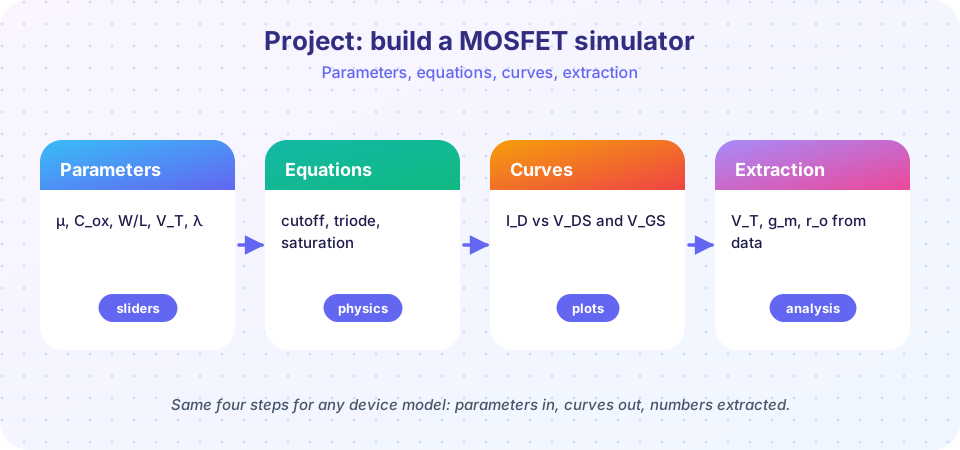
Build a compact MOSFET model in Python that works from subthreshold to strong inversion, plot its characteristics and extract V_T, slope, g_m and DIBL like an engineer.
Device engineers do not just read equations; they build compact models and then measure them, in simulation or in the lab, to extract parameters. In this project you will write a MOSFET model that behaves sensibly in every region, generate its I-V curves, and then pretend the output is "measured data" and extract threshold voltage, subthreshold slope, transconductance and DIBL from it. Everything runs in your browser.
The textbook equations break at V_GS = V_T: the square law predicts zero current, while the real device shows an exponential subthreshold tail. A neat way out is an interpolation model in the style of the EKV compact model. Define the forward and reverse terms
where β = µC_ox W/L, n ≥ 1 is the slope factor, and V_T here is the thermal voltage. For V_P ≫ V_T this reduces to the square law ½β(V_GS − V_T)² in saturation and to the triode equation for small V_DS; for V_P ≪ 0 it reduces to I ∝ e^((V_GS − V_T)/(n V_T)), an exponential with slope n V_T ln10 per decade. One formula, all regions, and it is smooth, which numerical circuit solvers like. We add DIBL by letting the threshold fall with the drain voltage: V_T = V_T0 − η V_DS.
Now treat the simulated curves as measurements and recover the model's parameters, as a process engineer would.
Threshold voltage, three ways.
Linear extrapolation at maximum g_m. At small V_DS (say 50 mV), find the gate voltage where g_m = dI_D/dV_GS is largest, draw the tangent line there and read where it crosses I_D = 0. The x-intercept corrects for the V_DS/2 offset to give V_T.
Constant-current criterion. Define V_T as the V_GS at which I_D = 100 nA × W/L (a common convention).
Square-root method in saturation: fit a line to √I_D against V_GS.
Subthreshold slope. Find the steepest part of log I_D against V_GS below threshold: S = ΔV_GS/Δlog₁₀I_D.
DIBL. Compare the threshold voltage at low and high V_DS: DIBL = (V_T,lin − V_T,sat)/(V_DS,sat − V_DS,lin), in mV/V.
Python
Step 2: parameter extraction
import numpy as np
import matplotlib.pyplot as plt
plt.rcParams.update({"figure.facecolor":"#faf5ff","axes.facecolor":"#ffffff","axes.edgecolor":"#c7d2fe","axes.spines.top":False,"axes.spines.right":False,"axes.grid":True,"grid.color":"#eef2ff","axes.prop_cycle": plt.cycler(color=["#6366f1","#ec4899","#f59e0b","#14b8a6","#38bdf8"]),"font.size":12})
UT =0.02585defnmos(vgs, vds, vt0=0.40, n=1.3, beta=2e-3, lam=0.08, eta=0.03):
vt = vt0 - eta * vds
vp =(vgs - vt)/ n
F =lambda x: np.log1p(np.exp(x /(2* UT)))**2return2* n**2* beta * UT**2*(F(vp)- F(vp - vds))*(1+ lam * vds)
vg = np.linspace(0,1.5,1501)defvt_gm_max(vds):
i = nmos(vg, vds)
gm = np.gradient(i, vg)
k = gm.argmax()return vg[k]- i[k]/ gm[k]- vds /2# tangent intercept, corrected by V_DS/2
vt_lin, vt_sat = vt_gm_max(0.05), vt_gm_max(1.0)print(f"Linear-extrapolation V_T: {vt_lin:.3f} V at V_DS = 0.05 V, {vt_sat:.3f} V at V_DS = 1.0 V")print("Model V_T0 = 0.400 V; every method reads a slightly different number")# constant-current V_T (I = 100 nA * W/L, W/L = 10 here) and DIBL
icc =100e-9*10
vt_cc_lin = np.interp(icc, nmos(vg,0.05), vg)
vt_cc_sat = np.interp(icc, nmos(vg,1.0), vg)print(f"Constant-current V_T (1 uA): {vt_cc_lin:.3f} V at V_DS = 0.05 V, {vt_cc_sat:.3f} V at V_DS = 1.0 V")print(f"DIBL = {(vt_cc_lin - vt_cc_sat)/0.95*1000:.0f} mV/V (model eta = 30 mV/V; channel-length modulation adds the rest)")# subthreshold slope from the steepest part of log10(I) below 0.3 V
sel = vg <0.30
li = np.log10(nmos(vg[sel],0.05))
S =1000/ np.max(np.gradient(li, vg[sel]))print(f"Subthreshold slope = {S:.1f} mV/decade (model: n*59.5 = {1.3*59.52:.1f})")# square-root method in saturation
sel2 =(vg >0.9)&(vg <1.4)
slope, icpt = np.polyfit(vg[sel2], np.sqrt(nmos(vg[sel2],1.0)),1)print(f"sqrt(I_D) method at V_DS = 1 V: V_T = {-icpt/slope:.3f} V (includes DIBL and mobility effects)")
fig,(a1, a2)= plt.subplots(1,2, figsize=(11,4.6))
i = nmos(vg,0.05); gm = np.gradient(i, vg); k = gm.argmax()
a1.plot(vg, i *1e3, linewidth=2.5, label="I_D at V_DS = 50 mV")
xs = np.linspace(vt_lin +0.025, vg[k]+0.2,30)
a1.plot(xs,(i[k]+ gm[k]*(xs - vg[k]))*1e3,"--", color="#ec4899", linewidth=2, label="tangent at max g_m")
a1.plot([vt_lin +0.025],[0],"o", color="#f59e0b", markersize=9)
a1.annotate(f"V_T = {vt_lin:.2f} V", xy=(vt_lin +0.025,0), xytext=(0.7,0.01), arrowprops=dict(arrowstyle="->", color="#f59e0b"))
a1.set_ylim(0, i[-1]*1e3*0.6); a1.set_xlim(0,1.2)
a1.set_xlabel("V_GS (V)"); a1.set_ylabel("I_D (mA)"); a1.set_title("Linear extrapolation"); a1.legend(fontsize=9)
a2.plot(vg, gm *1e3, linewidth=2.5, color="#14b8a6")
a2.set_xlabel("V_GS (V)"); a2.set_ylabel("g_m (mS)"); a2.set_title("Transconductance at V_DS = 50 mV")
plt.tight_layout()
plt.show()
Press Run (or Ctrl + Enter) to see the result here.
Program input · what you'd type while the program runs
Type the answers before you press Run, one per line. Each time the program reads a line (with input()), it gets the next line from this box.
A model earns its keep when you wire it into something. Combine an NMOS and a PMOS (the PMOS is the same equation with the voltages mirrored) and solve for the output where their currents balance, exactly as you did for the CMOS inverter, but now with subthreshold behavior and DIBL included.
Python
Step 3: inverter with the compact model
import numpy as np
import matplotlib.pyplot as plt
from scipy.optimize import brentq
plt.rcParams.update({"figure.facecolor":"#faf5ff","axes.facecolor":"#ffffff","axes.edgecolor":"#c7d2fe","axes.spines.top":False,"axes.spines.right":False,"axes.grid":True,"grid.color":"#eef2ff","axes.prop_cycle": plt.cycler(color=["#6366f1","#ec4899","#f59e0b","#14b8a6","#38bdf8"]),"font.size":12})
UT, VDD =0.02585,1.0defdev(vgs, vds, vt0, beta, n=1.3, lam=0.08, eta=0.03):
vt = vt0 - eta * vds
vp =(vgs - vt)/ n
F =lambda x: np.log1p(np.exp(x /(2* UT)))**2return2* n**2* beta * UT**2*(F(vp)- F(vp - vds))*(1+ lam * vds)defvout(vin, bn=2e-3, bp=2e-3):
f =lambda vo: dev(vin, vo,0.40, bn)- dev(VDD - vin, VDD - vo,0.40, bp)return brentq(f,0.0, VDD)
vin = np.linspace(0, VDD,201)
vo = np.array([vout(v)for v in vin])
gain = np.gradient(vo, vin)
vm = vin[np.argmin(np.abs(vo - vin))]print(f"V_M = {vm:.3f} V, peak gain = {abs(gain.min()):.1f}")# short-circuit (crowbar) current at V_in = V_DD/2 and leakage at V_in = 0
i_mid = dev(VDD /2, vout(VDD /2),0.40,2e-3)
i_leak = dev(0.0, VDD,0.40,2e-3)print(f"crowbar current at V_in = V_DD/2: {i_mid*1e6:.0f} uA; leakage current at V_in = 0: {i_leak*1e12:.0f} pA")
fig,(a1, a2)= plt.subplots(1,2, figsize=(11,4.4))
a1.plot(vin, vo, linewidth=2.5); a1.plot([0, VDD],[0, VDD],"--", color="#94a3b8")
a1.set_xlabel("V_in (V)"); a1.set_ylabel("V_out (V)"); a1.set_title("Transfer curve")
isup = np.array([dev(VDD - v, VDD - o,0.40,2e-3)for v, o inzip(vin, vo)])
a2.semilogy(vin, isup, linewidth=2.5, color="#ec4899")
a2.set_xlabel("V_in (V)"); a2.set_ylabel("Supply current (A)"); a2.set_title("Supply current: tiny except during switching")
plt.tight_layout()
plt.show()
Press Run (or Ctrl + Enter) to see the result here.
Program input · what you'd type while the program runs
Type the answers before you press Run, one per line. Each time the program reads a line (with input()), it gets the next line from this box.
Change the slope factor n from 1.3 to 1.0 and 1.6. How do S and the off-current at V_GS = 0 change?
Add velocity saturation by replacing V_P with a limited overdrive, or divide I_D by 1 + θ·(V_GS − V_T), and see how the output curves lose their quadratic shape.
Make the PMOS weaker (bp = 0.7e-3) and find the new V_M. Which way does it move and why?
Add a series source resistance R_s: solve for the internal V_GS and V_DS at each point. What happens to g_m?
Estimate the ring-oscillator frequency of three inverters from t_pd ≈ C V_DD/(2 I_on).