


















Lesson 9 of 45 · Crystals, Bands and Carriers
Electrons and Holes: Two Kinds of Carriers
Learn how free electrons and holes carry current, why a hole acts like a positive charge, what effective mass is, and how mobility and drift velocity work.
In a metal there is one kind of mobile charge: the electron. A semiconductor has two. Electrons in the conduction band carry negative charge. And the empty states they leave behind in the valence band behave like positive charges, called holes. Both move, both carry current, and both matter in every device from diode to MOSFET.
This lesson explains why the hole is a legitimate carrier and not a trick of bookkeeping, and introduces the two properties that decide how well a carrier moves: effective mass and mobility.
What you will learn
- How a hole forms, and why it moves like a positive charge.
- What effective mass means and why it is not the electron's real mass.
- How mobility is related to scattering time and effective mass.
- Why drift velocity eventually saturates in a strong field.
Key terms
- Hole: an empty electron state in the valence band that behaves as a carrier of charge +q.
- Effective mass: the mass (written m*) that makes an electron in a crystal obey Newton's law as if it were free.
- Mobility μ: drift velocity per unit electric field, v = μE.
- Saturation velocity: the maximum drift velocity in a very strong field, about 10⁷ cm/s in silicon.
Making a hole
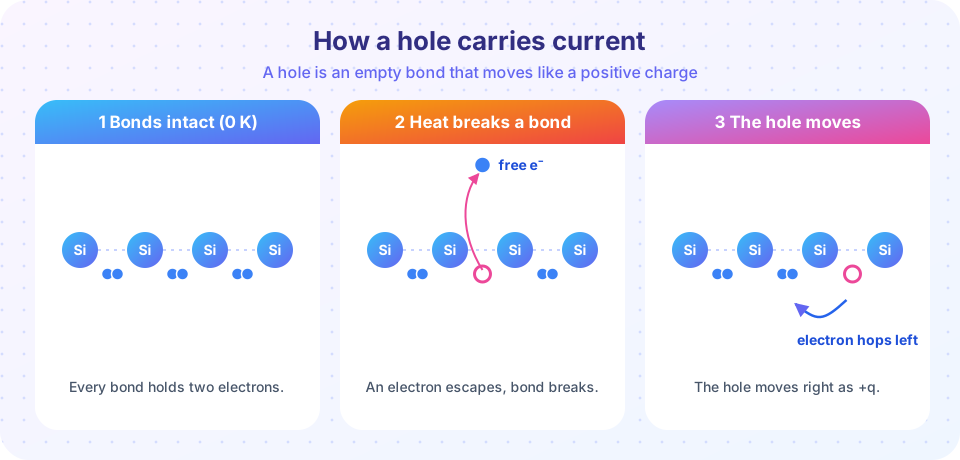
Suppose a bond in the silicon lattice loses an electron, which is lifted into the conduction band. The missing electron leaves a vacancy in the bond. A neighboring electron, pushed by an applied field, can hop into that vacancy, which moves the vacancy to where the neighbor was. Repeat, and the vacancy travels through the crystal in the direction opposite to the electrons' hopping. It carries a net charge of +q, because the bond that is missing an electron is locally positive. We call this moving vacancy a hole.
You can verify that treating a hole as a positive particle gives the right current. In an almost full band, the total current of all electrons equals minus the current that the missing electron would carry. That is the same as the current of a positive particle moving in the opposite sense. So the hole is a simple accounting shortcut that happens to be exactly right.
Effective mass
Electrons in a crystal feel the lattice's periodic potential on top of any applied force. Remarkably, near the band edges they respond to a force as if they were free particles, but with a different mass, the effective mass m*. It is defined by the curvature of the band:
1/m* = (1/ħ²) · d²E/dk²
A band with a sharp curve (E changing rapidly with k) has a small effective mass, and carriers accelerate easily. Near the band edges, the bands are nearly parabolic:
E(k) = Ec + ħ²k² / (2 m*n)         (conduction band)
E(k) = Ev − ħ²k² / (2 m*p)         (valence band)
Typical values in units of the free-electron mass m₀ = 9.109 × 10⁻³¹ kg:
| Material | m*n / m₀ | m*p / m₀ |
|---|---|---|
| Si (density of states) | 1.08 | 0.56 |
| Ge | 0.55 | 0.37 |
| GaAs | 0.067 | 0.48 |
GaAs electrons are exceptionally light, which is one reason GaAs transistors are fast. The valence band's curvature is negative, but the hole mass is defined as positive: m*p is the magnitude.
Mobility and scattering
When a field E acts on a carrier of charge q and effective mass m*, the carrier accelerates, but only until it scatters off a lattice vibration or an impurity. If the average time between collisions is τ, the average drift velocity is:
v = (q τ / m*) E = μ E so μ = q τ / m*
Mobility is therefore larger for light carriers and long scattering times. Typical mobilities at 300 K for lightly doped material (cm²/(V·s)):
| Material | μn | μp |
|---|---|---|
| Si | 1400 | 450 |
| Ge | 3900 | 1900 |
| GaAs | 8500 | 400 |
Silicon electrons are about three times as mobile as holes, which is why NMOS transistors are faster than PMOS of the same size, and why designers make PMOS devices wider.
Scattering has two main causes. At low doping, lattice vibrations (phonons) dominate, so mobility falls as temperature rises. At high doping, ionized impurity atoms scatter carriers, so mobility falls as doping rises.
Velocity saturation
At weak fields the drift velocity is proportional to the field. In strong fields, carriers gain energy faster than they can shed it to the lattice, and the velocity levels off at about 10⁷ cm/s in silicon. A common empirical formula is:
v = μE / (1 + μE / v_sat)
At 10⁴ V/cm, the linear estimate for silicon electrons would be 1.4 × 10⁷ cm/s, above the saturation limit, so the real velocity is lower. The effect is central to short-channel MOSFETs in chapter 6.
Try it
The first plot shows parabolic bands for two materials with different effective masses: the lighter the mass, the steeper the band.
Press Run (or Ctrl + Enter) to see the result here.
Program input · what you'd type while the program runs
Type the answers before you press Run, one per line. Each time the program reads a line (with input()), it gets the next line from this box.
Press Run (or Ctrl + Enter) to see the console output here.
No output.
Common misconceptions
"Holes are just electrons going backwards." Holes are a collective description of many electrons in the valence band. They have their own effective mass and mobility, which are different from the electron's.
"Effective mass is the real mass of the electron." The electron's real mass does not change. m* absorbs the effect of the lattice forces so that we can use free-particle laws.
Check your understanding
Quick check · 5 questions
of 5 answered You scored / 5 · perfect!
-
1. What charge does a hole carry?
A hole is a missing electron and behaves as a particle of charge +q. -
2. A band with a steeper curve gives carriers a
Since 1/m* is proportional to the curvature, a steeper band means a lighter carrier. -
3. The relation between mobility, scattering time and effective mass is
Drift velocity is v = (qτ/m*) E, so μ = qτ/m*. -
4. Why are PMOS transistors usually drawn wider than NMOS ones?
μp ≈ 450 versus μn ≈ 1400, so more width compensates for weaker hole drift. -
5. What limits drift velocity in a strong field?
At high fields the energy gained per scattering time is shed by phonon emission, and velocity levels off.
Summary
- Electrons in the conduction band and holes in the valence band both carry current.
- A hole is an empty valence state that behaves as a +q carrier.
- Effective mass m* captures lattice effects through band curvature; GaAs electrons are very light.
- μ = qτ/m*; Si has μn ≈ 1400 and μp ≈ 450 cm²/(V·s); velocity saturates near 10⁷ cm/s.
Track your progress
Create a free account to tick off lessons and pick up where you left off on any device.
of Semiconductor Devices lessons completed