


















Lesson 3 of 45 · Getting Started
The Device Landscape: Diodes, Transistors and Their Jobs
A guided tour of the main semiconductor devices: diode, LED, solar cell, BJT and MOSFET, what each does, and the history of how they were invented.
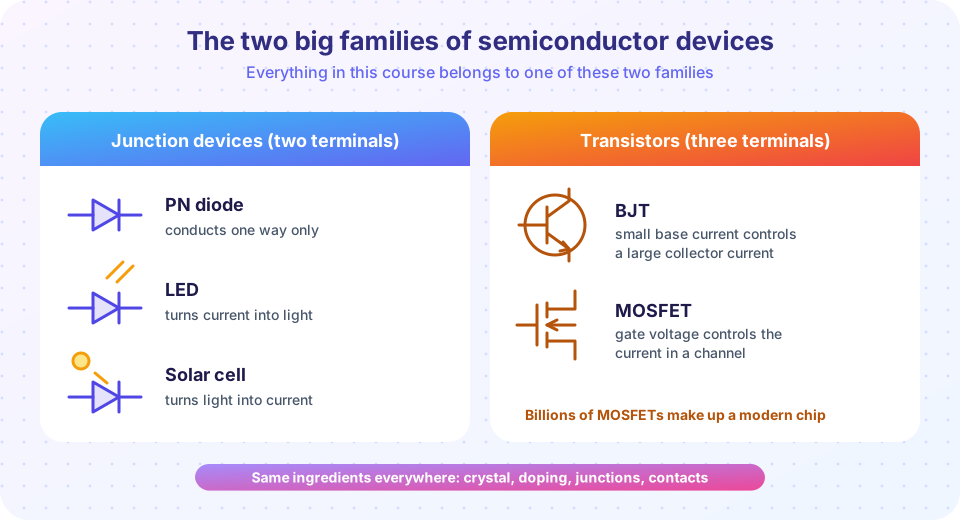
The list of semiconductor devices looks long, but it collapses into two families. Devices with two terminals use a single junction. Devices with three terminals add a control electrode that lets one signal steer another. Seeing the family tree first makes every later chapter easier, because you always know where the device you are studying fits.
This lesson gives you the map: what each device does, the circuit symbol you will see in diagrams, and the people who invented it.
What you will learn
- The two device families and what separates them.
- The job of a diode, LED, solar cell, BJT and MOSFET.
- How a control terminal changes the behavior from passive to active.
- A short history of the key inventions.
Key terms
- Two-terminal device: current is set by the voltage across its two ends (diode, LED, solar cell).
- Three-terminal device: a third electrode controls the current between the other two (transistor).
- Active device: one that can amplify or switch using a control signal.
- Terminal: a contact where current enters or leaves the device.
Family 1: junction devices
A PN diode is two doped regions in one crystal. Current flows easily in one direction, from p to n (forward), and barely at all the other way. In a circuit it is a one-way valve. Rectifiers that turn mains AC into DC are built from diodes.
An LED (light-emitting diode) is a diode made from a semiconductor in which recombining electrons and holes give off photons. Applied forward voltage produces light. Nick Holonyak at General Electric demonstrated the first visible (red) LED in 1962.
A solar cell is the same junction run backwards in function: light creates electron-hole pairs, and the junction's built-in field pulls them apart, producing a voltage and a current. The first practical silicon cell was announced by Chapin, Fuller and Pearson at Bell Labs in 1954.
Notice the symmetry. LED: electricity in, light out. Solar cell: light in, electricity out. The physics is the same junction viewed two ways, and chapter 7 will show it.
Family 2: transistors
A bipolar junction transistor (BJT) has three regions, n-p-n or p-n-p, and three terminals called emitter, base and collector. A small current into the base controls a much larger current between collector and emitter. The ratio is the current gain, β (or hFE), often 50 to 300. Both electrons and holes take part, hence "bipolar". Bardeen and Brattain built the first point-contact transistor at Bell Labs in December 1947, and the junction version, designed by Shockley, followed.
A MOSFET (metal-oxide-semiconductor field-effect transistor) works differently. The gate is separated from the semiconductor by a thin insulating oxide, so no steady current enters the gate. A voltage on the gate attracts carriers to the surface and forms a conducting channel between the source and drain terminals. Kahng and Atalla at Bell Labs built the first working silicon MOSFET in 1959 and 1960.
The MOSFET draws almost no control power, which makes it ideal for digital logic. A processor holds billions of them.
| Device | Terminals | Controlled by | Typical job |
|---|---|---|---|
| Diode | 2 | applied voltage polarity | rectify, protect |
| LED | 2 | forward current | emit light |
| Solar cell | 2 | incoming light | generate power |
| BJT | 3 | base current | amplify, switch |
| MOSFET | 3 | gate voltage | switch, logic, amplify |
Where the pieces come from
Two inventions turned single devices into electronics as we know it. Jack Kilby (Texas Instruments, 1958) and Robert Noyce (Fairchild, 1959) built the first integrated circuits, putting several devices and their wiring in one crystal. And the planar process, developed at Fairchild, made it possible to build devices in a flat surface by repeating the same steps. Chapter 8 follows that recipe.
Try it
The first example compares how the two transistor types are controlled. These are idealized textbook models (a constant β and a square-law MOSFET), not data for a specific part.
Press Run (or Ctrl + Enter) to see the result here.
Program input · what you'd type while the program runs
Type the answers before you press Run, one per line. Each time the program reads a line (with input()), it gets the next line from this box.
Common misconceptions
"A transistor is just a small switch." It also amplifies. In analog circuits a transistor is operated in the middle of its range, not fully on or off.
"The BJT and the MOSFET differ only in size." They are controlled differently. A BJT needs a continuous base current; a MOSFET gate draws almost none in steady state.
Check your understanding
Quick check · 5 questions
of 5 answered You scored / 5 · perfect!
-
1. How many terminals does a diode have?
A diode has an anode and a cathode. Transistors add a control terminal. -
2. Which device converts incoming light into electrical power?
A solar cell is a junction that separates light-generated electron-hole pairs. -
3. What controls the current in a MOSFET?
The gate sits behind an oxide, so a voltage on it creates a channel without any steady gate current. -
4. Current gain β of a BJT is the ratio of which two currents?
β = Ic / Ib, typically 50 to 300 for small-signal transistors. -
5. Why is the MOSFET favored in digital chips?
Low control power and simple shrinking let engineers place billions on one chip.
Summary
- Two-terminal junction devices: diode, LED and solar cell.
- Three-terminal transistors: BJT (current-controlled) and MOSFET (voltage-controlled).
- LED and solar cell are the same junction run in opposite directions.
- Integrated circuits and the planar process put many devices on one crystal.
Next: Your Toolkit: Units, Constants and Orders of Magnitude
Track your progress
Create a free account to tick off lessons and pick up where you left off on any device.
of Semiconductor Devices lessons completed