


















Lesson 15 of 45 · Doping and Conduction
Drift and Diffusion: How Carriers Move
Learn the two ways carriers move in a semiconductor: drift in an electric field and diffusion down a gradient, mobility versus doping, resistivity, and D = μ kT/q.
Carriers in a semiconductor are in constant, random thermal motion at about 10⁷ cm/s, colliding with lattice vibrations and impurities every fraction of a picosecond. That motion has no net direction until something biases it. There are two things that can: an electric field (drift) and a concentration gradient (diffusion). Together they account for every current in every device in this course.
This lesson derives each current, shows how doping changes mobility and resistivity, and connects the two mechanisms with the Einstein relation.
What you will learn
- The drift current density and how it leads to the resistivity of doped silicon.
- How mobility depends on doping, and what it does to resistivity.
- The diffusion current density and the diffusion coefficient.
- The Einstein relation D = μ kT/q and the diffusion length.
Key terms
- Drift: net carrier motion caused by an electric field.
- Diffusion: net motion of carriers from high to low concentration because of random thermal motion.
- Diffusion coefficient D: the constant that links flux to concentration gradient (cm²/s).
- Diffusion length L: the average distance a carrier diffuses before recombining, L = √(Dτ).
Drift current
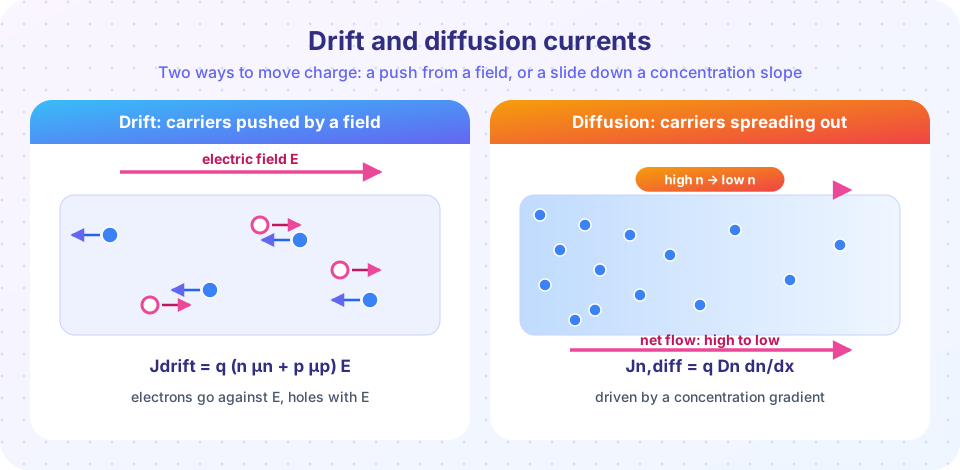
In a field E, electrons drift opposite to E with velocity vn = −μn E, holes along E with velocity vp = +μp E. Because electrons have negative charge, both give current in the direction of E:
Jn,drift = q n μn E
Jp,drift = q p μp E
J_drift  = q (n μn + p μp) E = σ E
That is Ohm's law written in local form, with σ = q(nμn + pμp). For a doped crystal, only the majority carrier matters: for n-type, ρ = 1/(q n μn) ≈ 1/(q Nd μn).
Mobility is not a constant. In lightly doped silicon it is set by lattice vibrations (about 1400 cm²/(V·s) for electrons and 470 for holes at 300 K). As doping rises, impurity ions scatter carriers more, and mobility drops, to roughly 80 for electrons and 50 for holes near 10²⁰ cm⁻³. An empirical fit is:
μ(N) = μmin + (μmax − μmin) / (1 + (N / Nref)^α)
For electrons in phosphorus-doped silicon, parameters near μmin = 68.5, μmax = 1414 cm²/(V·s), Nref = 9.2 × 10¹⁶ cm⁻³ and α = 0.71 describe measurements well. The resulting resistivity-versus-doping curve is the one fabrication engineers use every day: for 10¹⁶ cm⁻³ n-type silicon, ρ is about 0.5 Ω·cm; for p-type at the same doping, about 1.4 Ω·cm (holes are slower).
Diffusion current
Imagine a box with many electrons on the left and few on the right. Each electron moves randomly, so more electrons cross the middle from left to right than from right to left, even though there is no force. The net flux is proportional to the gradient:
Fn = −Dn dn/dx   (electrons per cm² per second)
Jn,diff = q Dn dn/dx
Jp,diff = −q Dp dp/dx
The signs follow from charge: electrons flowing toward +x carry conventional current toward −x. Diffusion needs no electric field and no external source.
Worked example
In silicon at 300 K, the electron density falls from 10¹⁶ to 10¹⁵ cm⁻³ across 1 µm (10⁻⁴ cm), and Dn = 36 cm²/s. The gradient is dn/dx = −9 × 10¹⁵ / 10⁻⁴ = −9 × 10¹⁹ cm⁻⁴. So:
Jn,diff = q Dn dn/dx = 1.602e-19 × 36 × (−9e19) ≈ −520 A/cm²
The minus sign means conventional current flows in the −x direction. Five hundred amperes per square centimeter is a large current density; sharp gradients over micrometers can drive large currents, which is how junctions work.
The Einstein relation
Both drift and diffusion come from the same random motion, so D and μ are not independent. Their ratio is fixed by temperature:
Dn / μn = kT / q so Dn = μn · kT/q
At 300 K, kT/q = 25.85 mV, so Dn = 1400 × 0.02585 ≈ 36 cm²/s and Dp = 450 × 0.02585 ≈ 12 cm²/s. Once you know a mobility you know the diffusion coefficient.
Total current and diffusion length
The total electron current includes both mechanisms:
Jn = q n μn E + q Dn dn/dx
Jp = q p μp E − q Dp dp/dx
Excess carriers do not diffuse forever: they recombine with an average lifetime τ (microseconds in good silicon). The average distance traveled is the diffusion length:
L = √(D τ)
With Dn = 36 cm²/s and τ = 1 µs, L = √(36 × 10⁻⁶) = 6 × 10⁻³ cm = 60 µm. In a diode, minority carriers injected across the junction spread over about one diffusion length before they recombine; chapter 4 uses this.
Try it
The first plot computes resistivity versus doping with the mobility fit, for n-type and p-type silicon at 300 K. It assumes complete ionization and ignores the very high-doping range where this fit becomes unreliable.
Press Run (or Ctrl + Enter) to see the result here.
Program input · what you'd type while the program runs
Type the answers before you press Run, one per line. Each time the program reads a line (with input()), it gets the next line from this box.
Press Run (or Ctrl + Enter) to see the result here.
Program input · what you'd type while the program runs
Type the answers before you press Run, one per line. Each time the program reads a line (with input()), it gets the next line from this box.
Common misconceptions
"Diffusion needs a force." Diffusion needs only random motion and a concentration difference. Even uncharged particles diffuse.
"Mobility is a fixed property of silicon." It depends on doping, temperature and field. Quoting a single number without conditions is risky.
Check your understanding
Quick check · 5 questions
of 5 answered You scored / 5 · perfect!
-
1. Drift current density is
Drift is conductivity σ = q(nμn + pμp) times the field E. -
2. What happens to mobility in silicon as doping increases from 10¹⁴ to 10¹⁹ cm⁻³?
Impurity scattering becomes dominant at high doping, reducing mobility. -
3. The Einstein relation connects
D = μ kT/q, which comes from the shared random-motion origin of both effects. -
4. With μn = 1400 cm²/(V·s) at 300 K, Dn is about
Dn = 1400 × 0.02585 = 36.2 cm²/s. -
5. The diffusion length with D = 36 cm²/s and τ = 1 µs is
L = √(36 × 10⁻⁶ cm²) = 6 × 10⁻³ cm = 60 µm.
Summary
- Drift: J = q(nμn + pμp)E, with σ = q(nμn + pμp) and mobility that falls as doping rises.
- Diffusion: Jn = q Dn dn/dx and Jp = −q Dp dp/dx, driven by gradients.
- Einstein relation: D = μ kT/q (Dn ≈ 36, Dp ≈ 12 cm²/s in Si at 300 K).
- Diffusion length L = √(Dτ), tens of micrometers in good silicon.
Track your progress
Create a free account to tick off lessons and pick up where you left off on any device.
of Semiconductor Devices lessons completed