


















Lesson 11 of 45 · Crystals, Bands and Carriers
Chapter 2 Review: Crystals, Bands and Carriers
Review chapter 2: the diamond lattice, energy bands, electrons and holes, effective mass, intrinsic carrier density ni and the mass-action law, with a ten-question quiz.
This chapter built the foundation every later device relies on. A regular lattice produces energy bands; the gap between bands controls how many carriers heat can create; carriers come in two kinds with different masses and mobilities; and in equilibrium the product n·p is fixed at ni².
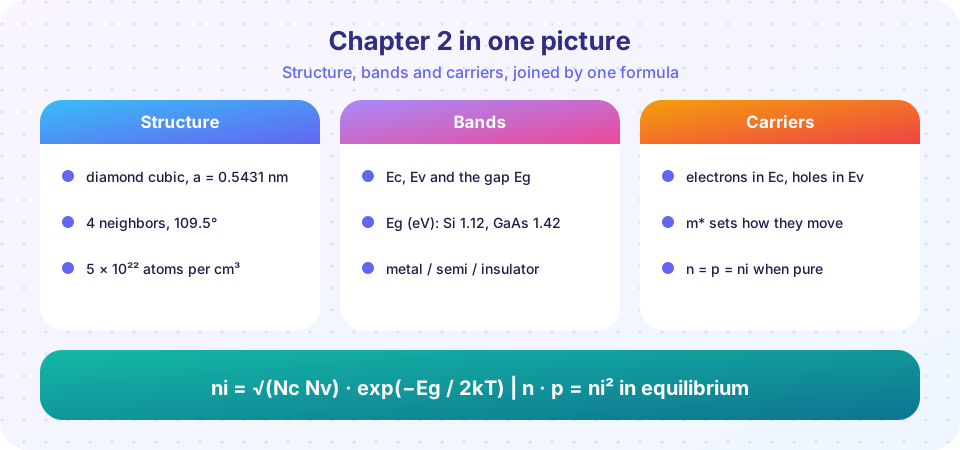
Recap table
| Lesson | Key idea | Formula or number |
|---|---|---|
| Crystal structure | Diamond cubic lattice, tetrahedral bonds | a = 0.5431 nm, 8 atoms per cell, 5 × 10²² cm⁻³ |
| Energy bands | Bands and the gap | Eg: Si 1.12, Ge 0.66, GaAs 1.42 eV; f(E) = 1/(1 + e^((E−EF)/kT)) |
| Electrons and holes | Two carriers, effective mass, mobility | μ = qτ/m*; μn(Si) ≈ 1400, μp ≈ 450 cm²/(V·s) |
| Intrinsic carriers | Thermal generation of pairs | ni = √(Nc Nv) e^(−Eg/2kT); n·p = ni² |
Try it
The first example checks your understanding by computation. It keeps silicon's density of states and changes only the band gap, so you see how strongly ni depends on Eg at 300 K.
Press Run (or Ctrl + Enter) to see the result here.
Program input · what you'd type while the program runs
Type the answers before you press Run, one per line. Each time the program reads a line (with input()), it gets the next line from this box.
Press Run (or Ctrl + Enter) to see the console output here.
No output.
Check your understanding
Quick check · 10 questions
of 10 answered You scored / 10 · perfect!
-
1. How many atoms does the diamond cubic unit cell contain?
Corner atoms count 1, face atoms 3, interior atoms 4. -
2. Which pair describes the edges of the band gap?
Ec is the lower edge of the conduction band and Ev the upper edge of the valence band. -
3. Which material has a direct band gap?
GaAs has its conduction minimum above its valence maximum, so it is an efficient light emitter. -
4. A hole in the valence band behaves as
A hole behaves as a particle of charge +q with effective mass m*p. -
5. Mobility is related to scattering time τ and effective mass m* by
Higher τ and lighter m* give higher mobility. -
6. For pure silicon at 300 K, ni is about
About 10¹⁰ cm⁻³, thirteen orders of magnitude below the atom density. -
7. If n = 10¹⁵ cm⁻³ in silicon with ni = 10¹⁰ cm⁻³, then p is
p = ni²/n = 10²⁰/10¹⁵ = 10⁵ cm⁻³. -
8. Why does silicon's ni rise so quickly with temperature?
At 300 K, Eg/2kT is about 21.7, so small changes in T change the exponential strongly. -
9. Which has the highest electron mobility in the lightly doped state?
GaAs electrons are very light (m* = 0.067 m₀), so μn is about 8500 cm²/(V·s). -
10. The mass-action law n·p = ni² applies to
The product depends only on material and temperature, not on doping, as long as the sample is in equilibrium.
Summary
- Lattice, bonds and bands describe the same crystal in space and in energy.
- Eg, effective mass and mobility are the three material numbers that appear in most device formulas.
- n·p = ni² is the bridge to chapter 3, where we choose n or p by doping.
Track your progress
Create a free account to tick off lessons and pick up where you left off on any device.
of Semiconductor Devices lessons completed