


















Lesson 33 of 45 · Optoelectronic Devices
LEDs and laser diodes
Learn how LEDs and laser diodes emit light: direct band gaps, radiative recombination, efficiency, white LEDs, stimulated emission, threshold gain and L-I curves.
A forward-biased pn junction injects electrons into the p side and holes into the n side. Where they meet, they recombine, and in the right material each recombination releases a photon. That is a light-emitting diode. Add a mirror cavity and enough gain, and the same junction produces a laser diode, whose light is far more directional, narrow in wavelength and coherent. This lesson shows how both work, what limits their efficiency and how to calculate with them.
What you will learn
- How photon energy relates to the band gap and which materials give which colors.
- The efficiency chain of an LED: internal quantum efficiency, light extraction and wall-plug efficiency.
- How white LEDs are made and how to size a current-limiting resistor.
- How stimulated emission, population inversion and an optical cavity create a laser.
- How to compute threshold gain and read a laser's L-I curve.
Key terms
Internal quantum efficiency (IQE): the fraction of injected carriers that recombine radiatively inside the chip.
Light extraction efficiency (LEE): the fraction of generated photons that actually escape the chip.
Population inversion: more electrons in the upper (conduction-band) states than in the lower states available to absorb the photon.
Threshold current (I_th): the current above which stimulated emission dominates and lasing begins.
Double heterostructure: a thin low-gap active layer sandwiched between wider-gap layers, confining carriers and light.
How an LED emits light
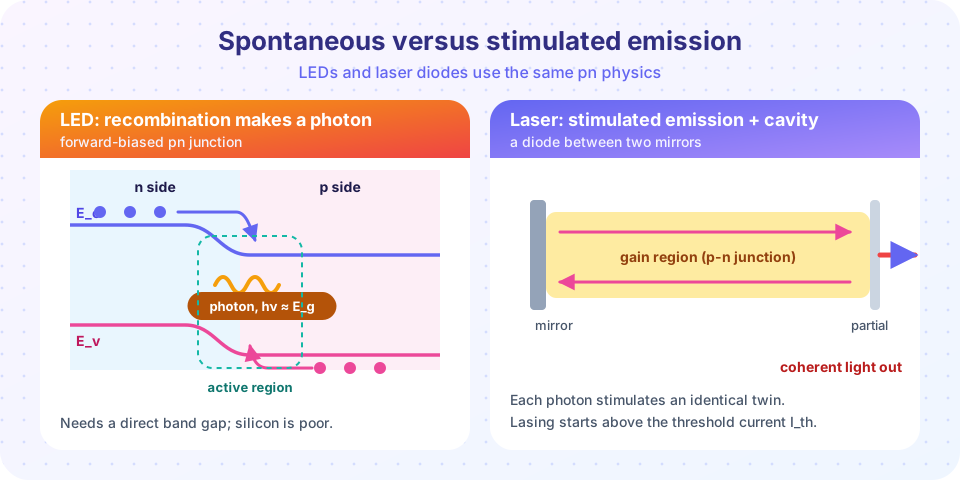
At zero bias the junction has a built-in barrier. Forward bias lowers it, so electrons flow into the p region and holes into the n region. In the region where they overlap, the active region, electrons fall from the conduction band to the valence band and give up an energy close to the band gap, hν ≈ E_g. The emitted wavelength is
λ (nm) = 1239.8 / E_g (eV)
| Material | Approx. gap (eV) | Emission | Typical use |
|---|---|---|---|
| GaN | 3.4 | 365 nm, ultraviolet | UV curing |
| InGaN | 2.3 to 2.9 | blue to green | blue/green LEDs, white-LED pump |
| AlGaInP | 1.9 to 2.2 | red to amber | indicator and brake lights |
| GaAs | 1.42 | 870 nm, infrared | remote controls |
| InGaAsP / InGaAs | 0.75 to 0.95 | 1310 to 1550 nm | fiber-optic communication |
The visible LEDs are made from alloys, such as InxGa1−xN, whose gap changes smoothly with composition. That tunability is the reason a few materials cover the whole rainbow. The blue LED was a decades-long challenge: Isamu Akasaki, Hiroshi Amano and Shuji Nakamura solved the growth and p-doping problems of GaN in the late 1980s and early 1990s and shared the 2014 Nobel Prize in Physics.
Efficiency: three numbers
The external quantum efficiency (EQE) is photons out per electron in: EQE = IQE × LEE, with the injection efficiency usually near 1. Semiconductors have a high refractive index (about 2.5 for GaN, 3.5 for GaAs), so light hits the surface beyond the critical angle and is trapped by total internal reflection. Roughly only 1 in 20 photons escapes a flat GaAs chip, which is why LED dies are roughened, shaped or coated. The wall-plug efficiency also includes the electrical side:
η_wp = EQE × (hν / qV)
where V is the operating voltage. A good modern blue LED can reach a wall-plug efficiency of roughly 70% or more at moderate current, while efficiency droops at high current.
White light
There is no single-junction white LED. The usual recipe is a blue InGaN LED coated with a phosphor, for instance cerium-doped yttrium aluminum garnet (YAG:Ce), which absorbs part of the blue and re-emits broad yellow light. Blue plus yellow looks white. Adding red and green phosphors improves color quality. Another route combines separate red, green and blue chips.
A resistor for an LED
An LED has a nearly fixed forward voltage V_f (about 2 V for red, 3 V for blue or white, typical values) and an exponential I-V curve, so it must be driven through a resistor or a constant-current source. The resistor drops the excess voltage:
R = (V_s − V_f) / I
Example. Supply 5 V, red LED (V_f = 2.0 V), I = 20 mA: R = (5 − 2.0)/0.020 = 150 Ω. For a blue LED at the same current: R = (5 − 3.0)/0.020 = 100 Ω. The resistor dissipates I² R = 60 mW in the red case.
From LED to laser
A laser needs three ingredients.
- Gain medium. In the active region, a high injection current pumps electrons into the conduction band and leaves holes in the valence band, so there are more electrons in the upper states than in the lower ones. This population inversion means a passing photon is more likely to stimulate emission than to be absorbed. In a semiconductor, the condition is that the separation of the electron and hole quasi-Fermi levels exceeds the photon energy.
- Optical feedback. Two mirrors send photons back and forth through the gain region. In an edge-emitting diode, the mirrors are cleaved crystal facets that reflect about 30% of the light (reflectivity R ≈ 0.3 for GaAs).
- Gain ≥ loss. The round trip must give back at least as many photons as it loses.
Double heterostructures (Zhores Alferov and Herbert Kroemer, Nobel Prize 2000) confine both carriers and light to a thin active layer, which lowered threshold current dramatically and made continuous room-temperature operation practical in 1970.
Threshold gain
Per unit length, the cavity loses light by internal absorption (α_i) and by leakage through the mirrors, α_m = (1/2L) ln(1/(R₁R₂)). The threshold gain is the sum:
g_th = α_i + (1 / 2L) ln(1 / (R₁ R₂))
Example. Cavity length L = 500 µm = 0.05 cm, R₁ = R₂ = 0.3, α_i = 10 cm⁻¹. Mirror loss: α_m = (1/0.1 cm) × ln(1/0.09) = 10 × 2.408 = 24.1 cm⁻¹. Threshold gain: g_th = 10 + 24.1 = 34.1 cm⁻¹. A shorter cavity or lower reflectivity raises the mirror loss and the threshold.
The L-I curve
Below threshold the output is weak spontaneous emission, like an LED. Above it, the output power rises linearly with current:
P = η_d · (hν / q) · (I − I_th)
where η_d is the differential quantum efficiency (the fraction of extra electrons that produce output photons). With η_d = 0.6 at 650 nm (hν = 1.91 eV) the slope efficiency is 0.6 × 1.91 = 1.14 W/A. With I_th = 30 mA the output at 50 mA is 1.14 × 0.020 = 22.9 mW.
Types you will meet: Fabry-Perot edge emitters (simple, several wavelength modes); DFB lasers with a grating for one wavelength (telecom); VCSELs (vertical-cavity surface-emitting lasers), which emit from the chip surface and are used in face recognition and short-reach data links.
Common misconceptions
"An LED emits exactly one wavelength." It has a spread of roughly 1.8 kT in energy (about 47 meV), which is 10 to 30 nm in the visible. A laser line is far narrower.
"Higher current always means more light." LED efficiency droops at high current, and heat shifts the wavelength and lowers output.
"Lasers need very large voltages." A laser diode runs from a few volts; its challenge is the precise control of current (a small overshoot can destroy the facets).
Try it
Compare the spectrum of a red LED with that of a laser, and plot the L-I curve of the example laser. The widths are illustrative: the LED line width comes from 1.8 kT, and the laser line is drawn broader than a real one so that it is visible.
Press Run (or Ctrl + Enter) to see the result here.
Program input · what you'd type while the program runs
Type the answers before you press Run, one per line. Each time the program reads a line (with input()), it gets the next line from this box.
The second widget sizes the resistor for an LED. The forward voltages are typical, not exact; check the datasheet of the LED you use.
Check your understanding
Quick check · 5 questions
of 5 answered You scored / 5 · perfect!
-
1. A semiconductor with E_g = 1.42 eV emits at about
λ = 1239.8 / 1.42 = 873 nm, in the near infrared (GaAs). -
2. Why is only a small fraction of the generated light extracted from a flat, high-index LED chip?
High refractive index gives a small escape cone, so most photons are reflected back inside. -
3. R = 100 Ω, V_s = 5 V and V_f = 3 V. The LED current is
I = (5 − 3)/100 = 20 mA. -
4. The condition for a laser to start is that
Above threshold the round-trip gain compensates absorption and mirror losses, so stimulated emission builds up. -
5. How is a white LED usually made?
A blue InGaN chip excites a phosphor that re-emits yellow; the combination looks white.
Summary
- Photon energy
hν ≈ E_g, soλ(nm) = 1239.8/E_g(eV); direct-gap alloys such as InGaN and AlGaInP cover the visible range. - LED efficiency is EQE = IQE × LEE; wall-plug efficiency adds hν/qV. Light extraction is a major design challenge.
- White LEDs are blue chips with phosphor; size the series resistor with
R = (V_s − V_f)/I. - A laser adds population inversion, mirrors and gain above loss:
g_th = α_i + (1/2L) ln(1/R₁R₂); above I_th,P = η_d (hν/q)(I − I_th).
Track your progress
Create a free account to tick off lessons and pick up where you left off on any device.
of Semiconductor Devices lessons completed