


















Lesson 35 of 45 · Optoelectronic Devices
Chapter review: Optoelectronic Devices
Review LEDs, laser diodes, photodiodes and solar cells with a one-picture summary, a recap table, quick calculators and a ten-question mixed quiz.
Light in, light out: this chapter showed that a single junction can be a lamp, a laser, a sensor or a power source depending on how it is built and biased. Use this page to pull the ideas together before moving on to the factory floor in chapter 8.
The chapter in one picture
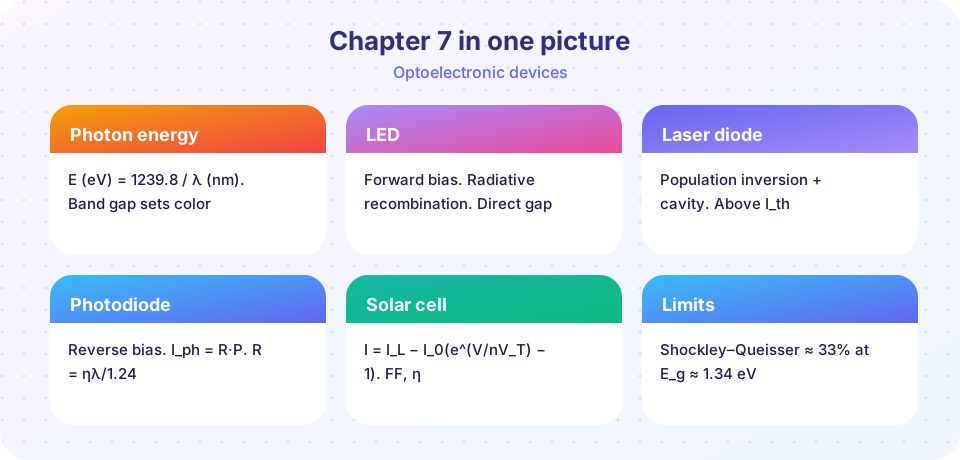
Recap table
| Device | Bias | Key relation | Example number |
|---|---|---|---|
| Photon energy | none | E(eV) = 1239.8/λ(nm) |
GaAs 1.42 eV → 873 nm |
| LED | forward | EQE = IQE × LEE; R = (V_s − V_f)/I |
150 Ω for red at 5 V, 20 mA |
| Laser diode | forward, above I_th | g_th = α_i + (1/2L)ln(1/R₁R₂); P = η_d(hν/q)(I − I_th) |
g_th = 34 cm⁻¹ for L = 500 µm |
| Photodiode | zero or reverse | R = ηλ[µm]/1.24 A/W |
0.548 A/W at 850 nm, η = 0.8 |
| Solar cell | forward, as a generator | V_oc = nV_T ln(I_L/I_0+1); FF = P_max/(I_scV_oc) |
η = 23% for 40 mA/cm², 0.70 V, FF 0.82 |
| Efficiency limit | none | detailed balance | about 33% at 1.34 eV (AM1.5G) |
Notice the patterns: whenever light is absorbed or emitted, the photon energy is tied to the gap; whenever current is wanted, there is a collection or injection efficiency in front of it; and every real device has a loss mechanism (extraction, series resistance, recombination) that the ideal formula leaves out.
Try it
A single calculator that links the five devices. Change the numbers and confirm each against the table.
Press Run (or Ctrl + Enter) to see the result here.
Program input · what you'd type while the program runs
Type the answers before you press Run, one per line. Each time the program reads a line (with input()), it gets the next line from this box.
Second, look at how the solar cell's output voltage and power vary with illumination, to see the logarithmic V_oc and the linear I_sc.
Press Run (or Ctrl + Enter) to see the result here.
Program input · what you'd type while the program runs
Type the answers before you press Run, one per line. Each time the program reads a line (with input()), it gets the next line from this box.
Check your understanding
Quick check · 10 questions
of 10 answered You scored / 10 · perfect!
-
1. Light of 530 nm has a photon energy of about
E = 1239.8 / 530 = 2.34 eV. -
2. Why is silicon rarely used for LEDs?
Recombination needs a phonon, so most carriers recombine without emitting light. -
3. LED forward voltage 2.0 V, supply 9 V, current 10 mA. The series resistor is
R = (9 − 2.0)/0.010 = 700 Ω. -
4. Above the laser threshold current, the optical output
P = η_d(hν/q)(I − I_th), a straight line of slope equal to the slope efficiency. -
5. A photodiode with η = 0.7 at 1550 nm has a responsivity of about
R = 0.7 × 1.55/1.24 = 0.875 A/W. -
6. Which statement about the solar cell I-V curve is correct?
At V = 0 the diode carries no current, so all of I_L flows out. -
7. Doubling the light intensity roughly does what to V_oc?
V_oc depends on ln(I_L), so doubling I_L adds nV_T ln 2, about 18 mV. -
8. The best single-junction solar cell band gap is near
A smaller gap wastes voltage, a larger gap misses too many photons. -
9. Why does a PIN photodiode have a wide intrinsic layer?
More absorption in the field region improves quantum efficiency and speed. -
10. A stimulated photon is
Stimulated emission produces a copy with the same energy, direction, phase and polarization.
Summary
- The band gap fixes the wavelength of the light a device emits or detects:
λ = 1239.8/E_g. - LEDs and lasers are forward-biased junctions; lasers add inversion, mirrors and gain above loss.
- Photodiodes and solar cells use absorption and the junction field to turn photons into current; the solar cell runs near the maximum power point.
- Quantum efficiency, extraction, fill factor and resistances turn ideal formulas into real device performance.
Track your progress
Create a free account to tick off lessons and pick up where you left off on any device.
of Semiconductor Devices lessons completed