


















Lesson 14 of 45 · Doping and Conduction
Carriers at Equilibrium: n, p and the Fermi Level
Calculate electron and hole densities in doped silicon using charge neutrality and np = ni², locate the Fermi level, and see freeze-out, extrinsic and intrinsic regimes.
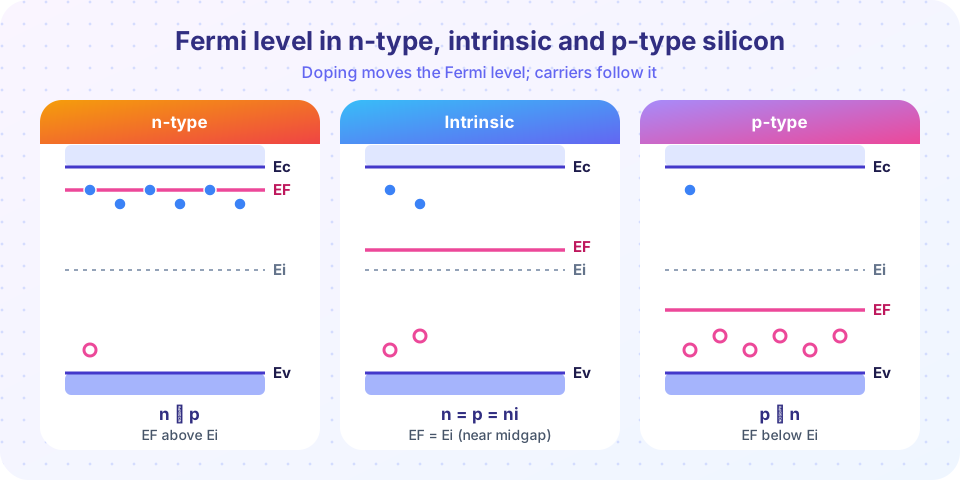
Given a crystal, a doping level and a temperature, how many electrons and holes does it have, and where is its Fermi level? This is the most frequently used calculation in the course. It needs only two ingredients: the law n·p = ni² from chapter 2, and the requirement that the crystal as a whole stays electrically neutral.
Once you can compute n, p and EF, you can draw the band diagram of any uniform piece of semiconductor, and in chapter 4 you will join two such pieces to form a junction.
What you will learn
- How to use charge neutrality to find n and p for any doping.
- The simple n-type and p-type results and the exact general formula.
- How to compute the Fermi level relative to Ei.
- The three temperature regimes: freeze-out, extrinsic and intrinsic.
Key terms
- Charge neutrality: the total positive charge equals the total negative charge: p + Nd⁺ = n + Na⁻.
- Majority carrier: the more abundant carrier (electrons in n-type, holes in p-type).
- Minority carrier: the less abundant one, with density ni²/majority.
- Ei: the intrinsic Fermi level, close to midgap.
Charge neutrality
A uniform crystal carries no net charge. Count the charges per cm³: positive are holes (p) and ionized donors (Nd⁺); negative are electrons (n) and ionized acceptors (Na⁻). So:
p + Nd⁺ = n + Na⁻
At room temperature all dopants are ionized, so Nd⁺ = Nd and Na⁻ = Na. Combine with the mass-action law p = ni²/n and solve for n:
n = (Nd − Na)/2 + √( ((Nd − Na)/2)² + ni² )
p = ni² / n
This is exact for complete ionization. It looks complicated, but in the common cases it collapses:
| Case | Condition | n | p |
|---|---|---|---|
| n-type | Nd − Na ≫ ni | Nd − Na | ni² / n |
| p-type | Na − Nd ≫ ni | ni² / p | Na − Nd |
| Intrinsic | Nd = Na = 0 | ni | ni |
Worked example
Silicon at 300 K (ni = 10¹⁰ cm⁻³) is doped with Nd = 10¹⁶ cm⁻³ phosphorus. Then n = 10¹⁶ cm⁻³ and p = (10¹⁰)² / 10¹⁶ = 10⁴ cm⁻³. The electrons outnumber the holes by a factor of 10¹², and the hole density is still large compared with zero, which matters for leakage current.
Now add boron Na = 3 × 10¹⁶ cm⁻³ to the same crystal. Net: Na − Nd = 2 × 10¹⁶ cm⁻³, so the crystal flips to p-type with p = 2 × 10¹⁶ cm⁻³ and n = 10²⁰ / (2 × 10¹⁶) = 5 × 10³ cm⁻³.
The Fermi level
From the carrier formulas of chapter 2 we can write the carrier densities relative to the intrinsic level Ei:
n = ni · exp((EF − Ei) / kT)
p = ni · exp((Ei − EF) / kT)
Take the logarithm and the position of EF follows:
EF − Ei = kT · ln(n / ni)       (n-type)
Ei − EF = kT · ln(p / ni)       (p-type)
For n = 10¹⁶ and ni = 10¹⁰: EF − Ei = 0.02585 eV × ln(10⁶) = 0.02585 × 13.82 ≈ 0.357 eV above Ei. With Ec − Ei ≈ 0.56 eV, EF is about 0.2 eV below Ec. Each factor of ten in doping moves EF by kT ln 10 = 59.5 mV, a number from the toolkit lesson that you will meet again.
A very useful consequence: the Fermi level is flat across a device in equilibrium. When two different regions touch, EF must be one line, and the bands bend to make that happen. That is the junction of chapter 4.
Three temperature regimes
For a given donor concentration, plot ln(n) against 1/T and you see three regions:
- Freeze-out (low T): kT is too small to ionize the donors, so n falls steeply as T decreases.
- Extrinsic (middle T): all donors are ionized and n ≈ Nd, flat. Devices live here.
- Intrinsic (high T): thermally generated pairs outnumber the donors; n ≈ ni(T) and rises steeply.
Where the extrinsic plateau ends depends on the doping: the heavier the doping, the hotter it must get before ni catches up with Nd. That is why power devices use high doping and wide-gap materials to stay controllable at high temperature.
Try it
The first simulation solves the charge-neutrality equation numerically at each temperature, including partial donor ionization (with the spin degeneracy factor 2), and shows all three regimes.
Press Run (or Ctrl + Enter) to see the result here.
Program input · what you'd type while the program runs
Type the answers before you press Run, one per line. Each time the program reads a line (with input()), it gets the next line from this box.
Press Run (or Ctrl + Enter) to see the result here.
Program input · what you'd type while the program runs
Type the answers before you press Run, one per line. Each time the program reads a line (with input()), it gets the next line from this box.
Common misconceptions
"In n-type silicon there are no holes." There are always holes: p = ni²/n. At Nd = 10¹⁶ cm⁻³ that is 10⁴ cm⁻³, small but not zero, and these minority carriers drive junction leakage.
"Heating n-type silicon adds more electrons proportionally." In the extrinsic range n stays at Nd. Only at high temperature does n rise, when the crystal turns intrinsic.
Check your understanding
Quick check · 6 questions
of 6 answered You scored / 6 · perfect!
-
1. Silicon with Nd = 10¹⁶ cm⁻³ at 300 K (ni = 10¹⁰ cm⁻³) has a hole density of
p = ni²/n = 10²⁰/10¹⁶ = 10⁴ cm⁻³. -
2. How far above Ei is EF when n = 10¹⁶ cm⁻³ and ni = 10¹⁰ cm⁻³ at 300 K?
EF − Ei = kT ln(n/ni) = 0.02585 × ln(10⁶) ≈ 0.357 eV. -
3. Which regime has n approximately equal to Nd?
In the extrinsic range every donor is ionized and thermally generated carriers are negligible. -
4. A silicon sample has Nd = 4 × 10¹⁶ cm⁻³ and Na = 1 × 10¹⁶ cm⁻³. The majority carrier density is
Net donors Nd − Na = 3 × 10¹⁶, so n ≈ 3 × 10¹⁶ cm⁻³. -
5. Why is the Fermi level constant across a device in equilibrium?
A gradient in EF would drive a net current. In equilibrium the current is zero, so EF is flat. -
6. Each decade increase of doping moves EF about
kT ln 10 = 25.85 mV × 2.303 ≈ 59.5 mV at 300 K.
Summary
- Charge neutrality plus n·p = ni² gives n = (Nd−Na)/2 + √(((Nd−Na)/2)² + ni²).
- In n-type: n ≈ Nd − Na and p = ni²/n; in p-type the reverse.
- EF − Ei = kT ln(n/ni); each decade of doping shifts EF by about 59.5 mV.
- Three regimes: freeze-out, extrinsic plateau (n = Nd) and intrinsic.
- EF is flat in equilibrium.
Track your progress
Create a free account to tick off lessons and pick up where you left off on any device.
of Semiconductor Devices lessons completed