


















Lesson 26 of 45 · Bipolar Junction Transistors
Chapter review: Bipolar Junction Transistors
Review the BJT chapter with a one-picture summary, a recap table of key equations and a ten-question quiz mixing structure, gain, regions and switching.
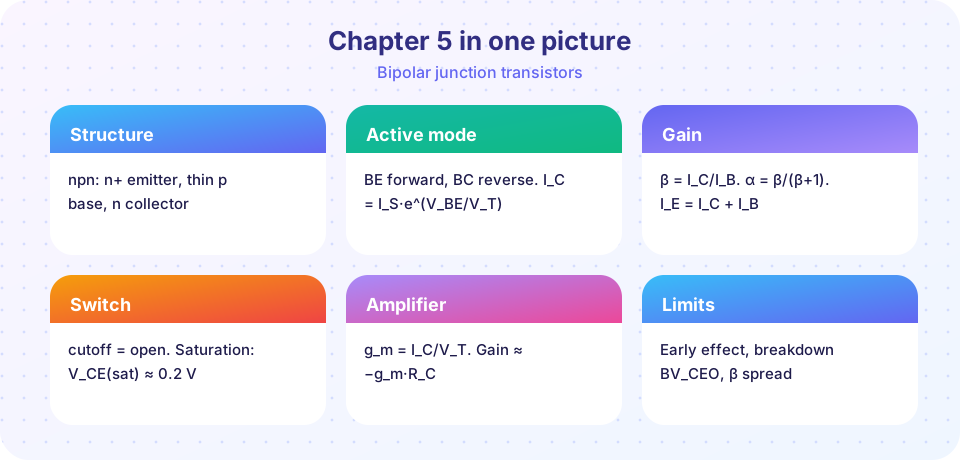
You have followed a transistor from its three doped layers to a working switch design. This review pulls the chapter into one page: a picture, a table of the equations worth memorizing, a short self-check calculator, and a ten-question quiz that mixes all three lessons.
The chapter in one picture
Recap table
| Topic | Key relation | Remember |
|---|---|---|
| Structure | n+ emitter, thin p base, n collector | emitter injects, base transports, collector collects |
| Exponential law | I_C = I_S e^(V_BE/V_T) |
59.5 mV per decade at 300 K |
| Saturation current | I_S = qA D_n n_i² / (N_B W_B) |
depends on the Gummel number N_B·W_B |
| Gain | β = I_C/I_B, α = β/(β+1) |
β varies with current and temperature |
| Transconductance | g_m = I_C/V_T |
38.7 mS per mA |
| Early effect | r_o ≈ V_A / I_C |
finite output resistance |
| Load line | V_CE = V_CC − I_C R_C |
Q-point at the intersection |
| Switch | forced β ≈ 10, V_CE(sat) ≈ 0.2 V | saturation stores charge |
Three habits will serve you well in every BJT problem. First, name the region before you pick an equation, because I_C = β·I_B is valid only in the forward-active region. Second, check the units of the exponent: it is always V divided by V_T, not millivolts divided by volts. Third, sanity-check the answer: V_CE of 0.2 V means saturation; a negative I_B means cutoff.
Try it
This calculator turns the relations of the chapter into numbers. Change the inputs and compare the output with your hand calculation; it is a formula tool, not a circuit simulator.
Press Run (or Ctrl + Enter) to see the result here.
Program input · what you'd type while the program runs
Type the answers before you press Run, one per line. Each time the program reads a line (with input()), it gets the next line from this box.
For a second check, find the base resistor of a switch for different logic levels. Predict the answers before you run the cell.
Press Run (or Ctrl + Enter) to see the result here.
Program input · what you'd type while the program runs
Type the answers before you press Run, one per line. Each time the program reads a line (with input()), it gets the next line from this box.
Check your understanding
Quick check · 10 questions
of 10 answered You scored / 10 · perfect!
-
1. Which statement about the emitter of an npn BJT is correct?
Heavy emitter doping gives high injection efficiency. -
2. At 300 K, how much must V_BE rise to multiply I_C by 100?
Two decades, each 59.5 mV, give about 119 mV. -
3. A BJT has α = 0.98. Its β is
β = α/(1−α) = 0.98/0.02 = 49. -
4. In the forward-active region the collector current is nearly independent of V_CE because
The injected carrier flow is set at the emitter junction; the reverse-biased collector junction sweeps them all away. -
5. A transistor carries 1 mA at 300 K. Its g_m is about
g_m = I_C / V_T = 1 mA / 25.85 mV. -
6. V_CC = 9 V, R_C = 1.8 kΩ, V_CE(sat) = 0.2 V. The saturation collector current is about
I_C(sat) = (9 − 0.2)/1.8 kΩ = 4.89 mA. -
7. Which region gives the BJT as a closed switch?
In saturation V_CE is about 0.2 V, like a closed switch. -
8. The Early voltage describes
Extended output curves meet at −V_A; a larger V_A means flatter curves and a higher r_o. -
9. Why is a forced beta (about 10) used in a switch?
Supplying generous base current guarantees saturation across β spread and temperature. -
10. Which of these is the main reason BJT switches are slow?
The stored charge must be removed on turn-off, giving a storage time.
Summary
- A BJT is a controlled current source: V_BE sets I_C exponentially, and β links I_B to I_C in the active region.
- Region names (cutoff, active, saturation) come from the junction biases; saturation gives a low, fixed V_CE.
- Design a switch with a forced beta, an R_C from V_CC and the load current, and an R_B from the logic voltage.
- Next you will meet the transistor that runs almost every digital chip: the MOSFET.
Track your progress
Create a free account to tick off lessons and pick up where you left off on any device.
of Semiconductor Devices lessons completed