


















Lesson 40 of 45 · Projects and Practice
Practice problem set: devices from BJT to solar cells
Twelve worked practice problems covering BJTs, MOS capacitors, MOSFETs, CMOS power, LEDs, lasers, photodiodes, solar cells, lithography and yield, with answers and a generator.
Reading about devices is not the same as solving problems with them. This lesson gives you twelve problems that touch every chapter of this half of the course, a checking script that prints all the answers, a random problem generator for unlimited practice, and a short quiz. Try each problem on paper first, then check yourself with the code.
What you will learn
- How to choose the right equation for a device by naming its region first.
- A four-step routine for numerical device problems.
- How to estimate quickly with orders of magnitude (60 mV/decade, 38.7 mS/mA, 1240/λ).
- How to check your own answers with a few lines of Python.
The routine
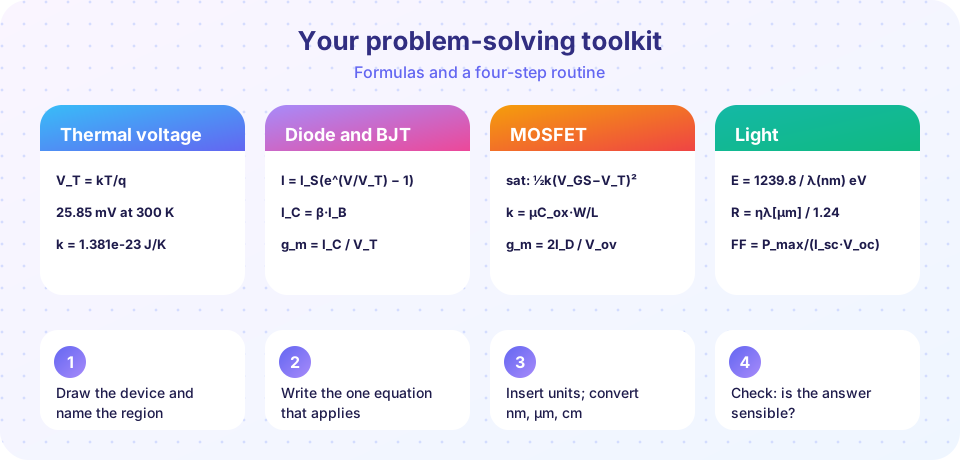
- Draw the device or circuit and mark every given voltage and current.
- Name the region (BJT: cutoff, active, saturation; MOSFET: cutoff, triode, saturation) and write the one equation for it.
- Insert numbers with units. Convert nm, µm and cm carefully; densities are usually in cm⁻³ and lengths in cm in the oxide formulas.
- Check. Is V_CE above 0.2 V in the active region? Is V_DS above V_ov in saturation? Is the order of magnitude plausible?
Constants you may use: V_T = 25.85 mV at 300 K, ε_Si = 11.7 ε₀, ε_ox = 3.9 ε₀, ε₀ = 8.854×10⁻¹⁴ F/cm, q = 1.602×10⁻¹⁹ C, n_i = 10¹⁰ cm⁻³ and hc = 1239.8 eV·nm.
The problems
Chapter 5: BJT
- A BJT has β = 150 and carries I_C = 3 mA. Find I_B, I_E, α and g_m.
- V_BE of a BJT in the active region rises from 0.62 V to 0.68 V. By what factor does I_C increase?
- A 12 V relay coil needs 50 mA. Design an npn switch driven from a 5 V logic output: choose a forced β of 10, V_BE = 0.7 V, and find the base current and R_B.
Chapter 6: MOS
- For a p-type MOS capacitor with N_A = 5×10¹⁶ cm⁻³ and a 5 nm oxide, find φ_F, W_max, C_ox and Q_dep/C_ox. If V_FB = −0.60 V, find V_T.
- An n-channel MOSFET has k'_n = 200 µA/V², W/L = 20, V_T = 0.4 V and λ = 0.1 V⁻¹. At V_GS = 1.2 V and V_DS = 1.5 V find k, the region, I_D (ignore λ in the first part), g_m and r_o.
- A MOSFET has n = 1.4 and V_T = 0.35 V. Find the subthreshold slope and the number of decades the current falls from V_GS = V_T to V_GS = 0.
- A CMOS gate has C_L = 2 fF, V_DD = 0.75 V, f = 2 GHz and α = 0.15. Find its dynamic power, and the power of 10⁸ such gates.
Chapter 7: optoelectronics
- A blue LED emits at 465 nm. Find the photon energy. For a 5 V supply, V_f = 3.1 V and 15 mA, find the series resistor.
- A laser diode has L = 400 µm, R₁ = R₂ = 0.32 and α_i = 12 cm⁻¹. Find the mirror loss and threshold gain.
- A photodiode with η = 0.9 sees 50 µW at 1550 nm. Find R, the photocurrent and the shot-noise current in a 100 MHz bandwidth.
- A solar cell has J_sc = 36 mA/cm², V_oc = 0.65 V and FF = 0.78 under 100 mW/cm². Find its efficiency.
Chapter 8: fabrication
- An ArF immersion scanner (193 nm, NA 1.35) with k₁ = 0.28 prints which half-pitch? A die of 0.8 cm² with D₀ = 0.25 cm⁻² has what Poisson yield?
Worked solutions
1. I_B = 3 mA/150 = 20 µA; I_E = 3 mA + 20 µA = 3.02 mA; α = 150/151 = 0.9934; g_m = 3 mA/25.85 mV = 116 mS.
2. ΔV_BE = 60 mV, so the factor is e^(0.060/0.02585) = e^2.321 = 10.2. (Indeed 60 mV is about one decade.)
3. I_C = 50 mA (set by the coil). Forced β = 10 gives I_B = 5 mA. R_B = (5 − 0.7)/5 mA = 860 Ω (use 820 Ω for more margin).
4. φ_F = 0.02585 ln(5×10¹⁶/10¹⁰) = 0.399 V, so 2φ_F = 0.797 V. W_max = √(2 × 1.036×10⁻¹² × 0.797/(1.602×10⁻¹⁹ × 5×10¹⁶)) = 1.44×10⁻⁵ cm = 0.144 µm. C_ox = 3.453×10⁻¹³/5×10⁻⁷ = 6.91×10⁻⁷ F/cm². Q_dep = qN_A W = 1.15×10⁻⁷ C/cm², so Q_dep/C_ox = 0.167 V. V_T = −0.60 + 0.797 + 0.167 = 0.364 V.
5. k = 200 µA/V² × 20 = 4 mA/V². V_ov = 0.8 V and V_DS = 1.5 V ≥ 0.8 V, so the device is in saturation. I_D = ½ × 4 mA/V² × 0.64 = 1.28 mA. g_m = kV_ov = 3.2 mS. r_o = 1/(λI_D) = 1/(0.1 × 1.28 mA) = 7.8 kΩ.
6. S = 1.4 × 59.5 = 83.3 mV/decade; 0.35/0.0833 = 4.2 decades.
7. P = 0.15 × 2×10⁻¹⁵ × 0.5625 × 2×10⁹ = 0.34 µW per gate; for 10⁸ gates, 34 W, which is why the activity factor of most gates is low and clocks are gated.
8. E = 1239.8/465 = 2.67 eV. R = (5 − 3.1)/0.015 = 127 Ω (use 130 Ω).
9. α_m = ln(1/0.1024)/(2 × 0.04 cm) = 2.279/0.08 = 28.5 cm⁻¹; g_th = 12 + 28.5 = 40.5 cm⁻¹.
10. R = 0.9 × 1.55/1.24 = 1.125 A/W; I_ph = 1.125 × 50 µW = 56.3 µA; i_n = √(2 × 1.602×10⁻¹⁹ × 56.3×10⁻⁶ × 10⁸) = 42 nA.
11. P_max = 36 × 0.65 × 0.78 = 18.3 mW/cm², so η = 18.3%.
12. R = 0.28 × 193/1.35 = 40 nm. Y = e^(−0.8 × 0.25) = e^(−0.2) = 81.9%.
Common misconceptions
"I can use I_C = βI_B in saturation." Only in the active region.
"V_T for the MOSFET is the same as V_T for thermal voltage." The symbol is shared; one is a gate threshold (volts, device-specific), the other is kT/q (25.85 mV at 300 K). Many texts use V_th or V_TH for the threshold to avoid confusion.
"Unit conversions are a detail." A factor of 10⁴ between µm and cm destroys an answer faster than any physics error.
Try it
This script computes every answer above so you can compare with your own work. Change a number and re-run to see how the answer responds.
Press Run (or Ctrl + Enter) to see the result here.
Program input · what you'd type while the program runs
Type the answers before you press Run, one per line. Each time the program reads a line (with input()), it gets the next line from this box.
For unlimited practice, this generator creates a new numeric variant of three problem types from a seed. Change the seed, solve on paper, then scroll down in the output for the answers.
Press Run (or Ctrl + Enter) to see the result here.
Program input · what you'd type while the program runs
Type the answers before you press Run, one per line. Each time the program reads a line (with input()), it gets the next line from this box.
Check your understanding
Quick check · 6 questions
of 6 answered You scored / 6 · perfect!
-
1. A BJT with β = 200 carries I_B = 25 µA in the active region. I_C is
I_C = βI_B = 200 × 25 µA = 5 mA. -
2. An n-channel MOSFET has V_T = 0.5 V and V_GS = 1.1 V. The saturation condition on V_DS is
Saturation needs V_DS ≥ V_GS − V_T = 0.6 V. -
3. For a 2.07 eV photon the wavelength is about
λ = 1239.8/2.07 = 599 nm. -
4. A cell with J_sc = 30 mA/cm², V_oc = 0.60 V and FF = 0.75 under 100 mW/cm² has efficiency
30 × 0.60 × 0.75 = 13.5 mW/cm², so 13.5%. -
5. A die of 2 cm² with D₀ = 0.1 cm⁻² has yield close to
Y = e^(−0.2) = 0.819. -
6. A subthreshold slope of 90 mV/decade and a V_T of 0.45 V mean the current at V_GS = 0 is below that at V_T by
0.45 V / 0.09 V per decade = 5 decades.
Summary
- Name the region, write one equation, insert units, and check plausibility.
- Orders of magnitude help: 60 mV/decade, 38.7 mS per mA, E = 1240/λ.
- Code is a convenient calculator for verifying answers and exploring variations.
Track your progress
Create a free account to tick off lessons and pick up where you left off on any device.
of Semiconductor Devices lessons completed