


















Lesson 31 of 45 · MOS Capacitors and MOSFETs
Chapter review: MOS Capacitors and MOSFETs
Review the MOS chapter with a one-picture summary, a recap table of threshold, current and CMOS equations, a quick calculator and a ten-question quiz.
This chapter took you from a simple capacitor with a silicon plate to the transistor that fills every chip. Use this page to consolidate: a picture, the equations that matter, a calculator for self-checking, and a ten-question quiz that spans the whole chapter.
The chapter in one picture
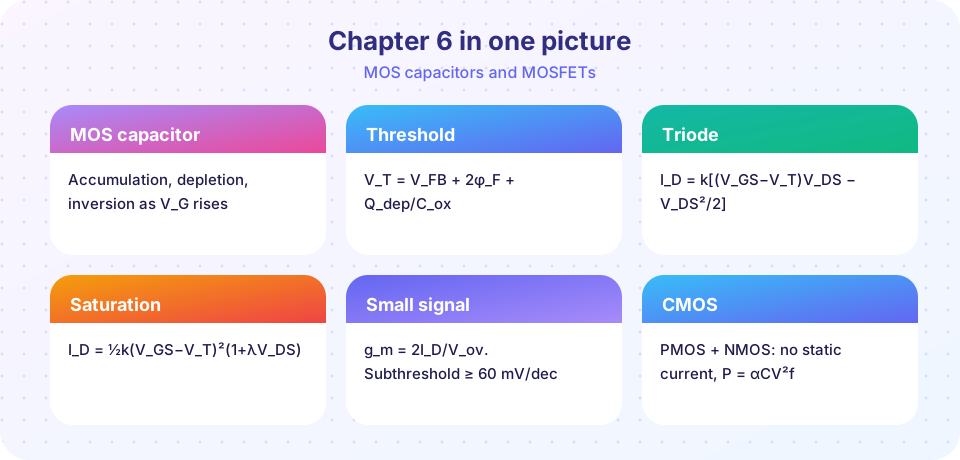
Recap table
| Idea | Equation | Typical number |
|---|---|---|
| Fermi potential | φ_F = V_T ln(N_A/n_i) |
0.417 V for 10¹⁷ cm⁻³ |
| Max depletion width | W = √(2ε_Si·2φ_F/(qN_A)) |
0.104 µm |
| Oxide capacitance | C_ox = ε_ox/t_ox |
0.345 µF/cm² for 10 nm |
| Threshold | V_T = V_FB + 2φ_F + Q_dep/C_ox |
0.34 V in the example |
| Triode | I_D = k[V_ov V_DS − V_DS²/2] |
R_on ≈ 1/(kV_ov) |
| Saturation | I_D = ½kV_ov²(1+λV_DS) |
0.93 mA at V_ov = 1.16 V |
| Transconductance | g_m = 2I_D/V_ov |
1.17 mS at 0.5 mA |
| Subthreshold | S = nV_T ln10 |
at least 59.5 mV/decade |
| CMOS dynamic power | P = αC_LV_DD²f |
0.19 µW per gate |
How to approach any MOSFET problem: first decide whether V_GS exceeds V_T (otherwise the device is off or in subthreshold), then compare V_DS with V_ov to choose triode or saturation, then use the matching equation. Always write the region and check the assumption after solving.
Try it
A one-stop calculator. Change the inputs and verify the table above against your hand calculation. It uses the square-law model, which is a first approximation of a real transistor.
Press Run (or Ctrl + Enter) to see the result here.
Program input · what you'd type while the program runs
Type the answers before you press Run, one per line. Each time the program reads a line (with input()), it gets the next line from this box.
For a second check, see how a thinner oxide improves the current for the same gate voltage (more gate control), and how it changes the subthreshold slope through n = 1 + C_dep/C_ox.
Press Run (or Ctrl + Enter) to see the result here.
Program input · what you'd type while the program runs
Type the answers before you press Run, one per line. Each time the program reads a line (with input()), it gets the next line from this box.
Check your understanding
Quick check · 10 questions
of 10 answered You scored / 10 · perfect!
-
1. What is the main role of the gate oxide?
The oxide insulates the gate while transmitting its electric field into the semiconductor. -
2. Strong inversion in a p-type MOS capacitor begins when the surface potential is
At ψ_s = 2φ_F the surface electron density equals the bulk hole density. -
3. Doubling C_ox (halving the oxide thickness) while keeping other parameters fixed does what to k = µC_oxW/L?
k is proportional to C_ox. -
4. An n-channel MOSFET has V_T = 0.4 V, V_GS = 1.0 V and V_DS = 0.3 V. Which region is it in?
V_ov = 0.6 V and V_DS = 0.3 V < V_ov, so the channel is not pinched off. -
5. With k = 2 mA/V² and V_ov = 0.5 V in saturation (λ = 0), g_m is
g_m = k V_ov = 2 mA/V² × 0.5 V = 1 mS. -
6. Which statement about subthreshold current is correct?
It is a diffusion current that changes by one decade per S mV of gate voltage. -
7. Why does a CMOS inverter dissipate almost no static power?
There is no DC path from V_DD to ground. -
8. Lowering V_DD from 1.2 V to 0.6 V changes P = αCV²f by
Power scales as V_DD². -
9. The body effect raises V_T when
A reverse-biased source-body junction widens the depletion region, increasing Q_dep and V_T. -
10. A MOSFET in the saturation region is the right choice for
In saturation the transistor is a voltage-controlled current source, the amplifier mode. A digital switch uses cutoff and triode.
Summary
- A MOS capacitor passes through accumulation, depletion and inversion; V_T = V_FB + 2φ_F + Q_dep/C_ox.
- I_D follows the triode or saturation equation depending on V_DS against V_ov.
- g_m = 2I_D/V_ov and r_o = 1/(λI_D) describe the small-signal transistor; subthreshold current sets leakage.
- CMOS pairs PMOS and NMOS so that only dynamic power P = αCV²f matters.
Track your progress
Create a free account to tick off lessons and pick up where you left off on any device.
of Semiconductor Devices lessons completed