


















Lesson 16 of 45 · Doping and Conduction
Chapter 3 Review: Doping and Conduction
Review chapter 3: donors and acceptors, carrier densities from charge neutrality, the Fermi level, drift, diffusion and the Einstein relation, with a ten-question quiz.
You can now take a piece of silicon, specify its doping, and predict its carrier densities, Fermi level, conductivity and diffusion behavior. That toolbox is exactly what the PN junction needs: two such pieces placed side by side.
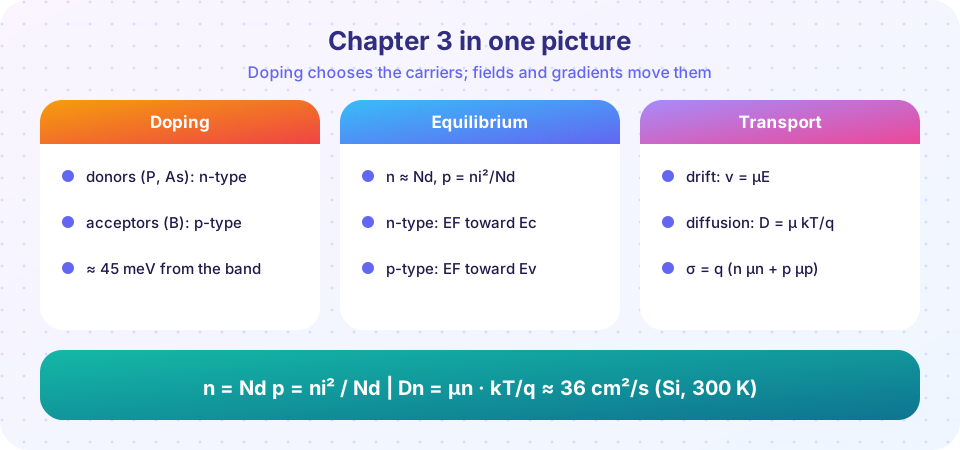
Recap table
| Lesson | Key idea | Formula |
|---|---|---|
| Donors and acceptors | Group V donates, group III accepts; levels about 45 meV from a band | E_ion = 13.6 eV (m*/m₀)/εr² |
| Carriers at equilibrium | Charge neutrality plus mass action | n ≈ Nd − Na, p = ni²/n, EF − Ei = kT ln(n/ni) |
| Drift and diffusion | Field-driven and gradient-driven currents | J = q(nμn + pμp)E + qDn dn/dx; D = μkT/q |
Try it
The first example practices the whole chapter in one calculation: from doping to resistivity, minority density and Fermi level.
Press Run (or Ctrl + Enter) to see the result here.
Program input · what you'd type while the program runs
Type the answers before you press Run, one per line. Each time the program reads a line (with input()), it gets the next line from this box.
Press Run (or Ctrl + Enter) to see the console output here.
No output.
Check your understanding
Quick check · 10 questions
of 10 answered You scored / 10 · perfect!
-
1. Which atom is a donor in silicon?
Phosphorus has five valence electrons and donates one. -
2. In n-type silicon with n = 10¹⁷ cm⁻³ and ni = 10¹⁰ cm⁻³, the hole density is
p = ni²/n = 10²⁰/10¹⁷ = 10³ cm⁻³. -
3. Charge neutrality for a uniform crystal reads
The total of positive charges (holes and ionized donors) equals negative charges (electrons and ionized acceptors). -
4. As n-type doping rises from 10¹⁶ to 10¹⁷ cm⁻³, EF moves
A factor of ten in n shifts EF − Ei by kT ln 10 = 59.5 mV toward Ec. -
5. Which describes diffusion?
Random motion produces a net flux down a concentration gradient. -
6. The Einstein relation says
At 300 K, D (cm²/s) ≈ μ (cm²/V·s) × 0.0259. -
7. As doping rises, mobility in silicon generally
Ionized impurity scattering grows with doping. -
8. In the extrinsic regime of n-type silicon at room temperature, n is approximately
All donors are ionized and thermal generation is negligible. -
9. Why does p-type silicon of the same doping have a higher resistivity than n-type?
ρ = 1/(q p μp); μp is about a third of μn. -
10. With Dn = 36 cm²/s and τ = 1 µs, the diffusion length is about
L = √(Dτ) = 6 × 10⁻³ cm = 60 µm.
Summary
- Doping chooses the majority carrier; n·p = ni² fixes the minority carrier.
- EF follows the majority carrier's band, one decade of doping per 59.5 mV.
- Drift current ∝ field, diffusion current ∝ gradient, linked by D = μkT/q.
- These are the ingredients of the PN junction in chapter 4.
Track your progress
Create a free account to tick off lessons and pick up where you left off on any device.
of Semiconductor Devices lessons completed