


















Lesson 4 of 45 · Getting Started
Your Toolkit: Units, Constants and Orders of Magnitude
Learn the units and constants used all course: the electronvolt, thermal voltage kT/q, cm⁻³ concentrations, and how to sanity-check semiconductor numbers.
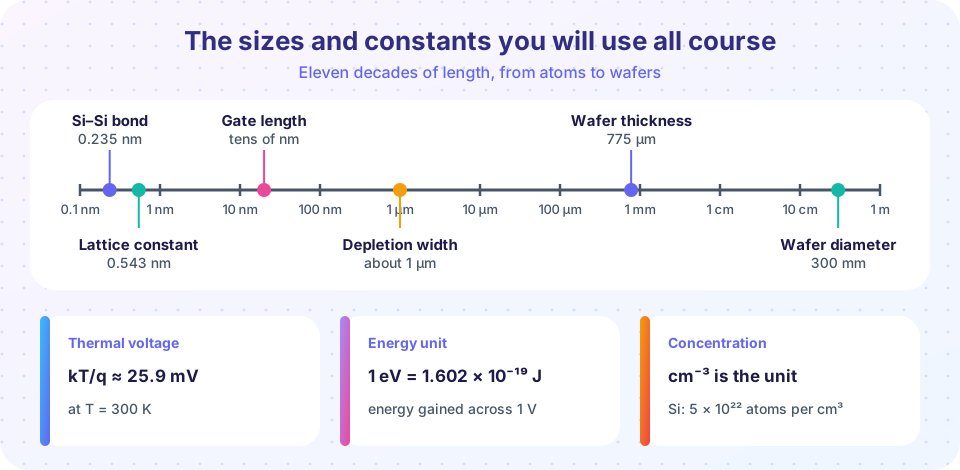
Semiconductor physics mixes numbers that span many orders of magnitude: atoms per cubic centimeter near 10²², carriers per cubic centimeter from 10⁶ to 10²⁰, distances from 0.5 nanometers to 300 millimeters. People who work comfortably in this field keep a small set of units and constants in their heads, and they check every answer for plausibility. This lesson gives you that set.
You will also pick up a habit that saves hours of confusion: write the unit on every number, and convert at the start of a calculation instead of the end.
What you will learn
- The electronvolt and how to convert between eV and joules.
- The thermal voltage kT/q and why it appears everywhere.
- The standard units for concentration, mobility and resistivity.
- A quick method to sanity-check results by orders of magnitude.
Key terms
- Electronvolt (eV): the energy an electron gains crossing 1 V; 1 eV = 1.602 × 10⁻¹⁹ J.
- Boltzmann constant k: 1.380649 × 10⁻²³ J/K, or 8.617 × 10⁻⁵ eV/K.
- Thermal voltage V_T = kT/q: about 25.9 mV at 300 K.
- Elementary charge q: 1.602176634 × 10⁻¹⁹ C.
Energy in electronvolts
The joule is awkward for one electron: the energies are about 10⁻¹⁹ J. The electronvolt fixes that. Because an electron's charge is q, moving it across a potential difference of V volts changes its energy by qV. So:
E (in joules) = E (in eV) × 1.602e-19
The band gap of silicon is 1.12 eV at room temperature, of germanium 0.66 eV and of gallium arsenide 1.42 eV. Photons carry energy too: a photon with wavelength λ has energy E = hc/λ, which in convenient units is E (eV) ≈ 1.2398 / λ (µm). A silicon band gap of 1.12 eV therefore corresponds to λ ≈ 1.1 µm, in the near infrared.
The thermal voltage
At temperature T, a typical thermal energy is kT. Divide by q to turn it into a voltage:
V_T = kT / q = (1.380649e-23 × 300) / 1.602177e-19 ≈ 0.02585 V
So at 300 K, V_T ≈ 25.9 mV. Many people use 26 mV or 25 mV as shorthand. It shows up in the diode equation I = I_s (exp(V/V_T) − 1), in the spread of carrier energies, and in the ratio of diffusion to mobility. An important consequence: increasing the voltage across a junction by V_T × ln 10 ≈ 59.5 mV at 300 K multiplies an exponential current by 10. Hold on to "about 60 mV per decade"; it will return in chapters 4 and 6.
Concentration, mobility and resistivity
Concentrations are volume densities. Semiconductor texts use cm⁻³ rather than m⁻³:
1 cm⁻³ = 1e6 m⁻³
Silicon has about 5 × 10²² atoms per cm³. That number comes from the crystal: the cubic unit cell has edge a = 0.5431 nm and contains 8 atoms, so the density is 8 / a³. A typical doping of 10¹⁶ cm⁻³ means one dopant atom for every 5 million silicon atoms, a small impurity with a big effect.
| Quantity | Common unit | SI unit | Conversion |
|---|---|---|---|
| Concentration | cm⁻³ | m⁻³ | × 10⁶ |
| Mobility | cm²/(V·s) | m²/(V·s) | × 10⁻⁴ |
| Resistivity | Ω·cm | Ω·m | × 10⁻² |
| Electric field | V/cm | V/m | × 10² |
| Length | µm, nm | m | × 10⁻⁶, 10⁻⁹ |
Mixing units is the most common error in this field. A good practice: decide on cm-based units (cm, cm⁻³, cm²/V·s, V/cm) and stay there for the whole calculation.
Sanity checks by orders of magnitude
Before trusting a number, ask whether it is plausible:
- A carrier density above the atom density (5 × 10²² cm⁻³) is impossible.
- A mobility of silicon should be hundreds to about a thousand cm²/(V·s) for lightly doped material.
- A depletion width of a few micrometers is plausible; of a few meters is not.
- A forward voltage of a silicon diode near 0.6 to 0.7 V is plausible; 6 V is not.
Another habit: use scientific notation with the exponent worked separately. Multiply the coefficients, add the exponents, then check the sign of the exponent against the story.
Try it
The first example computes the thermal voltage over a temperature range and the atom density of silicon. It is a plain calculation with exact constants.
Press Run (or Ctrl + Enter) to see the result here.
Program input · what you'd type while the program runs
Type the answers before you press Run, one per line. Each time the program reads a line (with input()), it gets the next line from this box.
Press Run (or Ctrl + Enter) to see the console output here.
No output.
Common misconceptions
"kT/q is a fixed 26 mV." It is 25.85 mV only at 300 K. It scales with T, so 330 K gives about 28.4 mV.
"cm⁻³ and m⁻³ are interchangeable." They differ by a factor of one million. A wrong factor here ruins a whole calculation.
Check your understanding
Quick check · 5 questions
of 5 answered You scored / 5 · perfect!
-
1. 1 eV equals about
The electronvolt is the energy of one elementary charge across 1 V, so 1 eV = 1.602 × 10⁻¹⁹ J. -
2. The thermal voltage kT/q at 300 K is closest to
kT/q = 1.38 × 10⁻²³ × 300 / 1.602 × 10⁻¹⁹ ≈ 0.0259 V. -
3. How many atoms per cm³ does a silicon crystal have (approximately)?
Eight atoms per cubic cell of edge 0.5431 nm gives about 5 × 10²² cm⁻³. -
4. A carrier density of 10²⁴ cm⁻³ in silicon is
Even the heaviest doping stays below about 10²¹ cm⁻³, far under the 5 × 10²² atoms per cm³. -
5. Converting 1400 cm²/(V·s) to SI units gives
Multiply by 10⁻⁴: 1400 × 10⁻⁴ = 0.14 m²/(V·s).
Summary
- 1 eV = 1.602 × 10⁻¹⁹ J; the silicon band gap is 1.12 eV.
- V_T = kT/q ≈ 25.9 mV at 300 K and scales with T; about 60 mV changes an exponential tenfold.
- Work in cm-based units and convert once; concentration cm⁻³ × 10⁶ = m⁻³.
- Always sanity-check against atom density and typical device sizes.
Track your progress
Create a free account to tick off lessons and pick up where you left off on any device.
of Semiconductor Devices lessons completed