


















Lesson 32 of 45 · Optoelectronic Devices
Chapter overview: Optoelectronic Devices
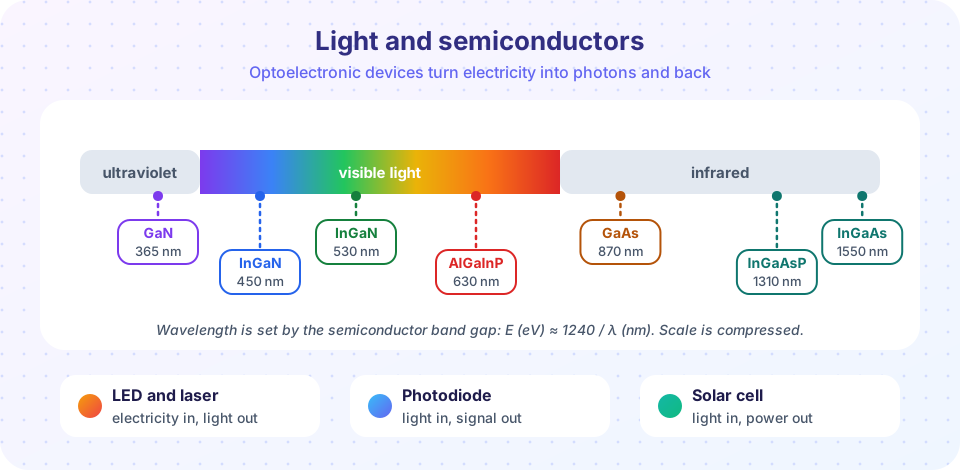
A map of the optoelectronics chapter: how band gaps set the color of LEDs and lasers, and how photodiodes and solar cells turn light back into current.
Light and electrons are interchangeable currency in a semiconductor. Feed a forward-biased junction with current and it can emit photons; shine photons on a junction and it produces current. The first gives us LEDs and laser diodes, the second photodiodes, image sensors and solar cells. The same physics (energy bands, pn junctions, recombination) covers all of them, and the band gap is the knob that decides which color a device emits or sees.
What you will learn in this chapter
- The photon-energy relation
E (eV) = 1239.8 / λ (nm)and why direct band-gap materials make good emitters. - How an LED converts current to light, what limits its efficiency and how white light is made.
- How a laser diode adds stimulated emission and an optical cavity to an LED structure.
- How photodiodes detect light and how to compute responsivity.
- How a solar cell works, how to read its I-V curve, and what limits its efficiency.
Key terms
Photon: a quantum of light with energy hν = hc/λ.
Direct band gap: a semiconductor in which the conduction-band minimum and valence-band maximum occur at the same crystal momentum, so electrons can recombine and emit a photon directly.
Radiative recombination: an electron falls into a hole and emits a photon.
Responsivity (R): photocurrent per unit optical power, in A/W.
Fill factor (FF): the ratio of maximum power to I_sc × V_oc for a solar cell.
Three ways light and junctions interact
Photons and carriers can interact in three basic ways, and every optoelectronic device exploits one of them.
- Absorption. A photon with energy above the band gap lifts an electron from the valence to the conduction band, creating an electron-hole pair. This is how photodiodes and solar cells work.
- Spontaneous emission. An excited electron falls into a hole at random and emits a photon in a random direction. This is how an LED works.
- Stimulated emission. An incoming photon triggers an electron to fall and emit a second photon identical to the first. With a mirror cavity and enough gain it produces a laser.
Why do some materials glow and others do not? Silicon has an indirect gap: the electron needs a vibration of the crystal lattice (a phonon) to change momentum before recombining, which makes radiative recombination slow, so silicon recombines mostly into heat. GaAs and GaN have direct gaps and emit light efficiently. That is why LEDs and lasers are made from compound semiconductors, while silicon dominates logic and, because absorption works well with thick layers, solar cells.
Light meets silicon
Band gap sets the color
Direct versus indirect
Emission types
Detection and power
Lessons in this chapter
- LEDs and laser diodes: direct gaps, efficiency, white LEDs, stimulated emission, thresholds.
- Photodiodes and solar cells: absorption, responsivity, the illuminated diode equation and efficiency limits.
- Chapter review: a recap and a ten-question quiz.
Try it
Pick a band gap and the widget converts it to a wavelength and a color. It is a calculator for E = hc/λ, using the nearest approximate visible color.
Check your understanding
Quick check · 3 questions
of 3 answered You scored / 3 · perfect!
-
1. Which relation links a photon's energy and its wavelength?
Photon energy equals Planck's constant times the speed of light divided by the wavelength. -
2. Why is silicon a poor light emitter?
Recombination in an indirect-gap material needs a phonon to conserve momentum, making radiative recombination slow. -
3. A photodiode absorbs light by
A photon with E ≥ E_g lifts an electron to the conduction band, generating a pair that the junction field separates.
Summary
- Optoelectronic devices convert between electrical and optical energy at semiconductor junctions.
- Absorption, spontaneous emission and stimulated emission are the three basic processes.
- The band gap sets the wavelength; direct-gap compound semiconductors dominate light emission.
- LEDs, lasers, photodiodes and solar cells share the same junction physics with different design goals.
Next: LEDs and laser diodes
Track your progress
Create a free account to tick off lessons and pick up where you left off on any device.
of Semiconductor Devices lessons completed