


















Lesson 1 of 45 · Getting Started
Course Map: How This Semiconductor Devices Course Works
Meet the nine-chapter plan for semiconductor devices: who the course is for, what you need first, how to study it, and what each chapter adds.
Every phone, car, solar panel and LED lamp contains semiconductor devices. They are tiny pieces of crystal, a fraction of a millimeter across, that control electric current in ways wires and resistors cannot. This course explains how they work, from the atoms in the crystal up to the transistors in a processor.
You do not need to memorize a catalog of part numbers. You will build one chain of ideas: a crystal has energy bands, doping adds carriers, two doped regions form a junction, and junctions make diodes, transistors, LEDs and solar cells. Once the chain is clear, each new device is a small step.
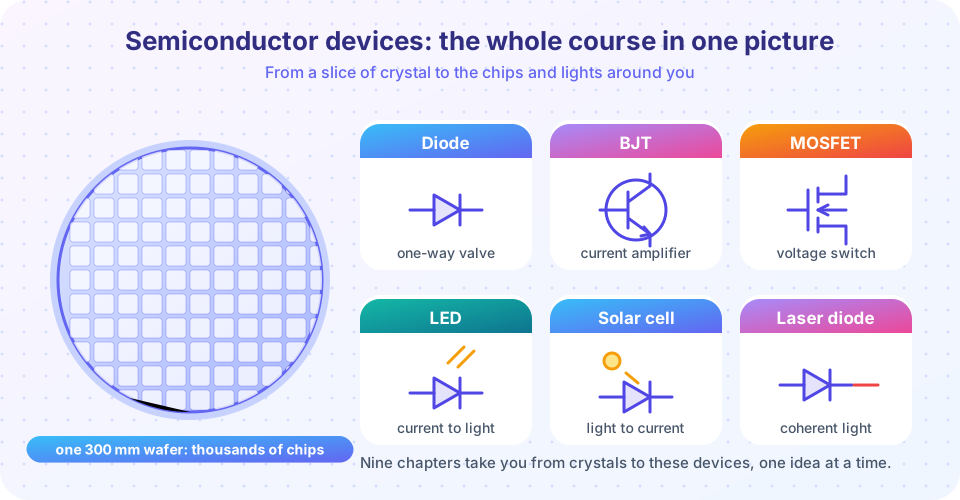
What you will learn
- Who this course is for and what background helps.
- The nine-chapter route from crystals to devices to fabrication.
- A study routine that mixes reading, calculation and simulation.
- How the interactive examples on each page are meant to be used.
Who this course is for
The course suits three groups: upper-secondary and first-year university students in physics or electrical engineering, hobbyists who want to know why a transistor works rather than only how to wire one, and software people who are curious about the hardware underneath their code.
You should be comfortable with basic algebra, exponentials and logarithms, and simple circuits (voltage, current, resistance, Ohm's law). Calculus appears in small doses, mostly to describe how a quantity changes with position. Quantum mechanics is introduced as a short story with pictures; you will not need to solve any Schrödinger equations.
Key terms
- Semiconductor: a material whose ability to conduct electricity lies between a metal and an insulator and can be tuned.
- Device: a piece of engineered semiconductor that does a job, such as switching or emitting light.
- Carrier: a mobile charge (an electron or a hole) that carries current.
- Junction: the boundary where two differently doped regions meet.
The nine chapters
Foundations
- Getting started
- Crystals and bands
- Doping
The junction
- The PN junction
Transistors
- BJTs
- MOSFETs
Light and making chips
- Optoelectronics
- Fabrication
Practice
- Projects
Chapters 1 to 4 are the foundation and are written in this slice of the course. Chapters 5 to 9 apply that foundation to specific devices. If you only want to understand transistors, you still need chapters 2 to 4: the transistor is two junctions in one crystal.
How to study
- Read once for the picture. Look at each illustration and the key terms before the details.
- Run every example. The code boxes are real simulations. Change a number and predict what happens before you press Run.
- Do the quiz without looking back. The explanations afterwards teach as much as the questions.
- Finish with the chapter review. It collects the chapter's equations and numbers on one page.
Keep a notebook with a running list of constants (the electron charge, Boltzmann's constant, the silicon band gap). You will use the same dozen numbers again and again.
A first look: the diode curve
Before any theory, here is the behavior that makes a diode useful. This is a calculator that applies the ideal diode equation, which you will derive in chapter 4. Notice how the current is almost zero for negative voltage and then explodes for positive voltage.
Try it
Press Run (or Ctrl + Enter) to see the result here.
Program input · what you'd type while the program runs
Type the answers before you press Run, one per line. Each time the program reads a line (with input()), it gets the next line from this box.
Common misconceptions
"Semiconductors are just bad conductors." They are not simply in between. Their conduction can be changed by many orders of magnitude with doping, light, temperature or an electric field. That tunability is the whole point.
"Transistors are complicated, so I should memorize equations." Almost every equation in this course comes from one picture: carriers moving by drift and diffusion in a crystal with energy bands.
Check your understanding
Quick check · 4 questions
of 4 answered You scored / 4 · perfect!
-
1. Which chapter introduces the PN junction?
Chapter 4 covers the PN junction. Chapters 2 and 3 prepare the crystal, bands and doping that it needs. -
2. Why do you need chapters 2 to 4 before studying transistors?
A bipolar transistor is two PN junctions back to back, and a MOSFET relies on the same carriers and band ideas. -
3. What does the diode curve in the first example show?
The exponential in the ideal diode equation is tiny for negative voltage and grows very fast for positive voltage. -
4. What is the best way to use the code examples?
Predicting first and then comparing turns the simulation into a test of your understanding.
Summary
- The course is a single chain: crystal, bands, doping, junction, devices, fabrication.
- You need algebra, exponentials and basic circuits; no advanced quantum mechanics.
- Examples are real calculations and simulations: predict, change, compare.
- Chapters 5 to 9 reuse the ideas of chapters 2 to 4 over and over.
Next: Why Semiconductors? Conductors, Insulators and In Between
Track your progress
Create a free account to tick off lessons and pick up where you left off on any device.
of Semiconductor Devices lessons completed