


















Lesson 44 of 45 · Projects and Practice
Cheat sheet: semiconductor devices on one page
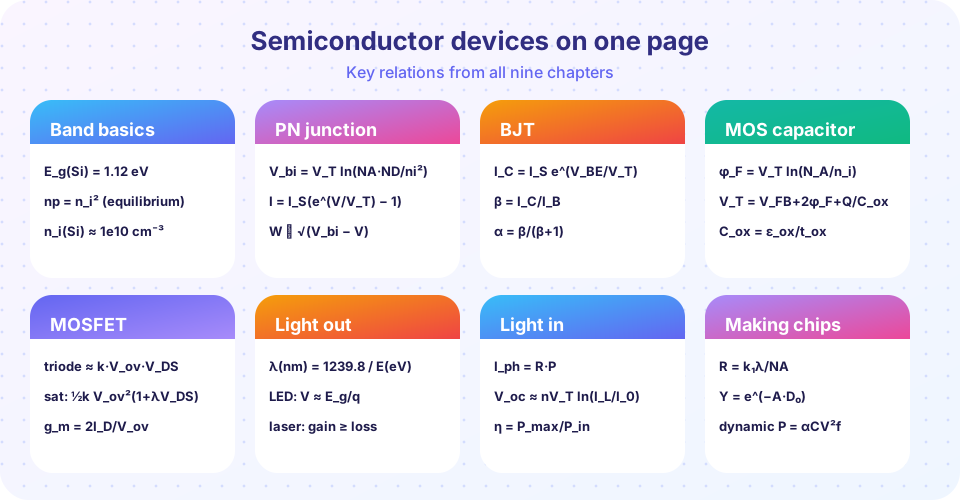
A one-page recap of semiconductor device equations and constants: bands, pn junctions, BJTs, MOS capacitors, MOSFETs, LEDs, lasers, solar cells and chip fabrication.
Keep this page open while you solve problems. It lists the constants, the equation for each device and the rules of thumb that save the most time. Equations are written in plain text; every symbol is defined in the glossary.
What you will learn
- Which equation belongs to which device and region.
- The constants and orders of magnitude worth memorizing.
- A routine for deciding where to start with any device problem.
Constants (300 K)
| Quantity | Value |
|---|---|
| Thermal voltage V_T = kT/q | 25.85 mV |
| One decade of exponential current | V_T ln 10 = 59.5 mV |
| Electron charge q | 1.602×10⁻¹⁹ C |
| Boltzmann constant k | 1.381×10⁻²³ J/K = 8.617×10⁻⁵ eV/K |
| hc | 1239.8 eV·nm |
| n_i of silicon | ≈ 10¹⁰ cm⁻³ |
| Band gaps | Si 1.12 eV, Ge 0.66 eV, GaAs 1.42 eV, GaN 3.4 eV |
| Permittivities | ε_Si = 11.7 ε₀, ε_ox = 3.9 ε₀, ε₀ = 8.854×10⁻¹⁴ F/cm |
| Silicon V_BE or diode turn-on | about 0.6 to 0.7 V |
Equations by device
Carriers. n·p = n_i²; with N_D ≫ n_i: n ≈ N_D, p ≈ n_i²/N_D. Drift J = qµnE; diffusion J = qD dn/dx; Einstein D = µkT/q.
PN junction. V_bi = V_T ln(N_A N_D / n_i²); depletion width W = √(2ε(V_bi − V)/q · (1/N_A + 1/N_D)); diode I = I_S(e^(V/nV_T) − 1).
BJT (npn, active). I_C = I_S e^(V_BE/V_T)(1 + V_CE/V_A); I_E = I_C + I_B; β = I_C/I_B; α = β/(β+1); g_m = I_C/V_T; r_o ≈ V_A/I_C. Saturation: V_CE ≈ 0.2 V. Switch: forced β ≈ 10.
MOS capacitor (p-type). φ_F = V_T ln(N_A/n_i); W_max = √(4ε_Si φ_F/(qN_A)); C_ox = ε_ox/t_ox; V_T = V_FB + 2φ_F + Q_dep/C_ox.
MOSFET (n-channel). Triode I_D = k[V_ov V_DS − V_DS²/2], saturation I_D = ½kV_ov²(1+λV_DS), with k = µC_ox W/L and V_ov = V_GS − V_T. g_m = kV_ov = 2I_D/V_ov; r_o = 1/(λI_D). Subthreshold S = nV_T ln10 ≥ 59.5 mV/dec.
CMOS. V_M = V_DD/2 for matched devices; P_dyn = αC V_DD² f.
Light out. λ(nm) = 1239.8/E(eV); LED R = (V_s − V_f)/I; laser g_th = α_i + (1/2L)ln(1/R₁R₂), P = η_d(hν/q)(I − I_th).
Light in. R = ηλ[µm]/1.24 A/W; solar I = I_L − I_0(e^(V/nV_T) − 1), V_oc = nV_T ln(I_L/I_0 + 1), FF = P_max/(I_scV_oc), η = P_max/P_in.
Making chips. Oxide x² + Ax = B(t+τ); lithography R = k₁λ/NA; implant N_p ≈ 0.4Φ/ΔR_p; yield Y = e^(−A·D₀); Dennard: dimensions and V × 1/κ.
Rules of thumb
- 60 mV per decade. A diode or BJT current changes tenfold per 60 mV; 18 mV doubles it.
- 38.7 mS per mA. A BJT's g_m at room temperature.
- E = 1240/λ. Energies in eV, wavelengths in nm.
- 0.2 V and 0.7 V. V_CE(sat) and V_BE of a silicon BJT.
- V_ov decides. For a MOSFET, compare V_DS with V_GS − V_T before choosing triode or saturation.
- V_DD² in power. Halve the supply, quarter the dynamic power.
Where to start with a problem
- Identify the device and write the region explicitly.
- Write the one equation for that region.
- Convert all lengths and densities to a consistent unit system (cm and cm⁻³ for the oxide and depletion formulas).
- Solve, then check the assumed region against the answer.
Try it
First, an interactive "60 mV rule" explorer: drag the slider for a voltage change and see the current multiplier for a diode or BJT.
Second, a calculator library with every one-line formula from this page. Copy it, edit the inputs and use it as your personal device calculator.
Press Run (or Ctrl + Enter) to see the result here.
Program input · what you'd type while the program runs
Type the answers before you press Run, one per line. Each time the program reads a line (with input()), it gets the next line from this box.
Check your understanding
Quick check · 4 questions
of 4 answered You scored / 4 · perfect!
-
1. A diode voltage rises by 18 mV at 300 K. The current changes by about
e^(0.018/0.02585) = 2.0; V_T ln 2 = 17.9 mV. -
2. Which pair shows the typical silicon BJT V_BE(on) and V_CE(sat)?
V_BE ≈ 0.7 V when conducting; V_CE(sat) ≈ 0.2 V. -
3. For a MOSFET with V_GS − V_T = 0.5 V and V_DS = 0.3 V the region is
V_DS < V_ov, so the channel is not pinched off. -
4. The energy of a 1550 nm photon is about
1239.8/1550 = 0.80 eV.
Summary
- Memorize the constants (V_T = 25.85 mV, 59.5 mV/decade, hc = 1239.8 eV·nm) and the region conditions.
- Every device has one main equation: exponential for diodes and BJTs, square-law for MOSFETs, E = hc/λ for light.
- Name the region, convert units, and check the answer.
Next: Further study
Track your progress
Create a free account to tick off lessons and pick up where you left off on any device.
of Semiconductor Devices lessons completed