


















Lesson 2 of 46 · Getting Started
What is public health? The population as the patient
Learn what public health is, how it differs from clinical medicine, its three core functions, and why moving a whole population a little can beat treating the sickest.
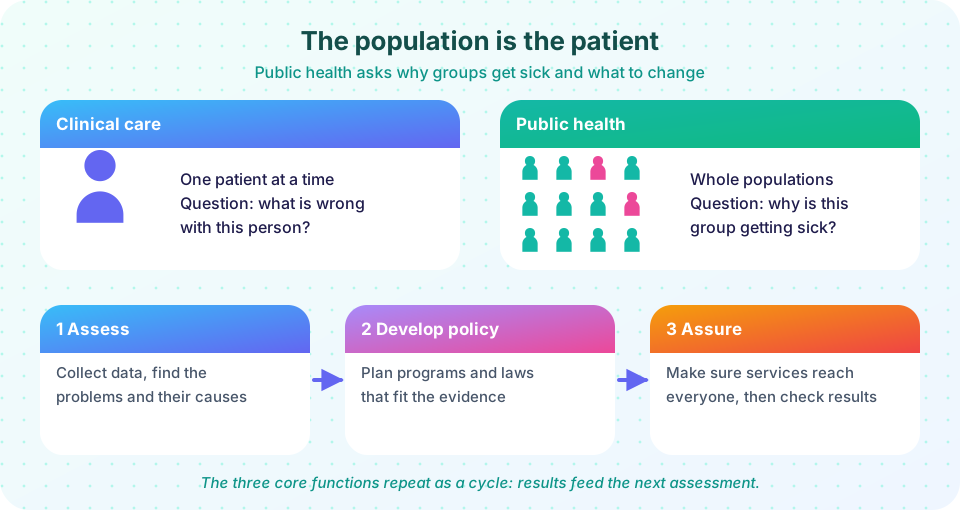
When you visit a doctor, the doctor asks: what is wrong with you? A public health professional asks a different question: why is this group of people getting sick, and what could we change so that fewer of them do? The first approach treats a person. The second treats a population. Both save lives, but they use different tools, and most of the improvement in human life expectancy over the last two centuries came from the second.
This lesson defines public health, explains its core functions, and introduces one of the most important ideas in the field: a small change across a whole population can prevent more disease than a large change in a few high-risk people.
What you will learn
- A standard definition of public health and how it differs from clinical care.
- The three core functions and how the ten essential services fit under them.
- Why the population approach and the high-risk approach are complementary.
- Examples of public health achievements and who delivers them.
Key terms
- Public health: the science and art of preventing disease, prolonging life and promoting health through the organized efforts of society (a classic definition from C.-E. A. Winslow, 1920).
- Population health: the health outcomes of a defined group, and how they are distributed within it.
- Epidemiology: the study of the distribution and determinants of health states in populations, and its application to control health problems.
- Surveillance: the ongoing, systematic collection and analysis of health data so that action can follow.
- Health equity: the absence of unfair, avoidable differences in health between groups.
A working definition
Winslow's definition has stood for a century because it names the three things that make public health distinctive. It aims at prevention (stopping problems before they start), it targets health, not only disease, and it relies on organized effort: governments, health agencies, schools, employers, community groups and researchers acting together. A single doctor cannot make a city's water safe. A health department, an engineer, a law and an inspector can.
The World Health Organization's constitution (1948) defines health itself as a state of complete physical, mental and social well-being and not merely the absence of disease or infirmity. Many scholars criticize the word "complete" as unattainable, but the broad idea has shaped public health ever since: health has social and mental dimensions, and the aim is well-being, not just survival.
Clinical care and public health compared
| Clinical medicine | Public health | |
|---|---|---|
| Unit of concern | The individual patient | A defined population |
| Typical question | What is wrong with this person? | Why is this group getting sick? |
| Main tools | Diagnosis, drugs, surgery | Surveillance, vaccines, laws, education, sanitation |
| Timing | Usually after symptoms appear | Usually before disease occurs |
| Success looks like | A patient who recovers | A disease that no longer occurs |
The two are partners, not rivals. A clinician who diagnoses measles contributes to public health by reporting the case. A health department that controls an outbreak makes the clinician's job easier. But the mindset differs: a clinician has a patient in the room, while a public health worker often cannot name the people who benefited, because the people who were not infected never show up in any record. This is public health's built-in paradox: success is invisible.
The three core functions
In 1988 the US Institute of Medicine's report The Future of Public Health described three core functions that are still used worldwide as a framework:
- Assessment. Monitor the health of the community, diagnose its problems and investigate hazards. Surveillance, disease registries, health surveys and outbreak investigations belong here.
- Policy development. Use the evidence to build plans and rules: vaccination schedules, tobacco taxes, building codes, school meal standards, workplace safety laws.
- Assurance. Make sure that needed services reach everyone, that the workforce is competent, and that programs are evaluated. This includes immunization clinics, inspections and checking whether a program actually works.
These form a cycle. Assurance produces new data, which feeds the next assessment. Later frameworks list ten essential public health services (in the US version: monitor health, diagnose and investigate, inform and educate, mobilize partnerships, develop policies, enforce laws, link people to care, assure a competent workforce, evaluate, and research). They are an expansion of the same three functions.
Who does public health?
Public health is a team sport. Epidemiologists study the patterns. Biostatisticians analyze the data. Environmental health officers inspect water, food and air. Health educators design campaigns. Nurses run clinics and school programs. Policy analysts draft laws. Community health workers, often members of the very communities they serve, bring trust and local knowledge that no database can supply. Outside the health sector, city planners, teachers, engineers and farmers also shape health, which is why the field talks about "health in all policies".
Achievements you may not notice
In 1999 the US Centers for Disease Control and Prevention listed ten great public health achievements of the 20th century. The list includes vaccination, safer workplaces, motor-vehicle safety (seat belts, drink-driving laws, child car seats), control of infectious diseases, a decline in deaths from heart disease and stroke, safer and healthier foods, healthier mothers and babies, family planning, fluoridation of drinking water and the recognition of tobacco as a health hazard. Almost none of these are medical treatments. They are changes in rules, environments and habits. And they are the reason that a person born in a wealthy country today can expect to live around three decades longer than a person born in 1900.
Global examples are just as striking. Smallpox was eradicated (declared in 1980). Polio has been pushed to the edge of eradication through vaccination campaigns. Oral rehydration therapy, a cheap mixture of salts and sugar in water, has saved many millions of children from deaths due to diarrhea.
Sick individuals and sick populations
The epidemiologist Geoffrey Rose (1985) made a point that every public health student should absorb. Imagine a risk factor, such as blood pressure, that is spread across the population like a bell curve. The people with very high values face the greatest individual risk, and it is natural to target them with treatment: the high-risk strategy. But the group of people with very high values is small. Most cases of disease come from the much larger group with moderate values, each of whom has a modest risk. This is the prevention paradox: a preventive measure that brings large benefits to the community may offer little to each participating individual.
The population strategy therefore tries to shift the whole distribution a little: lower the average salt in processed food, or the average exposure to tobacco smoke. The demonstration below uses assumed numbers to make the point clear. When the whole bell curve moves down by only 5 mmHg, the number of adults above the high-risk threshold falls by more than half, even though almost nobody notices a change. In practice, the two strategies work best together: treat those at high risk and shift the population.
Common misconceptions
"Public health is just free clinics for poor people." Public health serves everyone and works mostly outside clinics: through water systems, laws, data, schools and workplaces.
"If a prevention program works, nobody gets sick, so it looks like nothing happened." True, and that is exactly why public health needs numbers. We evaluate programs by comparing rates before and after, or between places with and without the program.
"Public health means telling people to change their behavior." Education is one tool, but many of the biggest gains came from changing environments, such as chlorinating water, so that the healthy choice is the default.
Try it
Press Run (or Ctrl + Enter) to see the result here.
Program input · what you'd type while the program runs
Type the answers before you press Run, one per line. Each time the program reads a line (with input()), it gets the next line from this box.
Check your understanding
Quick check · 5 questions
of 5 answered You scored / 5 · perfect!
-
1. Which question is most typical of public health rather than clinical medicine?
Public health looks at patterns in populations and at causes that can be changed for everyone, not at one patient. -
2. Which of these is a core function of public health?
Assessment, policy development and assurance are the three core functions. -
3. What does the prevention paradox say?
Most cases come from the large group at moderate risk, so shifting the whole population can prevent more cases than treating only the high-risk few, although each person gains little. -
4. Why is the success of public health often invisible?
Prevented illnesses leave no trace, so we need comparisons and rates to show what a program achieved. -
5. A city sets a limit on sodium in packaged foods. Which strategy does this mainly illustrate?
A rule that nudges everyone's intake down a little is a population strategy.
Summary
- Public health prevents disease and promotes health through organized effort, working on whole populations.
- Its three core functions are assessment, policy development and assurance, repeated as a cycle.
- Most big gains came from rules and environments, not treatments: sanitation, vaccines, safety laws and tobacco control.
- Rose's prevention paradox explains why shifting a whole distribution can beat treating only the highest-risk people; use both strategies.
Track your progress
Create a free account to tick off lessons and pick up where you left off on any device.
of Public Health and Epidemiology lessons completed