


















Lesson 5 of 46 · Foundations of Public Health
Chapter 2 overview: the foundations of public health
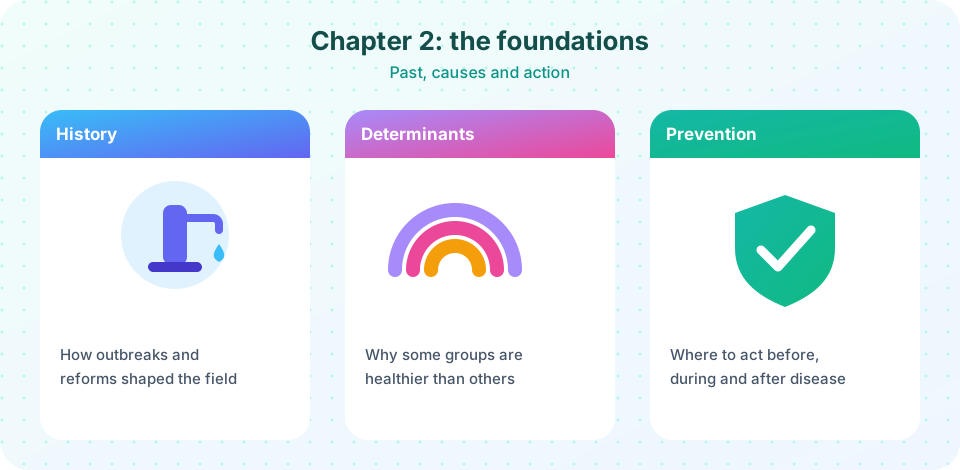
Preview chapter 2: how public health grew from outbreaks and reforms, what determines health, and where prevention can act before, during and after disease.
Before we count anything, it helps to understand where public health came from, what it believes causes good and bad health, and what it can do about it. Those three questions define this chapter. The answers are history, determinants and prevention, and together they explain why a modern health department spends as much time on sewers, schools and tax policy as on hospitals.
What you will learn
- The big picture of chapter 2 and how its three lessons connect.
- Why the past matters for how epidemiologists work today.
- A first look at the ideas of determinants and levels of prevention.
Key terms
- Sanitary reform: nineteenth-century measures such as sewers, clean water and refuse removal that cut infectious disease.
- Determinants of health: the personal, social, economic and environmental factors that influence health status.
- Health inequity: avoidable and unfair differences in health between groups.
- Primary, secondary and tertiary prevention: acting before disease, at early disease, and after disease is established.
The three ideas in one minute
History: learning by outbreaks
Determinants: what shapes health
Prevention: where to act
Why history comes first
You might wonder why a course on modern epidemiology spends a lesson on the 19th century. The reason is that nearly every method in the toolkit was invented to solve a particular historical problem. Cholera taught us to map cases and compare water sources. The smallpox vaccine taught us to value controlled comparison and, eventually, surveillance. The tobacco story, covered in chapter 4, taught us how to prove harm when a deadly exposure is also a profitable one. Knowing the stories makes the methods feel less like arbitrary rules and more like hard-won answers.
History also protects against a common error: the belief that public health is a modern invention and that health improvements come mainly from medicine. The data say otherwise. In industrial countries, death rates from many infectious diseases were already falling steeply before effective drugs or even vaccines were available, largely because of better nutrition, housing, water and sanitation. That finding, famously discussed by the physician and epidemiologist Thomas McKeown, remains debated in its details, but its central message about the power of living conditions is widely accepted.
What each lesson covers
- A short history of public health follows milestones from Jenner's vaccine to the Ottawa Charter, with John Snow's cholera investigation as the main worked example. You will recompute Snow's comparison of water companies.
- The determinants of health introduces the layered model of influences, the social gradient and the idea of upstream causes, with the Whitehall studies as evidence.
- Levels of prevention separates primary, secondary and tertiary prevention and uses a screening example to show why even a good test can produce mostly false alarms when a disease is rare.
- Chapter 2 review recaps the chapter and gives you a ten-question quiz.
How the three ideas fit
History is the evidence: what worked and how we found out. Determinants are the explanation: why some people and places are healthier than others. Prevention is the action: where in the course of a disease we can intervene. A skilled public health analyst moves between them constantly. For example, when a city has high rates of childhood asthma, history suggests looking at housing and air quality, the determinants model asks which social groups are most exposed, and the prevention framework asks whether to act on the causes, on early detection or on managing existing disease.
Questions to carry through the chapter
Reading with a question in mind makes the chapter easier to remember. As you move through the three lessons, keep these in the back of your mind:
- History: In each story, what did people count, and what did they compare? Notice how often the decisive step was a simple table of rates for two groups.
- Determinants: Which layer of the rainbow would you target for a problem in your own community, and what would the evidence need to look like to justify the action?
- Prevention: For a disease you care about, what are one primary, one secondary and one tertiary measure, and which of the three would prevent the most harm per dollar?
You will meet small calculations in this chapter, including a rate ratio, a rate difference and a positive predictive value. None of them needs more than arithmetic, and each is explained in words before the formula appears.
Try it
Check your understanding
Quick check · 3 questions
of 3 answered You scored / 3 · perfect!
-
1. Which sequence correctly matches the three ideas of chapter 2 with their roles?
History shows what worked, determinants explain why health differs, and prevention frames where to act. -
2. Thomas McKeown's famous argument stressed that falling infectious-disease deaths in industrial countries owed much to
Many death rates were falling before effective drugs existed, which pointed to living conditions; the details remain debated. -
3. Screening for a cancer before symptoms appear is an example of
Secondary prevention detects disease early, before symptoms.
Summary
- Chapter 2 asks where public health came from, what shapes health, and where prevention can act.
- Historical cases such as cholera and smallpox produced the methods used today.
- Living conditions mattered as much as medicine in the decline of infectious disease.
- The three lessons form evidence, explanation and action.
Track your progress
Create a free account to tick off lessons and pick up where you left off on any device.
of Public Health and Epidemiology lessons completed