


















Lesson 37 of 46 · Health Systems and Policy
Health Systems and Policy: Chapter Overview
Chapter 8 overview: what a health system is, the WHO six building blocks, financing models (Beveridge, Bismarck, national insurance), universal health coverage and primary health care.
A vaccine that sits in a warehouse does not protect anyone. A clinic with no trained nurse cannot treat pneumonia. A treatment that bankrupts a family is a treatment many people will not seek. Epidemiology tells us what causes disease and which interventions work, but it is the health system, with the policies around it, that determines whether those interventions reach people and whether the benefits are shared fairly.
This chapter moves from measuring disease to the organizations, money and decisions that shape population health. This lesson describes how a health system is put together and how countries pay for care. The following lessons look at the social conditions that shape health and at how policies are chosen and evaluated.
What a health system is
The World Health Organization defines a health system as all the organizations, people and actions whose primary intent is to promote, restore or maintain health. That includes hospitals and clinics, but also public health agencies, community health workers, regulators, insurers, medicine suppliers, health information services and even (when they act mainly for health) families and community groups.
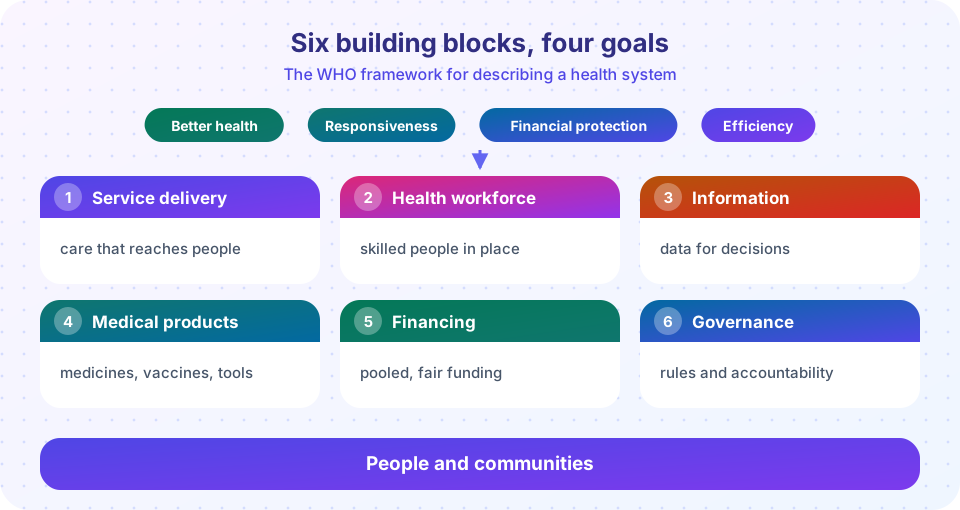
In the World Health Report 2000, WHO named the main goals of health systems: good health (level and distribution), responsiveness to people's expectations (dignity, choice, confidentiality), and fairness in financial contribution. Later documents added efficiency and, in many frameworks, quality and resilience (the ability to keep functioning during shocks such as a pandemic).
The six building blocks
A widely used framework from WHO (2007) divides a system into six interacting parts.
- Service delivery. How care and prevention reach people: primary care, hospitals, outreach, emergency services. Quality, safety and coverage matter.
- Health workforce. Doctors, nurses, midwives, community health workers, pharmacists and others, in the right number, with the right skills in the right places. Many low-income countries have too few health workers per population, and workers migrate to richer countries.
- Health information systems. Data from births and deaths, disease surveillance, facility records and surveys, needed to plan and to detect problems.
- Medical products, vaccines and technologies. Reliable access to quality essential medicines, vaccines, diagnostics and equipment.
- Financing. Raising, pooling and spending money so that people can use services without hardship.
- Leadership and governance. Policies, regulation, accountability and strategic direction.
The blocks depend on one another. More money without trained staff does not improve care, and data that no one uses change nothing. Systems thinking asks about bottlenecks and about unintended effects of changing one part.
A health system has six blocks
And three more
Universal health coverage
How countries pay for health care
Financing arrangements are often grouped in a few stylized models. Real systems blend them.
| Model | Who pays | Who provides | Typical examples |
|---|---|---|---|
| Beveridge (tax-funded) | General taxation | Mostly public providers | United Kingdom (NHS since 1948), Spain, Nordic countries |
| Bismarck (social insurance) | Contributions from employers and employees to insurance funds | Public and private providers | Germany, France, Japan |
| National health insurance | A single public insurer funded by taxes or premiums | Mostly private providers | Canada, Taiwan, South Korea |
| Out-of-pocket / market-based | Patients at the time of service | Public and private | Many low-income countries; parts of the United States system |
These labels are a teaching simplification, named after Otto von Bismarck's 1880s social insurance laws in Germany and William Beveridge's 1942 report in Britain; real systems differ widely. Two financing functions matter most for equity: pooling (sharing risk across many people, so that the healthy help pay for the sick) and purchasing (how services are paid for: per item, per patient, per case or by salary). Heavy reliance on out-of-pocket payments is linked to families delaying care or falling into poverty. The Sustainable Development Goals track "catastrophic" health spending using thresholds, for example when a household spends more than 10% or 25% of its budget on health.
Universal health coverage and primary care
Universal health coverage (UHC) means that all people can use the quality health services they need without suffering financial hardship. It is Target 3.8 of the Sustainable Development Goals. UHC has three dimensions: how many people are covered, how many services are covered and how much of the cost is covered.
The roots of UHC lie in the Declaration of Alma-Ata (1978), which proclaimed "Health for All" through primary health care: essential care that is accessible, acceptable and affordable, based on community participation and intersectoral action. The Astana Declaration (2018) renewed this commitment. Strong primary care is associated with better population health at lower cost, partly because it coordinates care and addresses problems before they become severe.
The Ottawa Charter for Health Promotion (1986) added a broader view: building healthy public policy, creating supportive environments, strengthening community action, developing personal skills and reorienting health services. It leads naturally to the next lesson: health is shaped by far more than medical care.
Public health functions
Public health agencies carry out functions that individual clinicians cannot. Frameworks list items such as surveillance and monitoring of population health, outbreak response, health protection (food safety, environmental health), health promotion, disease prevention (immunization programs, screening), health policy and planning, and workforce development. During a crisis, the strength of these functions, not just of hospitals, determines how well a country responds.
Key terms
Health system: all organizations, people and actions whose primary intent is to promote, restore or maintain health.
Pooling: collecting funds so that risk is shared across a population.
Out-of-pocket payment: direct payment by patients at the point of care.
Universal health coverage: access to needed quality services for all, without financial hardship.
Primary health care: first-contact, comprehensive, community-based care and public health.
Common misconceptions
"Health systems are the main reason people are healthy." Medical care matters, but nutrition, education, income, housing and sanitation shape population health at least as much (next lesson).
"Spending more always gives better health." Efficiency, distribution and quality matter. Countries with similar spending can have different outcomes.
"Universal coverage means free care for everything." UHC means financial protection and access to a defined set of quality services; priorities must be set.
"A system is either public or private." Most systems mix public financing, private provision and several payers.
Try it
First, a toy weakest-link model of the building blocks. Set a score for each block; the toy "system performance" is limited by the weakest of them (with a small bonus for the average). It is a thought experiment about bottlenecks, not a real performance index.
Second, a simulation of financial protection. Households have different incomes and sometimes need care. When more of the cost is paid out of pocket, more households spend more than 10% of their budget on health. The inputs are invented and illustrate the mechanism only.
Press Run (or Ctrl + Enter) to see the result here.
Program input · what you'd type while the program runs
Type the answers before you press Run, one per line. Each time the program reads a line (with input()), it gets the next line from this box.
Check your understanding
Quick check · 5 questions
of 5 answered You scored / 5 · perfect!
-
1. Which of these is NOT one of the WHO six health system building blocks?
Insurers may be part of financing arrangements, but the six blocks are service delivery, workforce, information, medical products, financing and governance. -
2. Which financing model funds care mainly from general taxation and uses mostly public providers?
The Beveridge model, as in the UK's NHS, is tax-funded. -
3. What does universal health coverage guarantee?
UHC concerns access, quality and financial protection. -
4. Why is pooling important in health financing?
Pooling spreads the cost of illness across many people. -
5. The Declaration of Alma-Ata (1978) is associated with:
Alma-Ata made primary health care the key to Health for All.
Summary
- A health system includes everything whose main purpose is health; WHO groups it into six building blocks.
- The goals are good health, responsiveness, fairness in financing and efficiency.
- Beveridge, Bismarck, national insurance and out-of-pocket are stylized financing models; real systems blend them.
- Universal health coverage and primary health care aim to give everyone needed services without hardship.
- Next: the social conditions outside the health system that shape health.
Track your progress
Create a free account to tick off lessons and pick up where you left off on any device.
of Public Health and Epidemiology lessons completed