


















Lesson 1 of 46 · Getting Started
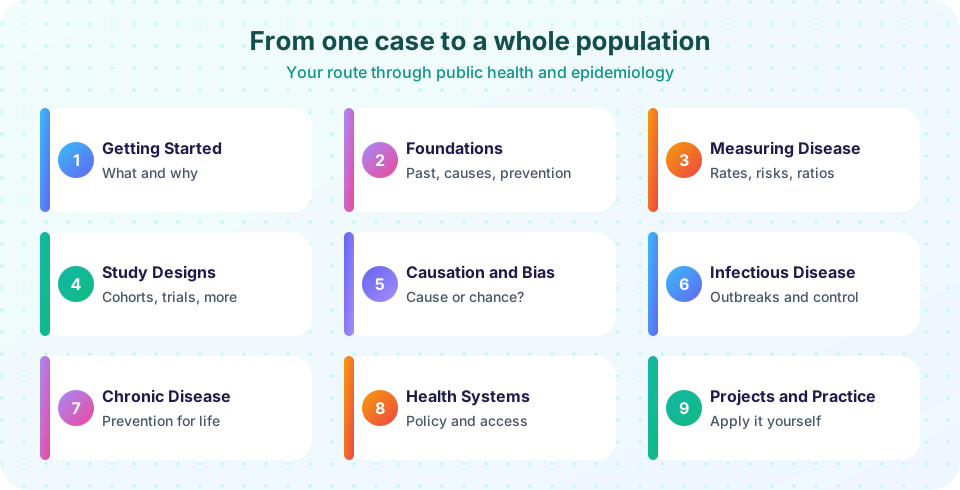
Course map: your path through public health and epidemiology
See the whole public health and epidemiology course at a glance: who it is for, how to study it, and what each of the nine chapters teaches.
Public health is the science and practice of keeping whole populations healthy. Epidemiology is its main research method: the study of how often diseases occur, who gets them, and why. Together they explain how a city stops a cholera outbreak, how a country decides whether a vaccine works, why heart disease is more common in some neighborhoods than others, and how to read a news headline that says "coffee doubles your risk of something" without panicking.
This course takes you from first principles to the working toolkit of a public health analyst. You will count cases, compare groups, design studies, weigh evidence for cause and effect, and study how outbreaks, chronic diseases and health systems behave. Every idea comes with numbers you can recompute and small demonstrations you can run in your browser.
Educational information only. This course teaches how health data are measured and interpreted. It is not medical advice and cannot diagnose or treat any condition. If you have symptoms or health concerns, speak with a qualified health professional or your local health service.
What you will learn
- Who this course is for and what you need before you start.
- How the nine chapters build on each other.
- A study routine that works for a quantitative science subject.
- How the interactive examples are meant to be used, and what they are not.
Who this course is for
The course is written for learners aged about 15 and up, and for adults who want a clear, rigorous introduction. It follows the common ground of international school and first-year university programs: IB Biology and Health options, Cambridge A Level Biology and Global Perspectives, US AP Biology, AP Statistics and introductory college courses in public health, epidemiology and global health. It also suits nurses, doctors in training, data analysts and policy students who need the vocabulary.
You do not need any special background. You should be comfortable with percentages, fractions and reading a bar chart or line graph. The course uses a little algebra, a few logarithms (when we build confidence intervals) and some short Python snippets. Every formula is explained in words before it appears, and every term is defined the first time it is used.
How the nine chapters fit together
Each chapter answers one question, and the answer prepares the next chapter.
Part 1: ideas
- Getting Started
- Foundations
Part 2: numbers
- Measuring Disease
- Study Designs
Part 3: evidence
- Causation and Bias
- Infectious Disease
Part 4: action
- Chronic Disease
- Health Systems
Part 5: practice
- Projects and Practice
Think of the course as a ladder. Chapters 1 and 2 give you the ideas. Chapter 3 gives you the arithmetic, and chapter 4 the ways to collect data. Chapter 5 is the critical-thinking chapter: it teaches you why a pattern in data is not always a cause. Chapters 6 and 7 apply everything to two huge families of disease, and chapter 8 asks how societies organize themselves to respond. Chapter 9 lets you practice on realistic problems.
What this chapter and the next contain
This opening chapter has four lessons:
- This course map.
- What is public health? covers the population view, the core functions and the difference from clinical medicine.
- How epidemiologists think covers denominators, comparison, person-place-time and the questions every investigation asks.
- Chapter review lets you consolidate with a quiz of eight questions.
How to study
A quantitative subject rewards a simple routine:
- Read actively. After each section, close your eyes and say the idea in one sentence. If you cannot, read it again.
- Recompute the numbers. Whenever a worked example gives a result such as a risk of 0.15, redo the division yourself. Epidemiology is learned by calculating, not by memorizing.
- Play with the demonstrations. Each lesson has small interactive examples. Change the inputs, predict what will happen, then check. Prediction before action is what makes the example teach you something.
- Use the quizzes honestly. Answer before you read the explanation. Wrong answers are the most useful information you will get.
- Come back. Reread the chapter review a week later. Spaced repetition beats cramming.
About the demonstrations
The interactive examples are small, clearly labelled models. Some use real published numbers (for example from John Snow's cholera study), and some use invented numbers chosen to make an idea visible. The lessons always say which. None of them is a diagnostic tool, a risk calculator for real people or a substitute for professional advice. When the course quotes a landmark study, it describes what that study found at a level of detail we are confident about and flags known limits, because good epidemiology is partly the habit of asking how sure we should be.
A few numbers to give you the scale
Public health is easier to grasp with a sense of size. Smallpox, which killed hundreds of millions of people over history, was declared eradicated in 1980 after a global vaccination campaign. Today, the leading causes of death worldwide are chronic diseases such as heart disease and stroke, which is one reason Chapter 7 is among the longest. And the difference in life expectancy between the healthiest and the least healthy countries is more than 25 years, a gap that has far more to do with living conditions and health services than with biology. Those facts frame the whole subject: disease is not distributed at random, and much of it is preventable.
Try it
Check your understanding
Quick check · 3 questions
of 3 answered You scored / 3 · perfect!
-
1. Which statement best describes epidemiology?
Epidemiology is the study of the distribution and determinants of health states in populations. Treating individual patients is clinical medicine. -
2. Why does the course ask you to recompute worked examples yourself?
Redoing a calculation builds the habit of checking numerators, denominators and units, which is the heart of epidemiologic reasoning. -
3. Which chapter focuses on why a pattern in data is not always a cause?
Chapter 5 covers confounding, bias, chance and the criteria used to judge causation.
Summary
- Public health works on whole populations, and epidemiology is its research method.
- The course moves from ideas (chapters 1 and 2) to numbers (3 and 4), evidence (5), disease families (6 and 7), systems (8) and practice (9).
- Study actively: predict, calculate, check, and revisit.
- Interactive examples are labelled models, never medical tools.
Next: What is public health?
Track your progress
Create a free account to tick off lessons and pick up where you left off on any device.
of Public Health and Epidemiology lessons completed