


















Lesson 38 of 46 · Health Systems and Policy
Social Determinants of Health and Equity
Why health follows a social gradient: the WHO Commission on Social Determinants, Dahlgren-Whitehead model, Whitehall studies, inequality versus inequity, and proportionate universalism.
Ask what keeps a population healthy and many people will answer "doctors and hospitals". Public health research gives a different answer: the strongest predictors of who stays healthy and who falls ill are often found outside medicine, in income, education, work, housing, neighborhoods and the experience of being respected. Within countries, people at the bottom of the social ladder tend to die younger than those above them, and the same pattern holds across countries.
This lesson explains the idea of social determinants, shows the evidence behind the social gradient in health, separates inequality from inequity, and describes how policy can act on these causes.
What you will learn
- Define social determinants of health and describe the Dahlgren-Whitehead model.
- Explain the social gradient with evidence from the Whitehall studies.
- Distinguish health inequality from health inequity.
- Describe the main pathways from social position to health.
- Explain proportionate universalism and the limits of individual-level explanations.
Key terms
Social determinants of health: the conditions in which people are born, grow, live, work and age, and the wider forces that shape those conditions.
Social gradient: a stepwise pattern in which health improves with each step up the social scale.
Health inequality: measurable differences in health between groups.
Health inequity: differences that are avoidable, unnecessary and unfair.
Proportionate universalism: universal action with an intensity proportional to the level of disadvantage.
What are the social determinants?
The World Health Organization's Commission on Social Determinants of Health, chaired by Sir Michael Marmot, defined social determinants as the conditions in which people are born, grow, live, work and age, shaped by the distribution of money, power and resources at global, national and local levels. Its 2008 report was titled Closing the Gap in a Generation and made three overarching recommendations:
- Improve daily living conditions: the circumstances of birth, early childhood, schooling, work, housing, and the physical and social environment.
- Tackle the inequitable distribution of power, money and resources, which shapes those conditions.
- Measure and understand the problem and assess the impact of action, including training in how social factors affect health.
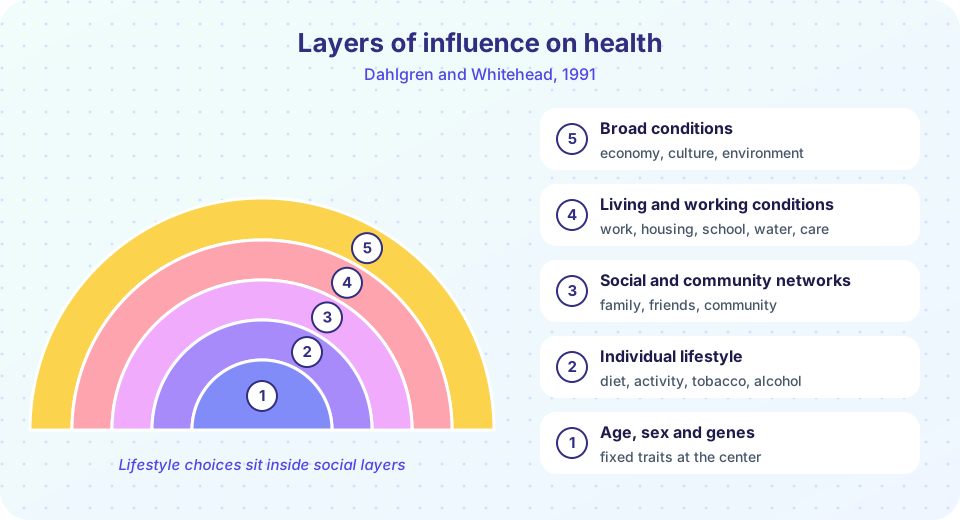
A widely used picture is the Dahlgren and Whitehead (1991) model, sometimes called the rainbow. At the center are individual characteristics that are mostly fixed: age, sex and genes. Around them lie layers: individual behavior and lifestyle; social and community networks; living and working conditions (education, work environment, unemployment, water and sanitation, health care services, housing, food and agriculture); and, on the outside, general socioeconomic, cultural and environmental conditions. A key message: lifestyle choices occur within these layers, not outside them. Whether people can afford fresh food, live near a safe place to walk, or work without constant strain strongly shapes their "choices".
The social gradient and the Whitehall studies
Health does not divide neatly into the poor, who are unhealthy, and everyone else. It improves step by step along the whole social ladder. The British Whitehall studies made this vivid.
- Whitehall I (begun 1967) followed about 18,000 male civil servants in London. All had stable jobs and access to the National Health Service, so extreme poverty and lack of care were not the explanation. Yet mortality over the follow-up was strongly graded by employment grade: men in the lowest grades (for example messengers and porters) had a death rate roughly three times that of men in the highest administrative grade, with each grade in between lying in order.
- Whitehall II (begun 1985) followed more than 10,000 men and women. The gradient appeared again, for several diseases. Conventional risk factors such as smoking, blood pressure and cholesterol explained part of the gradient, but not all of it. Researchers pointed to psychosocial work factors, such as low control over one's work, as additional contributors, an interpretation that has been debated and refined since.
The Whitehall findings overturned the idea that disadvantage matters only below some poverty line. They also helped inspire research into how chronic stress, control, social support and respect shape biology. The gradient is also seen between countries and over time: the Preston curve (Samuel Preston, 1975) shows that life expectancy rises with national income steeply at low incomes, then flattens at high ones, which implies that income redistribution within a country could, in principle, matter more than additional income.
Pathways from social position to health
Researchers describe several overlapping pathways:
- Material: income and wealth buy food, heat, safe housing, transport and health care; poor conditions expose people to damp, pollution and injury hazards.
- Behavioral: smoking, diet and physical activity are patterned by social position, partly through marketing, prices and the environment.
- Psychosocial: chronic stress, low control, insecurity and humiliation are thought to act through stress responses and through health-related behavior.
- Life-course: disadvantage accumulates from before birth, through childhood, education, and working life.
- Structural: discrimination, laws and institutions distribute opportunity unevenly, and these structures shape the other pathways.
Some of the association also goes in the other direction: illness can reduce income (health selection, or reverse causation). Studies that follow people over time suggest that this explains only a part of the gradient.
An influential but contested idea from Richard Wilkinson and Kate Pickett (The Spirit Level, 2009) is that, among rich countries, more unequal societies have worse health and social outcomes on average. The evidence has been argued over, partly about how robust the correlations are and how to interpret them; weigh it as an open hypothesis supported by some data, not as a settled law.
Inequality, inequity and equity
Margaret Whitehead (1992) separated two ideas.
- Health inequality is any measurable difference in health between groups, including differences that arise from biology (for example, age).
- Health inequity is a difference that is avoidable, unnecessary and unfair. Differences in life expectancy between rich and poor neighborhoods of the same city are widely regarded as inequities.
To say "unfair" is a value judgment, and societies disagree about which differences are fair. Epidemiology measures the gaps; political and ethical debate decides what to do about them.
Measures of inequality include the gap between the best-off and worst-off groups, the slope index of inequality (the absolute difference in outcome across the whole social scale, estimated by regression) and the concentration index (a Gini-like measure of how health is spread by income rank).
Acting on social determinants
Fighting inequity by treating only the poorest leaves the gradient untouched. The 2010 Marmot Review for England proposed proportionate universalism: services and actions should be universal, but with a scale and intensity proportionate to the level of disadvantage. Policy examples from many countries include:
- early childhood education and support for parents,
- minimum income protection and living wages,
- housing standards and green space,
- healthy work conditions and employment protection,
- taxes and regulation on harmful products,
- action against discrimination.
The idea of Health in All Policies says that governments should consider health effects when making decisions in transport, housing, agriculture, education and trade, not only in the health ministry.
Common misconceptions
"Health inequalities are mainly due to poor lifestyle choices." Behavior matters, but it is strongly shaped by circumstances. Whitehall research found that risk factors explained only part of the gradient.
"The social gradient only affects the poor." It runs across the whole range, even among people with stable jobs.
"Inequality and inequity mean the same." Inequity adds a judgment that the difference is avoidable and unfair.
"If poor health causes poverty, social determinants are irrelevant." Both directions occur; longitudinal studies show that social conditions have causal effects.
Try it
First, a plot of a stylized social gradient, with invented numbers. It also computes a simple slope index of inequality.
Press Run (or Ctrl + Enter) to see the result here.
Program input · what you'd type while the program runs
Type the answers before you press Run, one per line. Each time the program reads a line (with input()), it gets the next line from this box.
Second, a thought experiment about equity. Three groups start at different health scores, and ten units of a resource are shared out. Compare an equal split, a proportionate split and giving everything to the worst-off group. The model assumes diminishing returns and is a toy only.
Check your understanding
Quick check · 5 questions
of 5 answered You scored / 5 · perfect!
-
1. What did the Whitehall studies of British civil servants show?
A step-by-step gradient appeared across the whole hierarchy. -
2. Which description best fits health INEQUITY?
Whitehead's definition adds the judgment that a difference is unfair and avoidable. -
3. In the Dahlgren-Whitehead model, lifestyle choices are:
The layers are nested: behavior sits inside the social environment. -
4. Proportionate universalism means:
It reaches everyone while giving more to those who need more. -
5. Which statement about the Spirit Level hypothesis is the most accurate?
The correlations have been argued over and should be treated as an open hypothesis.
Summary
- Social determinants are the conditions of daily life and the structures that shape them; the Dahlgren-Whitehead model nests lifestyle within them.
- Whitehall found a social gradient across the whole hierarchy that conventional risk factors only partly explained.
- Pathways include material, behavioral, psychosocial, life-course and structural routes.
- Inequity means avoidable, unnecessary and unfair differences, and proportionate universalism offers a way to address them.
Next: Policy and evaluation
Track your progress
Create a free account to tick off lessons and pick up where you left off on any device.
of Public Health and Epidemiology lessons completed