


















Lesson 40 of 46 · Health Systems and Policy
Chapter Review: Health Systems and Policy
Review chapter 8 with a one-picture summary, recap table and a ten-question quiz on health system building blocks, financing, social determinants, equity, policy evaluation and ICERs.
This chapter widened the lens from diseases to the systems, social conditions and decisions that shape them. A health system turns knowledge into care. Social determinants decide who can use it and who needs it most. Policies change the circumstances for millions of people, and evaluation tells us whether the change was worth it. This review ties those ideas together.
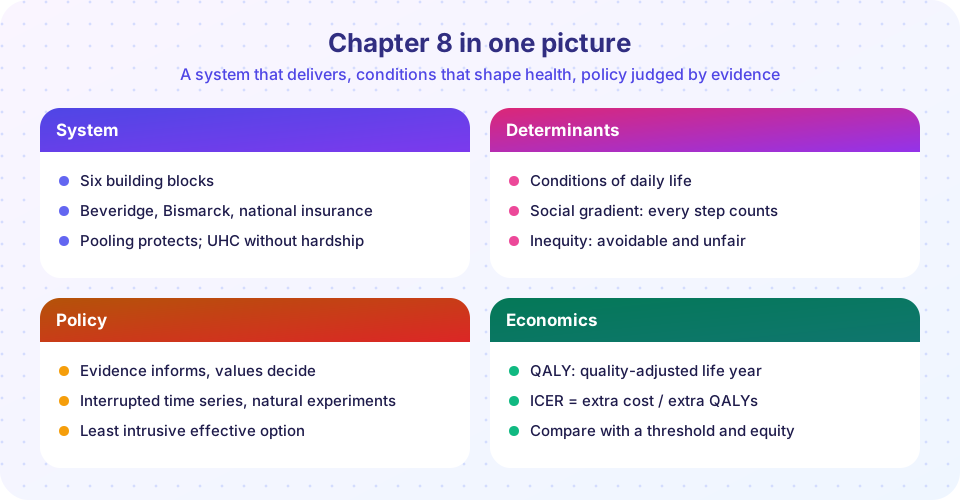
Recap table
| Topic | Key points |
|---|---|
| Building blocks | Service delivery, workforce, information, medical products, financing, governance; bottlenecks matter. |
| Goals | Good health, responsiveness, fair financing, efficiency. |
| Financing | Beveridge (tax), Bismarck (social insurance), national insurance, out-of-pocket; pooling protects against hardship. |
| UHC and primary care | Needed quality services without financial hardship; Alma-Ata 1978; Astana 2018. |
| Social determinants | Conditions of daily life and the structures behind them; Dahlgren-Whitehead model. |
| Gradient | Whitehall: health improves at every step; not only a poverty effect. |
| Equity | Inequity = avoidable, unnecessary, unfair; proportionate universalism. |
| Policy evaluation | Policy cycle; natural experiments, difference-in-differences, interrupted time series. |
| Economics | QALY and ICER = extra cost / extra QALYs; compare with a threshold and consider equity. |
| Ethics | Trade-offs between liberty, benefit and fairness; least intrusive effective option. |
Connecting the chapters
- The measurement tools of chapter 3 (rates, standardization, DALYs) show where gaps exist.
- The study designs of chapter 4 and the causal reasoning of chapter 5 decide whether a policy's effect is believable.
- The infectious disease ideas of chapter 6 explain why coverage, pooling and herd effects are collective goods.
- The prevention logic of chapter 7 (Rose's population strategy) is the reason policies, not just clinics, matter.
The big ideas, revisited
Health is produced mostly outside clinics, and delivered partly inside them. The social determinants lesson showed that income, education, work and housing shape who becomes ill, while the systems lesson showed that service delivery, workforce, financing and governance shape who gets care and at what price. Both matter, and they interact: an excellent hospital does not help a family that cannot afford to reach it, and a generous insurance scheme does not help if the clinic has no staff.
Fairness is a measurable goal. Inequity is a judgment, but epidemiology provides measures (gaps, slope indices, concentration indices, catastrophic spending) that show whether a system is moving toward or away from fairness. Averages hide gaps, so a good evaluation always looks at the distribution as well as the mean.
Policies are experiments we rarely get to randomize. Evaluating them needs designs that deal with trends and simultaneous events, such as interrupted time series with controls, together with honest process evaluation (was it implemented?), economic evaluation (what did it cost per unit of health?) and ethical reasoning (who gains, who pays, whose freedom is limited?). The habits from the causal chapter apply here too, with one addition: because policy affects many people at once, being wrong is costly in both directions, acting on a false effect or failing to act on a real one.
Three integrated cases
Case 1: reducing out-of-pocket payments. A middle-income country finances 55% of health spending out of pocket, and surveys show that many families sell assets to pay for hospital care. Policy options include tax-funded coverage for a defined package of essential services, a national insurance scheme with subsidies for poor households, or reducing prices of medicines. Pooling risk across a large population protects those who fall ill. Experience in several countries shows that expanding coverage works best when it is accompanied by investment in primary care and health workers; money that follows people to under-staffed clinics may improve financial protection without improving health. Monitoring catastrophic spending, unmet need and health outcomes together shows which block of the system is the bottleneck.
Case 2: a gradient in life expectancy across city districts. A city finds that men in its poorest district live about ten years less than men in the richest district, with a steady step in between. Treating only the poorest district addresses part of the problem; the gradient suggests that actions should be universal but scaled to need (proportionate universalism): early childhood services, housing quality, employment protection, transport and green space, as well as accessible health care. The city would also measure progress using the slope index of inequality, not only the average, because the average can improve while the gap widens.
Case 3: evaluating a sugar-sweetened beverage tax. A city introduces a tax at the start of a year. The evaluation team gathers monthly sales for 24 months before and 24 months after, and for a comparison city without a tax. An interrupted time series with a control series estimates the change in level and trend of sales after the tax, adjusting for seasonality. If sales fall in the taxed city and not in the comparison city, the tax is a plausible cause; threats include other events at the same time, shoppers crossing the border to buy untaxed drinks, and changes in product size. Later work looks at health outcomes such as obesity, which change slowly, and at cost-effectiveness using ICERs and distributional analysis, because the tax affects people with different incomes differently.
Traps that catch students in exams
- Equating inequality and inequity. Inequity needs a judgment of avoidable and unfair.
- Saying UHC means free care for everything. It means access to needed quality services without financial hardship.
- Assuming that more spending automatically improves health. Efficiency, distribution and quality matter.
- Judging a policy by a two-point before-and-after comparison. Use many time points and a comparison.
- Treating the ICER as a rule. It informs decisions alongside equity, severity and budget.
- Forgetting the ethics. Every population measure involves a trade-off between benefit and freedom, and you should state it.
Try it
A quick check on key formulas: choose a question and test your answer with a calculator that shows the formula used.
The second demonstration is a Python summary of the cost-effectiveness plane. Four interventions are plotted by extra cost and extra QALYs, with the willingness-to-pay line.
Press Run (or Ctrl + Enter) to see the result here.
Program input · what you'd type while the program runs
Type the answers before you press Run, one per line. Each time the program reads a line (with input()), it gets the next line from this box.
Check your understanding
Quick check · 10 questions
of 10 answered You scored / 10 · perfect!
-
1. Which is NOT a WHO health system building block?
The six blocks are service delivery, workforce, information, medical products, financing and governance. -
2. The Beveridge model is funded mainly by:
Beveridge systems such as the UK's NHS are tax-funded. -
3. What does the Whitehall evidence say about health and social position?
Even among stable, insured civil servants, health improved with each grade. -
4. Health inequity differs from inequality because inequity is:
The word carries a moral judgment about fairness. -
5. Proportionate universalism means:
Everyone is reached, with more intensity for those who are worse off. -
6. Pooling in health financing mainly serves to:
Pooling spreads costs across many people. -
7. An ICER is:
It expresses cost per unit of additional health. -
8. An interrupted time series studies:
Segmented regression estimates the changes at the interruption. -
9. Which pair is correctly matched?
The Declaration of Alma-Ata launched the primary health care movement. -
10. Why might a policy appear to fail in an evaluation?
Implementation failure, delayed effects and confounding can all hide an effective idea.
Summary
- Health systems combine six building blocks; financing and pooling decide access and protection.
- Social determinants and the gradient show that health is made largely outside clinics.
- Policy is shaped by evidence, values and politics, and can be evaluated with quasi-experimental designs and cost-effectiveness analysis.
- Chapter 9 gives you projects and practice to apply everything in the course.
Track your progress
Create a free account to tick off lessons and pick up where you left off on any device.
of Public Health and Epidemiology lessons completed