


















Lesson 46 of 46 · Projects and Practice
Further Study: Where to Go Next in Public Health
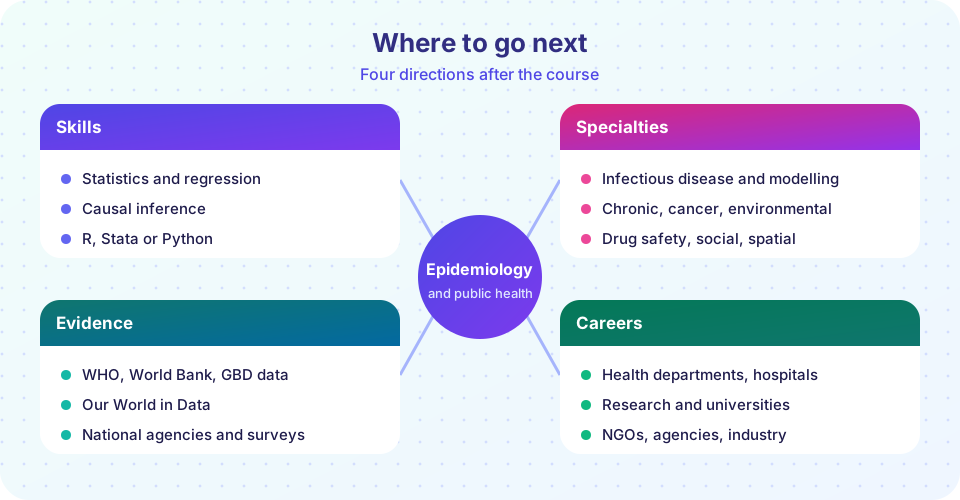
Where to go after this course: specialties in epidemiology, skills to build in statistics and data work, classic books, data sources, related tracks on this site and career paths.
You have covered a wide field: measuring disease, designing studies, reasoning about cause, understanding outbreaks, chronic disease, and the systems and policies that shape health. This final lesson suggests where to go next. Epidemiology is a broad subject, and the best next step depends on whether you want to analyze data, work in a health department, study a disease, or influence policy.
What you will learn
- Identify specialty areas of epidemiology and what each studies.
- Plan which quantitative and software skills to build next.
- Find reliable data and classic texts.
- See how this course connects to other tracks on this site.
Key terms
Biostatistics: statistics applied to health and biology.
Surveillance: ongoing collection, analysis and sharing of health data for action.
Pharmacoepidemiology: study of drug use and effects in populations.
Global health: health problems and solutions that cross borders, with attention to equity.
Evidence synthesis: systematic reviews and meta-analyses that combine many studies.
Specialties of epidemiology
- Infectious disease epidemiology and modelling: outbreak response, vaccination strategy, transmission models beyond the SIR model (age-structured, network and agent-based models).
- Chronic disease and cancer epidemiology: risk factors, screening programs, survival.
- Environmental and occupational epidemiology: air pollution, water contaminants, chemicals, workplace hazards, climate and health.
- Nutritional epidemiology: diet measurement and its difficulties (see Nutrition Science).
- Genetic and molecular epidemiology: gene-environment interaction, biomarkers, Mendelian randomization.
- Pharmacoepidemiology: drug safety and effectiveness in everyday use (see Pharmacology).
- Social epidemiology: the social determinants and inequalities of chapter 8.
- Psychiatric and behavioral epidemiology: mental health in populations.
- Spatial epidemiology: maps, clusters and geographic information systems.
- Clinical epidemiology: diagnosis, prognosis and treatment decisions at the bedside.
Skills to build
Statistics. The most useful next step for most learners is stronger statistics: confidence intervals, hypothesis tests, regression (linear, logistic, Poisson), survival analysis (Kaplan-Meier curves and Cox models), and handling missing data. On this site, start with Statistics and Probability and School Statistics; see Bayesian Statistics for an alternative way to update beliefs with data.
Causal inference. Chapter 5 introduced confounding, mediators and colliders. Modern methods (causal diagrams, propensity scores, instrumental variables, difference-in-differences, target trial emulation) formalize that reasoning: continue with Causal Inference.
Software. Epidemiologists commonly use R, Stata, Python and SAS. Good starting points are R Programming, Stata, Data Science, and Excel for quick tabulation. Learn to keep analyses reproducible: scripts, comments and version control.
Research methods. Learn how questionnaires are designed and validated, how samples are drawn, and how studies are reported. The checklists STROBE (observational studies), CONSORT (trials) and PRISMA (systematic reviews) show what a complete report contains. For measurement and design in the social sciences see Research Methods in Psychology.
Ethics. Epidemiology involves consent, privacy, data protection and fairness in the use of data. See Ethics for a broader grounding.
Related tracks on this site
| If you want to... | Try |
|---|---|
| Strengthen the numbers | Statistics and Probability, School Statistics |
| Reason about causes | Causal Inference, Bayesian Statistics |
| Understand the body and disease | Anatomy and Physiology, Microbiology |
| Study diet and drugs in populations | Nutrition Science, Pharmacology |
| Learn emergency skills | First Aid |
| Study environment and health | Environmental Science |
| Analyze data yourself | R Programming, Stata, Data Science |
Reading and reference
These are well-known works; look for the current edition.
- Modern Epidemiology (Rothman, Greenland and Lash): a graduate-level reference.
- Gordis Epidemiology: a standard introductory textbook.
- The Strategy of Preventive Medicine (Geoffrey Rose): the source of the high-risk and population strategies and the prevention paradox.
- Causal Inference: What If (Miguel Hernan and James Robins): a rigorous modern approach to causal reasoning; available free from the authors.
- The Status Syndrome and Fair Society, Healthy Lives (Michael Marmot): the social gradient and the 2010 review for England.
- A Dictionary of Epidemiology (edited by Miquel Porta): precise definitions.
For original papers, three milestones to read: Bradford Hill's 1965 address "The Environment and Disease: Association or Causation?"; Geoffrey Rose's 1985 paper "Sick individuals and sick populations"; and Snow's On the Mode of Communication of Cholera (1855), available in public-domain scans.
Data sources to explore
- WHO Global Health Observatory and World Bank health indicators for country-level data.
- Global Burden of Disease results (Institute for Health Metrics and Evaluation) for DALYs and risk factors.
- Our World in Data for clear charts with sources linked.
- National statistics offices and public health agencies (for example the US CDC, the UK Health Security Agency, ECDC in Europe).
- Open surveys such as the Demographic and Health Surveys (DHS).
Always read the documentation: how a variable is defined, how it was collected, which groups are missing and how recent the data are.
Careers and next steps
Paths include public health agencies (surveillance, outbreak response), hospitals (infection control, quality improvement), universities and research institutes, pharmaceutical and device companies, non-governmental organizations and international agencies, and data science roles in health technology. Formal routes include a Master of Public Health (MPH), a Master of Science in epidemiology or biostatistics, field epidemiology training programs (many countries run them, often supported by public health agencies), and doctoral research. If you are still choosing, volunteering for a local health project or analyzing a public dataset as a portfolio piece is a good first step.
A note on responsibility: this course is educational. It does not replace professional medical training or provide personal medical advice. In an emergency or for personal health questions, contact a qualified health professional.
Try it
First, a small planner: choose your interests and get a suggested sequence of next topics. The suggestions are generic and meant to spark ideas.
Second, an exercise to start your own analysis: simulate a small cohort, then compute a risk ratio and a Wilson confidence interval for a single risk. Change the numbers, and think about what would make you trust or distrust each estimate.
Press Run (or Ctrl + Enter) to see the result here.
Program input · what you'd type while the program runs
Type the answers before you press Run, one per line. Each time the program reads a line (with input()), it gets the next line from this box.
Check your understanding
Quick check · 4 questions
of 4 answered You scored / 4 · perfect!
-
1. Which specialty studies drug safety and effectiveness in real-world populations?
Pharmacoepidemiology examines drug use and its effects in populations. -
2. Which reporting checklist is used for observational studies?
STROBE is for observational studies; CONSORT is for trials and PRISMA for systematic reviews. -
3. Which book introduced the high-risk and population strategies of prevention?
Rose set out the two strategies and the prevention paradox. -
4. What should you always check before using a public dataset?
Documentation tells you what the numbers really mean.
Summary
- Epidemiology has many specialties; choose by the questions that excite you.
- Build statistics, causal-inference and programming skills next, and keep analyses reproducible.
- Use classic texts and reliable open data, and read their documentation.
- Many related tracks on this site extend what you learned here.
- This course is educational and does not replace professional medical advice.
Track your progress
Create a free account to tick off lessons and pick up where you left off on any device.
of Public Health and Epidemiology lessons completed