


















Lesson 6 of 46 · Foundations of Public Health
A short history of public health: from Jenner to the Ottawa Charter
Follow public health from Jenner's vaccine and the sanitary reforms to John Snow's cholera map, smallpox eradication and modern health promotion, with Snow's numbers recomputed.
In August 1854 cholera struck a few streets in Soho, London, with ferocious speed. Within about a week and a half, hundreds of residents were dead. At the time, most physicians believed that cholera spread through "miasma", bad air from rotting matter. A local physician named John Snow disagreed. He asked a simple question, where did the people who died get their water?, and answered it with a map and a table of counts. The investigation that followed has become the foundation story of epidemiology.
This lesson tells that story and the larger one around it: how vaccination, sanitation, statistics, germ theory and international agreements built the public health we know. As you read, notice a pattern. Again and again the breakthrough was not a new drug but a new way of seeing groups of people.
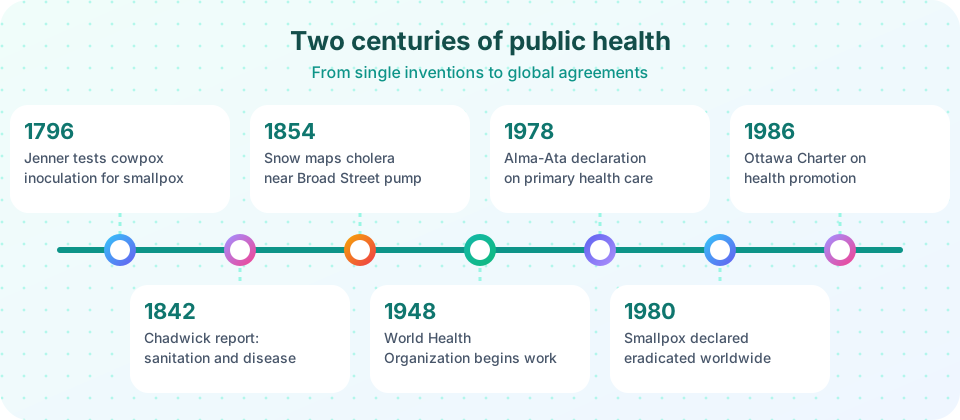
What you will learn
- Key milestones from 1796 to 1986 and what each contributed.
- How John Snow used a comparison of groups to point to contaminated water.
- Why sanitation and vaccination were the central tools of the first public health era.
- How the focus widened from infections to health promotion and primary care.
Key terms
- Miasma theory: the old belief that disease came from foul air rather than from living organisms.
- Germ theory: the idea, established in the second half of the 19th century, that specific microbes cause specific diseases.
- Sanitary reform: public works and laws that provide clean water, sewage removal and decent housing.
- Eradication: the permanent reduction of a disease's worldwide incidence to zero.
- Health promotion: the process of enabling people to increase control over, and improve, their health.
Early foundations: vaccination and statistics
Humans had been trying to prevent smallpox for centuries by variolation, deliberately infecting a person with a small amount of material from a smallpox sore, which caused a milder illness and protection but carried real risk. In 1796 the English country doctor Edward Jenner tested a safer idea. Folk wisdom held that milkmaids who had caught cowpox did not get smallpox. Jenner inoculated a boy, James Phipps, with cowpox material and later exposed him to smallpox; the boy did not fall ill. The word vaccine comes from the Latin vacca, cow. Modern ethics would not permit an experiment like Jenner's, but the principle, that a mild related infection can protect against a deadly one, launched immunization.
The same century saw the birth of health statistics. Governments began registering births and deaths, which made it possible to compute death rates and compare towns. In Britain, William Farr (the first compiler of abstracts in the General Register Office) used those records to study how mortality varied by occupation and place. Florence Nightingale, who served in the Crimean War in the 1850s, used statistical charts to show that far more soldiers died of disease and poor sanitation than of wounds, and used the pictures to persuade officials to reform military hospitals. Counting turned suffering into evidence.
The sanitary movement
Industrial cities grew faster than their sewers. Crowded housing, open cesspools, contaminated water and heavy infectious disease killed many people, especially children. In 1842 the lawyer and reformer Edwin Chadwick published a report on the sanitary condition of the laboring population of Great Britain, which linked filth and overcrowding to disease and argued that engineering solutions, such as drains, sewers and a clean water supply, would be cheaper than the costs of sickness. His diagnosis of the mechanism was wrong, since he too believed in miasma, but his recommendation was right. The 1848 Public Health Act established a central board of health and gave localities powers to build sanitation works. Similar movements arose across Europe and North America.
John Snow and the Broad Street pump
Cholera, a severe diarrheal disease, reached Britain in 1831 and returned in epidemics. Snow, a respected anesthetist, had concluded from the pattern of earlier outbreaks that cholera was spread by something swallowed, most likely in contaminated water, rather than by bad air. In 1854 he had two ways of testing the idea.
The map. Snow plotted deaths in Soho around Broad Street (now Broadwick Street) and found that they clustered around one public water pump. More than 600 people died in the outbreak. He also noticed exceptions that fit: workers at a nearby brewery, who drank beer and their own well water, largely escaped, and a widow living far away who liked the taste of the Broad Street water and had it delivered had died. Snow persuaded local officials to remove the pump's handle (on 8 September, after the epidemic was already waning), and the pump went out of use. Historians still debate how much the removal itself changed the course of the epidemic, which had been falling by then, but the map's persuasive and scientific value is clear.
The comparison of water companies. The stronger evidence came from what Snow called a "grand experiment". Two companies supplied water to neighboring parts of south London. The Southwark and Vauxhall company drew water from the Thames in a sewage-polluted stretch of the river, while the Lambeth company had moved its intake upstream to a cleaner point. In many streets the pipes of both companies ran side by side, so that neighboring houses, similar in income and surroundings, got different water. This is a natural experiment: nobody assigned the water, but circumstances created two groups that were comparable except for their supply. Snow went house to house and found that the rate of death from cholera was many times higher in houses supplied by the polluted company.
The first demonstration below recomputes that rate from the counts commonly reported from Snow's 1855 table. You should find about 315 deaths per 10,000 houses for the polluted supply and about 37 for the cleaner one, a ratio of roughly eight to one. The comparison is persuasive because the denominators (houses) are explicit and because the groups were comparable in everything except water. You will recognize the elements of epidemiologic thinking from the previous chapter: a case definition, a denominator and a comparison.
Germ theory catches up
Snow had no microscope-based proof of the cause. That came later. In the 1860s and 1870s Louis Pasteur and others established that microbes cause fermentation and disease, and Robert Koch developed methods for isolating bacteria and set out criteria, known as Koch's postulates, for proving a given microbe causes a given disease. In 1883 and 1884 Koch's team identified the cholera bacterium, Vibrio cholerae. Meanwhile a Hungarian physician, Ignaz Semmelweis, had shown in 1847 at a Vienna maternity hospital that deaths from childbed fever fell sharply when doctors washed their hands with a chlorine solution after performing autopsies. His ideas were resisted for years, a lesson about how slowly evidence changes habits.
Vaccines, antibiotics and eradication
The 20th century brought vaccines against diphtheria, tetanus, pertussis, polio, measles and many others, and antibiotics from the 1940s. Systematic campaigns made it possible to aim for eradication. Smallpox was the first target. A coordinated global effort, led by the World Health Organization from 1967, combined mass vaccination with surveillance and containment (finding every case and vaccinating the contacts around it). The last natural case occurred in Somalia in 1977, and in 1980 the World Health Assembly declared smallpox eradicated. It remains the only human disease so far to be eradicated.
From disease to health promotion
The World Health Organization began operating in 1948 with a constitution that defined health broadly. In 1978 the Declaration of Alma-Ata, adopted at an international conference in what is now Kazakhstan, named primary health care, accessible, community-based and affordable, as the key to "health for all". In 1986 the Ottawa Charter for Health Promotion set out strategies: build healthy public policy, create supportive environments, strengthen community action, develop personal skills and reorient health services. The emphasis moved from fighting individual diseases toward the social conditions behind health, the subject of the next lesson.
Lessons the history teaches
- Look for patterns in groups. Snow's map and his water-company comparison both depended on seeing disease across a population.
- Act on the evidence you have. Chadwick and Snow acted before the germ was known. Waiting for complete proof can cost lives.
- Mechanisms and measurements complement each other. The microbe was found 30 years after Snow's table.
- Change meets resistance. Semmelweis, and later campaigns against tobacco, show how entrenched practices defend themselves.
- Success needs delivery. Eradicating smallpox required not only a vaccine but organized surveillance and political cooperation.
Common misconceptions
"John Snow stopped the epidemic by removing the pump handle." The outbreak was already declining when the handle was removed. Snow's lasting contribution was the method of mapping and comparing, not the handle.
"Before germ theory, nothing worked." Sanitation, quarantine, vaccination and statistics all produced results before microbes were understood. Good epidemiology can work without a known mechanism.
"Vaccines and antibiotics explain most of the fall in infectious deaths." In many countries death rates had fallen substantially before their widespread use, thanks to better nutrition, hygiene and housing, though both later made a major difference for specific diseases.
Try it
Press Run (or Ctrl + Enter) to see the result here.
Program input · what you'd type while the program runs
Type the answers before you press Run, one per line. Each time the program reads a line (with input()), it gets the next line from this box.
Check your understanding
Quick check · 5 questions
of 5 answered You scored / 5 · perfect!
-
1. What did John Snow's comparison of two water companies show?
Houses on the sewage-polluted supply had a much higher cholera death rate than neighbors on the cleaner supply, supporting a water-borne cause. -
2. Why is Snow's water-company comparison called a natural experiment?
Nobody randomized the water; the overlapping pipes of two companies created two similar groups with different exposure. -
3. When was smallpox declared eradicated?
The World Health Assembly declared global eradication in 1980, after the last natural case in 1977. -
4. Edwin Chadwick's 1842 report is best remembered for
He held to miasma theory, but his recommendation, drains, sewers and clean water, was effective. -
5. The Declaration of Alma-Ata (1978) emphasized
Alma-Ata named accessible, community-based primary health care as the key to health for all.
Summary
- Jenner's vaccine, Chadwick's sanitary reforms and Snow's cholera work show that counting and comparing groups can reveal causes before mechanisms are known.
- Snow's water-company comparison was a natural experiment with a rate ratio of roughly eight.
- Germ theory (Pasteur, Koch) supplied the mechanism later.
- Smallpox eradication (1980) proved global control is possible; Alma-Ata and Ottawa widened the focus to primary care and health promotion.
Track your progress
Create a free account to tick off lessons and pick up where you left off on any device.
of Public Health and Epidemiology lessons completed