


















Lesson 8 of 46 · Foundations of Public Health
Levels of prevention: primary, secondary and tertiary
Learn where prevention acts along the natural history of disease, with examples of each level, screening criteria, and why a good test can still give mostly false alarms.
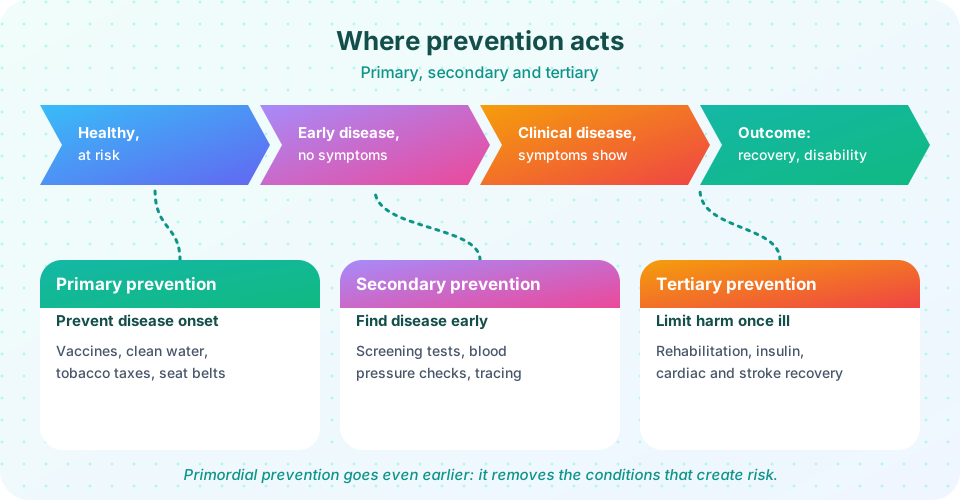
Disease does not appear all at once. A person is healthy, becomes exposed, develops early changes in the body, later feels symptoms, and finally recovers, lives with disability or dies. At every stage there is an opportunity to intervene, and each opportunity has a name. Public health calls this the levels of prevention, and understanding them helps you see why a vaccine, a mammogram and a stroke rehabilitation program are three very different kinds of work.
This lesson explains the natural history of disease, defines each level with examples, introduces the logic of screening, and shows with a small calculation why even a very good test can give mostly false positives when a disease is rare. It prepares you for the study designs and measures in the next chapters.
What you will learn
- The stages of the natural history of disease.
- Definitions and examples of primordial, primary, secondary and tertiary prevention.
- The criteria for a good screening program.
- Sensitivity, specificity and positive predictive value, and why prevalence changes what a positive test means.
Key terms
- Natural history of disease: the course of a disease from exposure to outcome without intervention.
- Screening: testing people without symptoms to find disease early.
- Sensitivity: the proportion of people with the disease whom the test correctly identifies as positive.
- Specificity: the proportion of people without the disease whom the test correctly identifies as negative.
- Positive predictive value (PPV): the proportion of positive tests that are true positives.
The natural history of disease
Most diseases pass through four broad stages:
- Susceptibility. The person is healthy but exposed to or at risk of the cause: a smoker, a person in a crowded room with an infectious case, a person whose diet is high in salt.
- Subclinical disease. The disease process has started, but there are no symptoms yet. Cells may be changing, an artery narrowing, or an infection incubating. This stage can last days (many infections) or decades (many cancers and heart disease).
- Clinical disease. Signs and symptoms appear, and the person may seek care.
- Outcome. Recovery, ongoing disability, chronic illness or death.
The incubation period (for infections) or latency (for chronic diseases) is the time from exposure to the appearance of disease. Knowing the natural history tells you when an intervention can work. A screening test is useless if it is applied after the stage when treatment helps, or before the disease is detectable.
The levels of prevention
Primordial prevention
Some authors add a level before the first: primordial prevention, which stops the risk factors themselves from arising. Teaching children never to start smoking, designing cities so that walking is natural, and improving national food policy all belong here. It addresses the upstream conditions from the previous lesson.
Primary prevention
Primary prevention keeps disease from occurring in people who are currently healthy. It acts on susceptibility. Examples:
- Vaccination, which protects against measles, polio, tetanus and many other diseases.
- Safe water and sanitation, which interrupts transmission of cholera and typhoid.
- Tobacco taxes and smoke-free laws, which prevent lung cancer and heart disease.
- Seat belts, helmets and speed limits, which prevent injuries.
- Folic acid supplementation of foods and early pregnancy, which prevents neural tube defects.
Primary prevention can be aimed at the whole population (a law, a water treatment plant) or at people at high risk (vaccinating health workers). Its benefits are often the largest and the most cost-effective, but also the hardest to see.
Secondary prevention
Secondary prevention detects disease early, before symptoms, so that treatment can start when it works best. Its tools are screening and early case finding. Examples include mammography for breast cancer, tests for cervical cancer precursors, colonoscopy or stool tests for bowel cancer, newborn screening for metabolic disorders, blood pressure checks, and contact tracing in tuberculosis outbreaks. It does not prevent the disease from starting, but it can prevent a worse outcome.
Tertiary prevention
Tertiary prevention reduces the harm of disease that is already clinically established: preventing complications, disability and recurrence, and improving quality of life. Examples include cardiac rehabilitation after a heart attack, stroke rehabilitation, insulin and regular foot checks for people with diabetes (to prevent amputations), physiotherapy and support groups for chronic conditions.
Some writers also speak of quaternary prevention: protecting people from unnecessary or harmful medical interventions, such as overdiagnosis and overtreatment. It reminds us that more testing is not always better.
When is screening a good idea?
In 1968 two physicians, James Wilson and Gunnar Jungner, wrote a report for the World Health Organization that set out principles for screening, still widely cited. In modern language, a screening program makes sense when:
- the condition is an important health problem;
- its natural history is understood, with a detectable early stage;
- an accepted treatment exists, and early treatment gives better results than late treatment;
- a suitable test exists that is acceptable, safe and reasonably accurate;
- the costs, including follow-up of positive tests, are balanced against the benefits.
Notice that none of these says "the test is accurate". Accuracy is necessary but not sufficient. A program must also improve outcomes in a way that justifies the harms of testing, such as anxiety, false alarms, unnecessary biopsies and overdiagnosis, the detection of disease that would never have caused symptoms.
Another trap is lead-time bias. Imagine a cancer that will kill a person at age 70 whether it is found at 60 or at 65. Screening finds it at 60, so "survival after diagnosis" jumps from 5 to 10 years, even though the person died at the same age. Survival time from diagnosis can look better simply because diagnosis happened earlier. The right measure of a screening program's success is usually deaths from the disease in the whole screened population compared with an unscreened one, as in randomized trials.
How accurate is a test?
Two numbers describe a test, compared against a reference ("gold standard") diagnosis:
- Sensitivity = true positives / all people with the disease.
- Specificity = true negatives / all people without the disease.
A third number, the positive predictive value (PPV), answers the question a patient actually cares about: "My test is positive. What is the chance I have the disease?" PPV = true positives / all positives. The PPV depends not only on the test, but also on how common the disease is, the prevalence.
Take a hypothetical test with 90 percent sensitivity and 95 percent specificity, applied to 10,000 people of whom 1 percent (100 people) have the disease. The test finds 90 of the 100 sick people. Among the 9,900 healthy people, 5 percent, or 495, test positive falsely. So there are 585 positives, of whom 90 are real: a PPV of about 15 percent. About five of every six positive tests are false alarms, even though the test is "95 percent specific". When the disease is rare, the healthy people vastly outnumber the sick, and even a small false-positive rate produces many false positives.
This has practical consequences. Screening works best when applied to groups at higher risk (older age groups, family history), where prevalence is higher, and positive screening tests must be followed by confirmatory testing and calm, clear counseling. The calculator below lets you explore the effect.
Common misconceptions
"Prevention is always better and cheaper than cure." Prevention often is, but not always: a screening program with low yield and many false positives may cost more and harm some people. Each program must be evaluated.
"A 95 percent accurate test means a positive result is 95 percent likely to be right." The probability depends on prevalence. For a rare disease, most positives may be false.
"Screening only has benefits." Screening can cause overdiagnosis, false reassurance (false negatives), anxiety and complications from follow-up procedures.
Try it
Press Run (or Ctrl + Enter) to see the result here.
Program input · what you'd type while the program runs
Type the answers before you press Run, one per line. Each time the program reads a line (with input()), it gets the next line from this box.
Check your understanding
Quick check · 6 questions
of 6 answered You scored / 6 · perfect!
-
1. A national program screens adults for high blood pressure so that treatment can start before a stroke. Which level is this?
Screening detects a condition early, before complications, which is secondary prevention. -
2. Which is a tertiary prevention measure?
Tertiary prevention limits harm and disability once disease is established. -
3. A test has 90 percent sensitivity. What does that mean?
Sensitivity is the proportion of people with the disease who are correctly identified. -
4. Why can a test with 95 percent specificity produce mostly false positives?
PPV depends on prevalence: with low prevalence the false positives from the large healthy group outnumber the true positives. -
5. Survival time after diagnosis rises when screening finds a cancer earlier even though the age of death is unchanged. This is called
Earlier diagnosis lengthens the apparent survival without delaying death. -
6. Teaching children never to start smoking is best classified as
It prevents the risk factor, or exposure, from arising in healthy people.
Summary
- Disease passes through susceptibility, subclinical disease, clinical disease and outcome; prevention can act at each stage.
- Primary prevention stops disease, secondary finds it early (screening), tertiary limits harm; primordial prevention prevents the risk factors.
- A good screening program needs an important condition, a detectable early stage, an effective treatment and an acceptable test, and must be judged by outcomes such as deaths avoided.
- PPV depends on prevalence: the same test gives mostly false positives when disease is rare.
Next: Chapter 2 review
Track your progress
Create a free account to tick off lessons and pick up where you left off on any device.
of Public Health and Epidemiology lessons completed