


















Lesson 26 of 46 · Causation and Bias
Chapter Review: Causation and Bias
Review chapter 5 with a one-picture summary, a recap table and a ten-question quiz on confounding, the Bradford Hill viewpoints, selection bias and information bias.
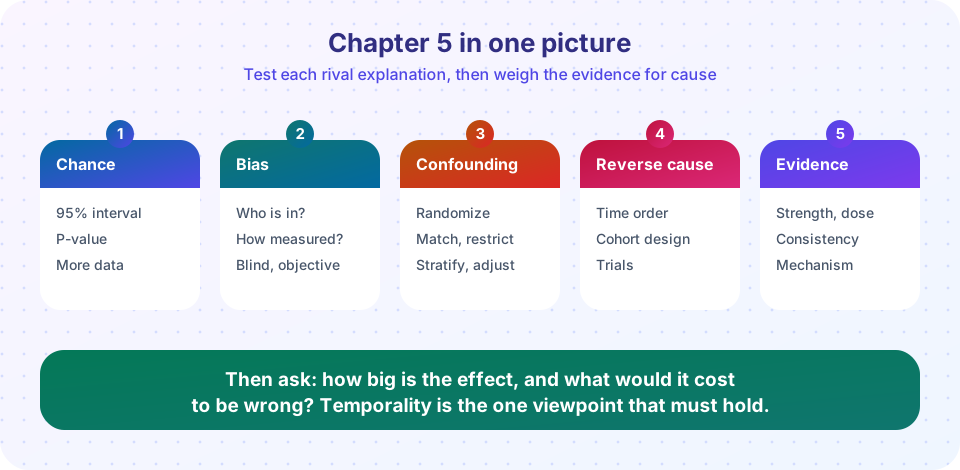
You have now met the main reasons an association can mislead, and the main tools for judging whether it reflects a cause. This review pulls the chapter together in one picture, one table and one quiz. If a row of the table feels shaky, go back to the lesson named in it.
Recap table
| Idea | One-sentence summary | Lesson |
|---|---|---|
| Association vs cause | An association has five possible explanations; only one is a true cause. | Overview |
| Chance | Random variation; quantified with confidence intervals and p-values, shrinks with sample size. | Overview |
| Confounding | A third factor linked to exposure and outcome, not on the causal path, mixes its effect with the exposure's. | Confounding |
| Simpson's paradox | A crude association can reverse once you stratify; causal structure decides which is right. | Confounding |
| Control of confounding | Randomization, restriction, matching, stratification, standardization, regression. | Confounding |
| Bradford Hill viewpoints | Nine ways to weigh evidence; temporality is essential, none is a checklist item. | Hill |
| Selection bias | Who is in the analysis differs from the target population in a way tied to exposure and outcome. | Bias |
| Information bias | Wrong measurement; nondifferential tends to shrink toward the null, differential can go either way. | Bias |
The reasoning routine
When you read a claim such as "people who do X have more Y", run this routine in your head.
- Is the association real? Look at the effect size, the confidence interval and whether the numbers are plausible. This addresses chance.
- Who was studied, and how were they chosen? Think about selection bias and loss to follow-up.
- How were exposure and outcome measured? Think about recall, interviewer and detection bias, and misclassification.
- What else could explain it? List possible confounders, ask whether they were measured and how well, and whether the authors adjusted for something that sits on the causal path.
- Could the outcome have affected the exposure? Think about reverse causation.
- What do the broader viewpoints say? Time order, dose-response, consistency across studies, plausibility, evidence from interventions.
- How much would it matter if you are wrong? The more costly the action, the stronger the evidence you should want.
Five short cases to practice on
Reasoning improves with repetition. Read each scenario, name the most likely problem, and then compare your answer with the discussion.
Case 1: vitamin supplements and long life. Observational studies often find that supplement users live longer. People who take supplements tend to be better educated, wealthier, less likely to smoke and more likely to exercise and see a doctor, which is called healthy-user bias and is a form of confounding. Adjusting for the measured factors helps, but residual confounding is likely, because "health consciousness" is hard to measure. Randomized trials of several vitamins and supplements have mostly not reproduced the large benefits seen in observational data. The lesson: when users and non-users differ in many ways, you should expect confounding, and ask whether there is trial evidence.
Case 2: red wine and heart disease. Studies in the 1980s and 1990s reported that light drinkers had fewer heart attacks than non-drinkers, giving a "J-shaped" curve. One known problem is the sick quitter effect: the non-drinker group included former drinkers who had stopped because of illness, which made abstainers look unhealthy. Another is confounding by social class and diet. This is a good example of a comparison group that is not what it appears to be, a selection problem, and it is why many researchers now separate lifelong abstainers from former drinkers, and use genetic methods that avoid some of these biases.
Case 3: mobile phones and brain tumors. Case-control studies asked patients with brain tumors and healthy controls about past phone use. Patients, who were searching for explanations of their illness, may have remembered or reported their use differently, so recall bias is a concern, and participation rates among controls were lower than among cases. Meanwhile, national brain tumor rates did not rise in step with the large rise in phone use, which counts against a large effect (a point about coherence). The honest summary is that evidence of harm is limited and inconsistent, and that the main studies have known biases. This is not the same as proof of safety, and research continues as technology changes.
Case 4: exercise and depression. People who exercise more report fewer depressive symptoms in cross-sectional surveys. Which came first? Depression itself reduces energy and motivation, which makes people exercise less (reverse causation), and a third factor such as employment or social support might affect both. Longitudinal studies and randomized trials of exercise programs are needed to untangle the directions, and temporality is the first thing to check.
Case 5: a hospital-based study of two conditions. A researcher studies patients admitted to one hospital and finds that people with a certain skin condition rarely have a certain metabolic disease. If either condition can lead to admission, this is classic Berkson's bias, and the population-level relationship may be absent. The remedy is to sample from the population or from a community register instead of from hospital admissions.
Traps that catch students in exams
- Confusing confounders and mediators. Ask whether the factor is on the pathway from exposure to outcome. If yes, adjusting for it removes part of the effect.
- Treating a statistically significant result as proof of cause. A tiny p-value addresses chance only; it says nothing about bias or confounding.
- Assuming misclassification always biases toward the null. That is true only for simple nondifferential error in a binary exposure.
- Treating Hill's viewpoints as a scoring checklist. Temporality is essential; others are supportive; none is decisive.
- Forgetting direction. When you name a bias, also say which way it pushes the estimate, and whether it could explain the whole finding.
- Using survival after diagnosis to judge screening. Lead-time and length-time bias make this misleading (chapter 7).
Try it
A decision-practice tool: choose a claim and see which suspects to investigate first. It is a rehearsal aid, not an analysis of the claim itself.
A second, quantitative review: use Python to see how sample size shrinks random error but leaves bias untouched.
Press Run (or Ctrl + Enter) to see the result here.
Program input · what you'd type while the program runs
Type the answers before you press Run, one per line. Each time the program reads a line (with input()), it gets the next line from this box.
Check your understanding
Quick check · 10 questions
of 10 answered You scored / 10 · perfect!
-
1. A study finds that Simpson's paradox is present: the crude association is positive and the stratified associations are negative. What should you do first?
Statistics alone cannot say which answer is right. The causal role of the third variable decides it. -
2. Which of the following must be true for a variable to be a confounder?
Those are the three standard conditions. -
3. Which Bradford Hill viewpoint is the only one that must hold?
A cause must precede its effect. -
4. Nondifferential misclassification of a binary exposure usually has which effect?
Random measurement error blurs the contrast between groups. -
5. Comparing factory workers with the general population is vulnerable to which bias?
Ill people are less likely to be employed, so workers are healthier than average. -
6. Which design step is most effective against interviewer bias?
Blinding stops interviewers from probing cases more thoroughly. -
7. People with early heart disease reduce salt, so salt appears protective. Which problem is this?
The outcome influenced the exposure. -
8. Why can a very large biased study be worse than a small unbiased one?
Precision without validity can be misleading. -
9. Adjusting for a mediator in an analysis will usually:
A mediator carries part of the effect that you wish to estimate. -
10. Which method balances unmeasured confounders on average?
Only random allocation balances unknown factors in expectation.
Summary
- Every association must survive tests for chance, bias, confounding and reverse causation.
- Hill's viewpoints help weigh evidence but never replace judgment.
- Good design prevents bias; analysis can only partly repair it.
- You are now ready to apply these ideas to infectious disease in chapter 6.
Track your progress
Create a free account to tick off lessons and pick up where you left off on any device.
of Public Health and Epidemiology lessons completed