


















Lesson 24 of 46 · Causation and Bias
The Bradford Hill Viewpoints
Austin Bradford Hill's nine viewpoints for judging whether an association is causal, with the smoking and lung cancer evidence, common misreadings and a scoring demo.
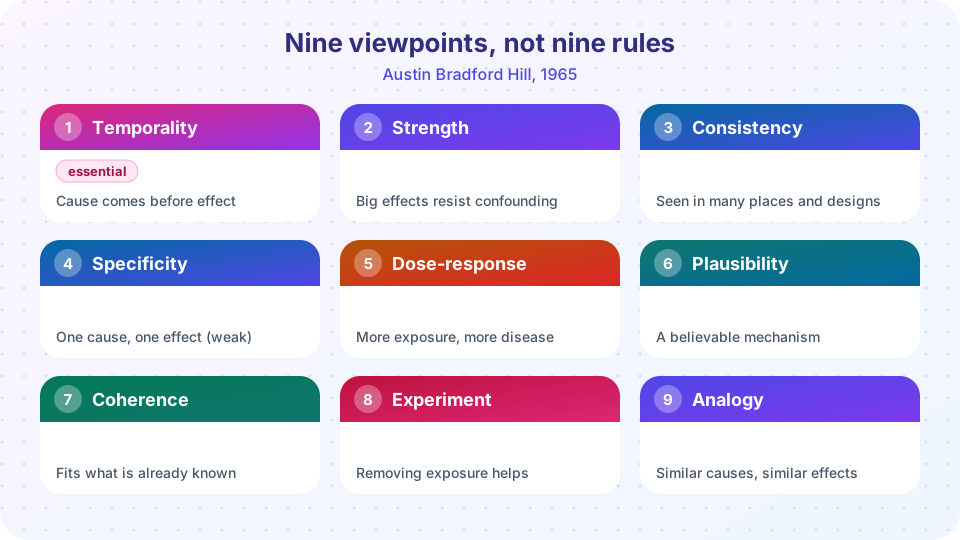
In 1965 the statistician Sir Austin Bradford Hill gave an address to the Royal Society of Medicine called "The Environment and Disease: Association or Causation?" It listed nine "viewpoints" that help a scientist decide whether an observed association is likely to be causal. They have been taught as the "Bradford Hill criteria" ever since, and are probably the most cited framework in epidemiology.
Hill was careful. He did not offer a checklist that gives a yes or no answer. He wrote that none of the viewpoints could bring "indisputable evidence for or against the cause-and-effect hypothesis", and he warned against treating them as rules. They are a structured way of thinking, not a calculator. This lesson explains each viewpoint with examples and shows how they were applied to the most famous causal question in public health: does smoking cause lung cancer?
What you will learn
- Name and explain the nine Bradford Hill viewpoints.
- Apply them to the smoking and lung cancer evidence.
- Explain why temporality is essential and specificity is weak.
- Avoid the common error of treating the viewpoints as a scoring checklist.
Key terms
Temporality: the cause must come before the effect.
Dose-response (biological gradient): more exposure leads to more disease.
Consistency: the same finding appears in different people, places and study designs.
Plausibility: a believable biological mechanism, given current knowledge.
Causal inference: the process of reasoning from evidence to a judgment about cause.
The nine viewpoints
1. Strength of association
A large risk ratio is harder to explain away with a small unmeasured confounder. In the British doctors cohort study begun by Doll and Hill in 1951, heavy smokers had lung cancer death rates many times those of non-smokers, more than ten times in early reports. For comparison, a risk ratio of 1.2 could easily be produced by modest confounding. Strength supports causation, but a weak association can still be causal. The link between second-hand smoke and lung cancer is a modest increase in risk, and it is considered causal.
2. Consistency
Different investigators, in different populations, using different designs, find the same thing. By 1964 dozens of studies in several countries, both case-control and cohort, had linked cigarettes with lung cancer. Consistency makes it unlikely that one flaw in one design explains everything. The reverse also holds: inconsistent results are not necessarily disproof, because real effects can differ across groups.
3. Specificity
One cause leads to one effect. Hill himself called this the weakest viewpoint: smoking causes many diseases (lung cancer, heart disease, emphysema, several other cancers), and many diseases have several causes. Where specificity is present, it helps; its absence says very little.
4. Temporality
The cause precedes the effect. This is the one viewpoint that is logically necessary. It is easy to check in a prospective cohort and hard in a cross-sectional survey, where exposure and outcome are measured at the same moment. Beware slow diseases: a condition that is still undiagnosed may change behavior (people with early illness lose their appetite, change their diet or stop drinking) and so create reverse causation.
5. Biological gradient (dose-response)
Risk rises with dose or duration. In smoking studies, lung cancer risk increased with the number of cigarettes per day and with years of smoking, and it fell among those who quit. A gradient is persuasive because confounders rarely line up so neatly with exposure level. Some real effects, though, have thresholds or follow U-shaped curves.
6. Plausibility
The link makes biological sense. Tobacco smoke contains carcinogens such as benzo[a]pyrene that damage DNA. Hill warned that plausibility depends on the knowledge of the day: John Snow's finding that cholera was water-borne in 1854 was not plausible to those who believed in miasma, and it was correct anyway.
7. Coherence
The causal interpretation should not conflict with what is known about the disease's natural history and biology. Rising lung cancer rates followed the rise of cigarette consumption by several decades, and rates in women rose later when women began smoking in large numbers.
8. Experiment
Evidence from interventions: removing the exposure should reduce disease. Randomized trials are the best form of this evidence, but often impossible for harmful exposures. Natural experiments count: when people quit smoking, their risk falls over time compared with continuing smokers, and when a country introduces a smoking ban, hospital admissions for heart attacks have in several studies dropped.
9. Analogy
Similar exposures cause similar effects. If one drug (thalidomide) can cause birth defects, it is not surprising that another might. Hill admitted this is the weakest kind of reasoning because scientists can often find analogies for anything.
Using the viewpoints well
Modern commentators suggest several ways to avoid misusing the list.
- Do not add up scores. Some viewpoints (temporality) are essential, others (specificity, analogy) are weak. A tally of "seven out of nine" is not a probability of causation.
- Weigh the quality of evidence behind each. Consistent findings from ten studies with the same bias add little.
- Start with good study design and bias assessment. Hill's address begins by saying that the association must first be "clear-cut" and not explained by chance or bias; the viewpoints come after that step.
- Combine with newer tools. Causal diagrams, sensitivity analyses and approaches that triangulate evidence from methods with different biases (for example a cohort study plus a Mendelian randomization study plus a trial) address problems Hill did not discuss.
The Surgeon General's Advisory Committee report on smoking and health (1964) is a good model. It reviewed thousands of articles and used explicit criteria very like Hill's before concluding that cigarette smoking is a cause of lung cancer in men. The conclusion rested on many lines of evidence rather than any single study.
Common misconceptions
"The criteria are a test: pass five out of nine and it is causal." Hill described them as viewpoints, not rules, and said no single one is required except temporality.
"No specificity means no causation." Many causes have multiple effects. Smoking is the standard example.
"Hill proved smoking causes cancer." Doll and Hill produced key evidence, and a large body of research by many groups, including later laboratory work and trials of smoking cessation, built the case.
Try it
Rate a causal claim with the nine viewpoints. The tool below is a thinking aid: it lists your ratings but, like Hill, does not output a verdict.
The second demonstration illustrates the dose-response viewpoint. It uses invented numbers that follow the typical shape of a gradient, and compares them with a confounded pattern that is flat once you look within groups.
Press Run (or Ctrl + Enter) to see the result here.
Program input · what you'd type while the program runs
Type the answers before you press Run, one per line. Each time the program reads a line (with input()), it gets the next line from this box.
Check your understanding
Quick check · 5 questions
of 5 answered You scored / 5 · perfect!
-
1. Which Bradford Hill viewpoint is logically necessary for a causal claim?
A cause must precede its effect. The other viewpoints add support but are not strictly required. -
2. Why is specificity considered a weak viewpoint?
Smoking causes many diseases, so lack of specificity does not argue against causation. -
3. A study finds that lung cancer risk rises steadily with cigarettes per day. Which viewpoint is this?
A dose-response pattern is the biological gradient. -
4. What is the best way to use the Hill viewpoints?
Hill described them as viewpoints that support judgment, not rules. -
5. Hill's approach to plausibility warns that it depends on what?
A mechanism that seems implausible today may be understood tomorrow, as with Snow's cholera finding.
Summary
- Hill's nine viewpoints are strength, consistency, specificity, temporality, biological gradient, plausibility, coherence, experiment and analogy.
- Temporality is necessary; specificity and analogy are weak; none of them is a pass-or-fail rule.
- The smoking and lung cancer case combined many lines of evidence over decades.
- Use the viewpoints after you have addressed chance, bias and confounding, and weigh the quality of evidence rather than counting ticks.
Track your progress
Create a free account to tick off lessons and pick up where you left off on any device.
of Public Health and Epidemiology lessons completed