


















Lesson 20 of 46 · Study Designs
Randomized controlled trials: assigning exposure by chance
Learn how randomized controlled trials work, from Lind's scurvy test and the Salk polio trial to randomization, allocation concealment, blinding, intention-to-treat and ethics.
In 1747 a Royal Navy surgeon named James Lind took twelve sailors with scurvy aboard HMS Salisbury, kept them in similar conditions on the same diet, and gave pairs of them six different remedies: cider, elixir of vitriol, vinegar, seawater, a spice paste, and two oranges and a lemon daily. The pair who received the citrus fruit recovered fastest. It was a small and imperfect experiment, but it is remembered because of its logic: compare treatments in people who were as similar as possible, changing only one thing.
Modern randomized controlled trials (RCTs) apply this logic with a powerful addition, random assignment. They are the best tool epidemiology has for judging whether an intervention works, because randomization tackles the problem that haunts every observational study: confounding. This lesson explains how a trial is built, why each safeguard exists, and what trials cannot do.
What you will learn
- The structure of an RCT and why randomization works.
- Allocation concealment, blinding, placebos and the intention-to-treat principle.
- Landmark trials and the ethical rules that govern human experiments.
- Strengths and limits, including generalizability.
Key terms
- Randomization: assigning participants to groups by a chance process so that every participant has a known probability of each assignment.
- Allocation concealment: hiding the upcoming assignment from the people enrolling participants, so they cannot influence who gets what.
- Blinding (masking): keeping participants, investigators or outcome assessors unaware of the assignment.
- Placebo: an inactive treatment that looks like the real one.
- Intention-to-treat (ITT): analyzing participants in the groups they were randomized to, whatever treatment they actually received.
The basic structure
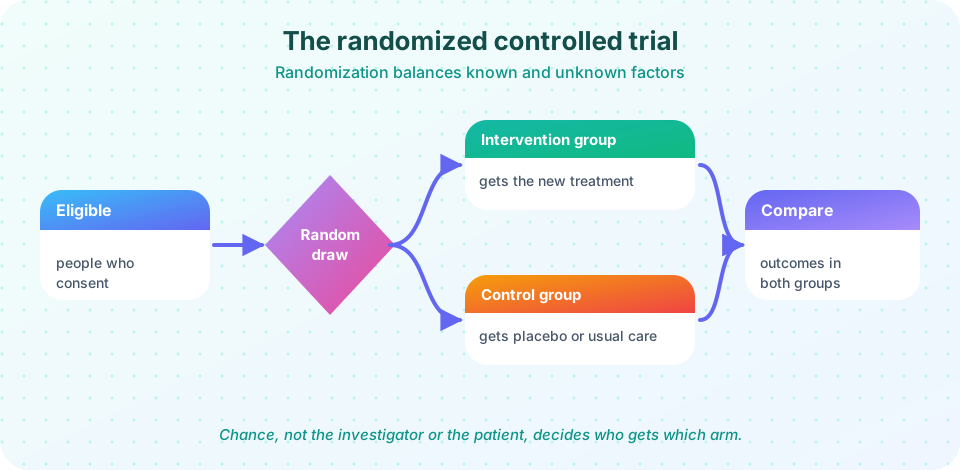
- Define the question and the population, with eligibility criteria and a specific primary outcome (for example, hospital admission for influenza within 6 months).
- Obtain informed consent from every participant.
- Randomize eligible, consenting participants into an intervention group and a control group (which receives a placebo, standard care or no intervention).
- Deliver the interventions and follow everyone in the same way, for the same time.
- Measure outcomes in both groups and compare them with a risk ratio, risk difference or hazard ratio.
- Analyze by intention to treat, and report all participants using a standard flow diagram (the CONSORT statement).
Why randomization is so powerful
In an observational study, people who choose a treatment differ from those who do not: they may be healthier, wealthier or more health-conscious, and those same differences affect the outcome. This is confounding. If a doctor decides who gets a new drug, she may give it to the patients she thinks will respond best.
Random assignment breaks the link between the characteristics of the participants and the treatment they receive. With a large enough sample, the groups will be balanced on all characteristics at baseline, including those that nobody measured or even knows about, so a difference in outcomes can be attributed to the intervention (or to chance, which statistics can quantify). The first demonstration shows this with a simulation. A treatment truly reduces risk by 40 percent (risk ratio 0.60). When healthier people choose the treatment, the observational estimate is about 0.33, wildly exaggerating the benefit, while the randomized comparison gives a value near 0.60. The mean frailty of the two randomized groups is the same; in the observational data they differ greatly. Randomization is not magic: with small trials, chance imbalances can occur, and the "same on average" guarantee refers to repeated trials, not to one particular sample.
Methods of randomization
- Simple randomization: like a coin toss. Easy but, in small trials, can create unequal groups.
- Block randomization: assignments are made in blocks (for example four at a time, two to each arm) so the groups stay balanced throughout recruitment. The second demonstration shows a permuted-block list.
- Stratified randomization: separate lists for important subgroups (such as study site or severity) to ensure balance within them.
- Cluster randomization: groups, such as schools, villages or clinics, are randomized rather than individuals. It suits interventions delivered to a group, for example a hand-washing program, or where contamination between individuals would be a problem. The analysis must account for similarity within clusters.
Allocation concealment
Randomization works only if the person recruiting a participant cannot foresee the next assignment. If a doctor can see that the next allocation is "placebo", he might decide not to enroll a seriously ill patient, which destroys the comparability. The Medical Research Council's 1948 trial of streptomycin for tuberculosis, led by Austin Bradford Hill, is often called the first modern randomized trial because it assigned patients using random numbers kept in sealed envelopes, so that the doctors in each hospital did not know in advance who would receive the drug. Today concealment uses central telephone or web systems.
Blinding and placebos
Participants who know they are receiving a treatment may feel better (the placebo effect), report more or fewer side effects, or change behavior; investigators who know the assignment may assess outcomes differently. Blinding reduces these biases. In a single-blind trial participants do not know their assignment, in a double-blind trial neither participants nor investigators do, and sometimes outcome assessors and analysts are also masked. The control group receives a placebo, an inert substance identical in appearance. When the intervention cannot be blinded (a surgery, a school program), use objective outcomes (death, a laboratory test) and blinded outcome assessors.
Analysis: intention to treat
Suppose some participants assigned to the treatment never take it, and some assigned to control obtain it elsewhere. Should you analyze people by the treatment they received (per-protocol) or by the group they were assigned to (intention-to-treat)? The per-protocol approach destroys the randomization: those who stick with a treatment may be different from those who stop (perhaps because of side effects, or because they feel ill). ITT preserves the balance and answers the practical question "what is the effect of offering this treatment in the real world?", although it dilutes the effect when many do not adhere. Both analyses are usually reported, with ITT as the primary one.
Landmark trials
- Lind's scurvy trial (1747): a pioneer comparison of treatments.
- MRC streptomycin trial (1948): the first widely recognized randomized trial with concealed allocation, showing a benefit in tuberculosis.
- Salk polio vaccine field trial (1954): one of the largest health experiments ever. Well over a million American children took part. In some areas the vaccine was compared with a placebo injection in a double-blind design; in others, second-grade children were vaccinated while first and third graders served as untreated comparisons. Analysis led by Thomas Francis Jr. at the University of Michigan found that the vaccine was safe and effective, announced in April 1955. The trial also illustrated the value of the placebo-controlled design: the observed-control areas were more open to bias, because who agreed to participate differed.
Phases of clinical trials
New medicines pass through phases: Phase I (small groups, safety and dosing), Phase II (several hundred people, preliminary effectiveness and side effects), Phase III (large randomized trials confirming benefit and monitoring harms, often thousands of participants) and Phase IV (post-marketing surveillance after approval). Rare adverse effects may only be detected in Phase IV, because the earlier trials are too small.
Ethics
Experiments on people are justified only if participants are protected. After the atrocities of Nazi doctors, the Nuremberg Code (1947) required voluntary consent. The World Medical Association's Declaration of Helsinki (1964, revised many times) set rules for research ethics. The Tuskegee study, in which the US Public Health Service observed Black men with syphilis from 1932 to 1972 without informing them or giving effective treatment when it became available, was an observational study, not a trial, but its exposure led to the Belmont Report (1979): respect for persons, beneficence and justice. A trial is ethical only if there is genuine uncertainty about which arm is better (equipoise), participants give informed consent and an independent data and safety monitoring board can stop the trial early if one arm proves clearly better or harmful.
Strengths and limits
Strengths: the strongest protection against confounding and selection bias; clear temporal order; allows blinding; can test an intervention directly.
Limits:
- Cost and time: large trials may cost millions and take years.
- Ethics: you cannot randomize people to a harmful exposure such as smoking.
- Generalizability: participants are often healthier or more motivated than real patients, and trial conditions differ from everyday practice (the difference between efficacy in ideal conditions and effectiveness in practice).
- Short follow-up: long-term and rare harms may be missed.
- Not everything can be randomized: laws, economic changes and environmental exposures often require natural experiments or observational designs.
Common misconceptions
"Randomization guarantees identical groups." It balances groups in expectation; in a small trial chance imbalances still happen.
"Randomized trials are always right." A poorly designed or biased trial can mislead, and a single trial may not generalize. Replication and systematic reviews matter.
"Randomizing means choosing patients at random." It means assigning willing, eligible participants to groups at random, not selecting participants from the population at random.
"Dropouts can simply be excluded." Excluding them breaks the randomization; ITT analysis keeps everyone in their assigned group.
Try it
Press Run (or Ctrl + Enter) to see the result here.
Program input · what you'd type while the program runs
Type the answers before you press Run, one per line. Each time the program reads a line (with input()), it gets the next line from this box.
Press Run (or Ctrl + Enter) to see the result here.
Program input · what you'd type while the program runs
Type the answers before you press Run, one per line. Each time the program reads a line (with input()), it gets the next line from this box.
Check your understanding
Quick check · 6 questions
of 6 answered You scored / 6 · perfect!
-
1. What is the main advantage of randomization?
Random assignment breaks the link between participant characteristics and treatment, controlling confounding. -
2. What does allocation concealment protect against?
Concealment prevents selection bias at enrollment; blinding protects against bias after assignment. -
3. In an intention-to-treat analysis, participants are analyzed
ITT preserves the balance created by randomization. -
4. A double-blind trial means
Both participants and investigators are masked to reduce biased reporting and assessment. -
5. Which question is a trial LEAST suited to answer?
It would be unethical to randomize people to smoke, so such questions rely on observational evidence. -
6. Cluster randomization randomizes
Whole groups are assigned, which suits group-level interventions and avoids contamination.
Summary
- A randomized controlled trial assigns participants to intervention or control by chance, which balances known and unknown confounders in expectation.
- Safeguards: allocation concealment, blinding, placebo, intention-to-treat analysis and ethical oversight (consent, equipoise, monitoring boards).
- Landmark trials: Lind (1747), streptomycin (1948), Salk (1954).
- Trials are costly, sometimes unethical or impractical, and their results may not generalize, so epidemiologists combine designs.
Next: Chapter 4 review
Track your progress
Create a free account to tick off lessons and pick up where you left off on any device.
of Public Health and Epidemiology lessons completed