


















Lesson 21 of 46 · Study Designs
Chapter 4 review: study designs compared
Review chapter 4: descriptive, cross-sectional, ecological, cohort, case-control and randomized designs, compared by direction, measures, strengths and weaknesses, with a ten-question quiz.
You can now do more than read a study: you can classify it, say what it can and cannot show, and suggest a better design when the question demands one. This review compares all the designs in one place, gives you a scenario trainer and a ten-question quiz, and prepares you for chapter 5, which asks the hardest question in epidemiology: when is an association a cause?
What you will learn
- A side-by-side comparison of the designs.
- How to match a research question to a design.
- Key weaknesses of each design, which chapter 5 explores in depth.
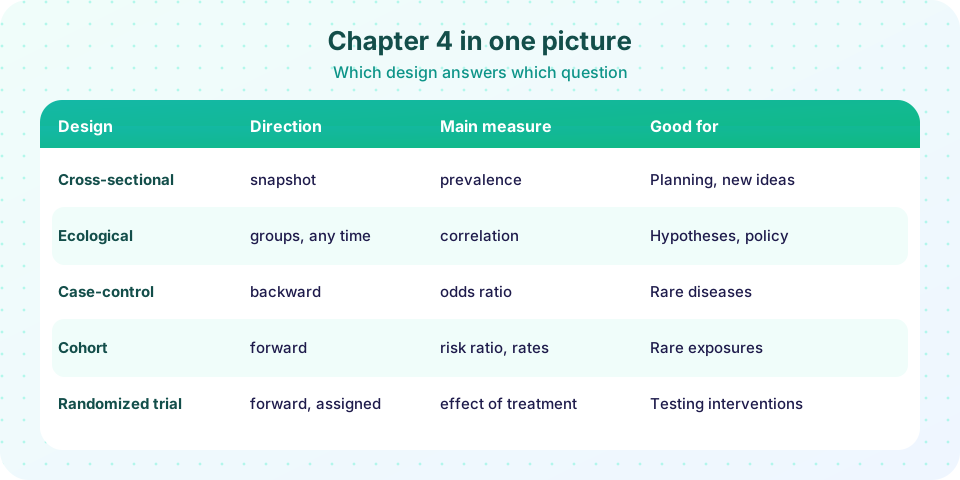
Chapter in one table
| Design | Starting point | Direction | Main measure | Main strength | Main weakness |
|---|---|---|---|---|---|
| Case report or series | A few unusual patients | None | None (description) | Spots new problems | No comparison group |
| Cross-sectional | A sample of the population | Snapshot | Prevalence, prevalence ratio | Cheap; good for planning | No temporal order |
| Ecological | Groups (countries, regions) | Any | Correlation | Uses routine data | Ecological fallacy |
| Case-control | Cases and controls | Backward | Odds ratio | Efficient for rare diseases | Recall and selection bias |
| Cohort | Exposed and unexposed | Forward | Risk ratio, rate ratio, hazard ratio | Temporality; several outcomes | Costly; loss to follow-up |
| Randomized trial | Eligible participants | Forward (assigned) | Risk ratio, risk difference | Controls confounding | Cost, ethics, generalizability |
Matching questions to designs
- "How common is hypertension among adults in this city?" Cross-sectional survey.
- "Does a very rare birth defect relate to a medicine taken during pregnancy?" Case-control.
- "Do workers exposed to a solvent develop more liver disease over 20 years?" Cohort (retrospective if records exist).
- "Does a new school-meal program reduce childhood obesity?" Cluster randomized trial, if feasible.
- "Do countries with more fast-food outlets have higher obesity rates?" Ecological, remembering the fallacy.
- "Five patients arrive with the same strange rash." Case series, then investigate.
A reminder about the measures
The design determines the measure. A trial or cohort gives risks, so you can compute risk ratios and differences. A case-control study gives only the odds ratio. A cross-sectional study gives prevalence and prevalence ratios. An ecological study gives correlations between group averages. Quote the measure that the design supports, not the one that sounds familiar.
A worked comparison
A new vaccine is under study. Researchers can (a) run a randomized trial, (b) follow vaccinated and unvaccinated people in a cohort after launch, or (c) compare vaccination history of people with and without the disease in a case-control study. The trial gives the cleanest estimate of vaccine efficacy but only under trial conditions. The cohort study reflects real-world effectiveness and can track rare side effects, but the people who choose vaccination may differ in other ways. The case-control study, often using a test-negative design (controls are people tested for the disease who test negative), is quick and cheap and is widely used for seasonal vaccines, but depends on careful choice of controls. In practice, programs use all three in sequence: trials before approval, cohort and case-control studies afterward.
Pitfalls to remember
- Treating an ecological correlation as an individual-level effect.
- Reading a cross-sectional association as proof of order in time.
- Using risk language for a case-control study, which can only give odds ratios.
- Ignoring loss to follow-up in cohorts, and recall bias in case-control studies.
- Assuming a trial's result applies unchanged to everyone, whatever their health or circumstances.
Looking ahead
All the observational designs share one problem: the groups compared are not identical, so a difference in outcomes may reflect something other than the exposure. Chapter 5 gives that problem its names (confounding, selection bias, information bias, chance) and shows how epidemiologists reason about causes in spite of it.
Try it
Check your understanding
Quick check · 10 questions
of 10 answered You scored / 10 · perfect!
-
1. Which design can estimate incidence and risk directly AND establish that exposure preceded outcome, without randomization?
Cohort studies follow exposed and unexposed groups forward, so risks, rates and temporal order are observed. -
2. A rare cancer is suspected to be related to a medication. The most efficient design is
Case-control studies sample cases and controls, so a rare disease does not require following huge numbers of people. -
3. Which design is most vulnerable to the ecological fallacy?
Group-level data cannot show what happens to individuals within the groups. -
4. Which measure is the natural output of a case-control study?
Because the numbers of cases and controls are fixed by the investigator, only odds of exposure can be compared. -
5. Randomization helps mainly because it
Assignment by chance breaks the link between participant characteristics and treatment. -
6. A cross-sectional study finds that depression is more common among unemployed people. What cannot be concluded?
Exposure and outcome are measured at the same time, so the direction cannot be known. -
7. Which problem is MOST typical of case-control studies?
Past exposures are reported after disease has occurred, and cases may recall them differently from controls. -
8. A new vaccine is compared with placebo in a trial. Participants are analyzed in the groups to which they were assigned, even if some stopped taking the vaccine. This is
ITT keeps participants in their assigned groups, preserving randomization. -
9. Which is a limitation of randomized trials?
Trials are strong against confounding but can be costly, short, ethically impossible for some exposures and limited in generalizability. -
10. An outbreak team compares attack rates among people who ate and did not eat each food at a banquet. This is closest to
The banquet attendees form a small cohort followed from exposure (eating) to outcome (illness).
Summary
- Descriptive designs generate hypotheses; analytic designs test them.
- Cohort: forward, risks and rates. Case-control: backward, odds ratio. Cross-sectional: snapshot, prevalence. Ecological: group-level, vulnerable to the fallacy. Randomized trial: assigned, strongest against confounding.
- The right design depends on the question, how rare the outcome and exposure are, and ethics and budget.
- Chapter 5 asks when an association can be treated as a cause.
Track your progress
Create a free account to tick off lessons and pick up where you left off on any device.
of Public Health and Epidemiology lessons completed