


















Lesson 44 of 46 · Projects and Practice
Epidemiology Glossary: Key Terms from A to Z
A plain-language glossary of epidemiology and public health terms from the second half of the course: bias, confounding, R0, PAF, DALY, screening measures, equity and policy terms.
Epidemiology has a precise vocabulary, and many words that are casual in everyday speech (rate, risk, cause, significant) have exact meanings here. This glossary collects the key terms from chapters 5 to 8, and a few from earlier chapters that they depend on. Definitions are brief; the lesson names tell you where to read more.
What you will learn
- Recognize and define the main terms of the second half of the course.
- Tell apart pairs that are easy to confuse, such as incidence and prevalence, efficacy and effectiveness, or inequality and inequity.
- Use the flashcards to practice.
Key terms
Exposure: any factor that may affect the chance of disease.
Outcome: the health event being studied.
Risk: probability of an outcome over a period.
Rate: events per unit of person-time.
Population at risk: people who can develop the outcome.
Causation and bias
| Term | Meaning |
|---|---|
| Association | A statistical link between exposure and outcome. |
| Bias | Systematic error in design, conduct or analysis. |
| Bradford Hill viewpoints | Nine considerations (strength, consistency, specificity, temporality, gradient, plausibility, coherence, experiment, analogy) for judging causation. |
| Collider | A variable caused by two others; conditioning on it can create a false association. |
| Confounder | A factor linked to exposure and outcome, not on the causal pathway, that distorts the association. |
| Counterfactual | What would have happened under a different exposure. |
| Differential misclassification | Measurement error that differs between compared groups. |
| E-value | The strength of unmeasured confounding needed to explain away an observed association. |
| Effect modification | A real difference in the effect across subgroups. |
| Information bias | Error from inaccurate measurement of exposure or outcome. |
| Mediator | A variable on the causal path between exposure and outcome. |
| Nondifferential misclassification | Measurement error equal across groups, usually biasing toward the null. |
| Recall bias | Cases and controls remember past exposure differently. |
| Residual confounding | Confounding left after adjustment because of poor measurement or unmeasured factors. |
| Reverse causation | The outcome (or its early stage) influences the exposure. |
| Selection bias | The analyzed group differs from the target population in a way tied to exposure and outcome. |
| Simpson's paradox | A reversal of an association when data are split into strata. |
Infectious disease
| Term | Meaning |
|---|---|
| Attack rate | Proportion of an exposed group who become ill. |
| Case definition | Standard criteria for counting a case. |
| Epidemic curve | A histogram of cases by date of symptom onset. |
| Fomite | An inanimate object that carries infectious agents. |
| Herd immunity threshold | The immune fraction above which an epidemic declines: 1 - 1/R0. |
| Incubation period | Time from infection to symptoms. |
| R0 | Average secondary cases per case in a fully susceptible population. |
| Rt | The effective reproduction number at time t. |
| Reservoir | Where an infectious agent normally lives and multiplies. |
| Serial interval | Time between symptom onsets in successive cases. |
| SIR model | A compartment model of susceptible, infectious and recovered people. |
| Vaccine efficacy | Percent reduction in disease among the vaccinated in a trial: 1 - RR. |
| Vaccine effectiveness | The same measure in routine use. |
| Zoonosis | An infection passed from animals to humans. |
Chronic disease and prevention
| Term | Meaning |
|---|---|
| Attributable fraction | Share of disease among the exposed that is due to the exposure: (RR - 1)/RR. |
| DALY | Disability-adjusted life year: years of life lost plus years lived with disability. |
| Lead-time bias | Apparent longer survival because screening advances the date of diagnosis. |
| Length-time bias | Screening over-detects slow-growing disease. |
| NNT | Number needed to treat: 1 / absolute risk reduction. |
| NPV | Probability of no disease given a negative test. |
| Overdiagnosis | Detecting disease that would never have caused harm. |
| PAF | Share of all cases in a population attributable to an exposure. |
| PPV | Probability of disease given a positive test. |
| Prevention paradox | A measure that benefits the community offers little to each individual. |
| Primordial prevention | Preventing the emergence of risk factors. |
| QALY | Quality-adjusted life year. |
| Sensitivity | Proportion of diseased people who test positive. |
| Specificity | Proportion of healthy people who test negative. |
Systems and policy
| Term | Meaning |
|---|---|
| Health equity | Absence of avoidable, unfair differences in health. |
| Health inequality | Any measurable difference in health between groups. |
| ICER | Extra cost per extra QALY gained. |
| Interrupted time series | A design that compares level and trend before and after an intervention. |
| Natural experiment | An exposure assigned by events outside researchers' control. |
| Pooling | Collecting funds so that risk is shared. |
| Primary health care | First-contact, comprehensive, community-based care. |
| Proportionate universalism | Universal action scaled to disadvantage. |
| Social determinants of health | Conditions of life and the structures that shape them. |
| Social gradient | A stepwise improvement in health along the social ladder. |
| Universal health coverage | Access to needed quality services without financial hardship. |
Easily confused pairs
- Incidence vs prevalence: new cases in a period vs all existing cases at a point or over a period.
- Risk vs rate: probability over a time span vs events per person-time.
- Efficacy vs effectiveness: ideal trial conditions vs routine use.
- Sensitivity vs PPV: starts from diseased people vs starts from positive tests.
- Inequality vs inequity: a measurable difference vs an unfair, avoidable one.
- Confounder vs mediator: a distorting third factor outside the pathway vs a factor on the pathway.
How to learn the terms
Memorizing a list of definitions rarely works. Three habits work better.
Learn terms in pairs and contrasts. Many terms only make sense against their neighbors: sensitivity and specificity, efficacy and effectiveness, confounder and mediator, incidence and prevalence. For each pair, write one sentence that says how they differ, and one example in which you might confuse them.
Attach each term to an example from the course. "Selection bias" is abstract, but "Berkson's bias in a hospital sample" is concrete. "Herd immunity threshold" is easier to remember as "93% for measles". When you read a definition, recall the lesson, the picture and the number that went with it.
Use the term in a sentence about a new situation. Try to describe a news story with the vocabulary: "That study may suffer from recall bias because ..." Being able to apply a term shows that you have understood it, and the flashcards below give practice with quick recall.
Notice also that some words have everyday meanings that differ from their technical ones. "Significant" in statistics refers to a test result, not to importance. "Rate" in strict use means events per person-time, though people say "rate" for any proportion. "Cause" in epidemiology usually means a factor that changes the probability of an outcome, not a factor that always produces it. Being precise with such words is part of the discipline.
Try it
First, flashcards with a random term; try to say the definition before you reveal it.
Second, a quick "which term am I?" game: read a definition and choose the term.
Check your understanding
Quick check · 4 questions
of 4 answered You scored / 4 · perfect!
-
1. Which term describes a variable on the causal pathway between exposure and outcome?
A mediator carries part of the effect from exposure to outcome. -
2. Which pair is correctly defined?
Specificity is TN / (TN + FP). -
3. What is R0?
R0 is the basic reproduction number. -
4. A DALY is made of:
Years of life lost plus years lived with disability.
Summary
- The vocabulary of epidemiology is precise: use terms exactly.
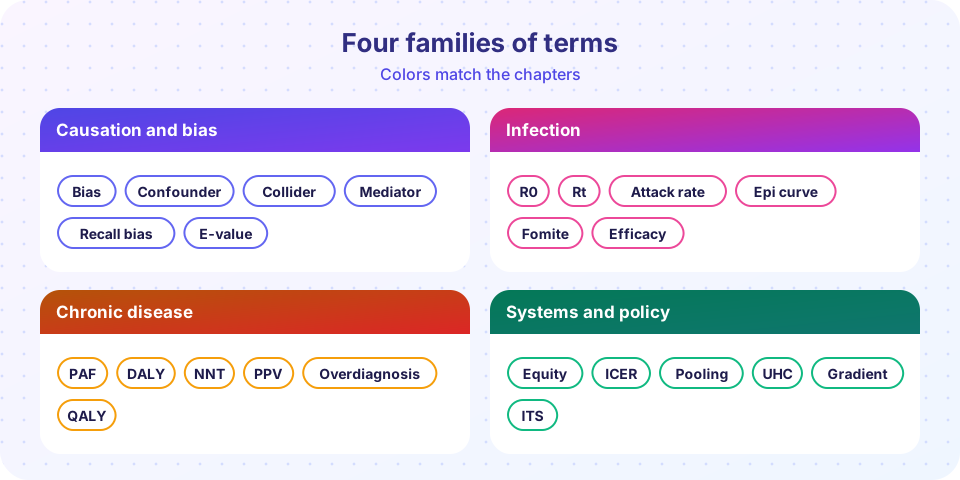
- Terms fall into families: causation and bias, infection, chronic disease and systems and policy.
- Confusable pairs (incidence and prevalence, efficacy and effectiveness, inequality and inequity) deserve special attention.
- Practice with the flashcards until the definitions feel automatic.
Next: Epidemiology cheat sheet
Track your progress
Create a free account to tick off lessons and pick up where you left off on any device.
of Public Health and Epidemiology lessons completed