


















Lesson 32 of 46 · Chronic Disease and Prevention
Chronic Disease and Prevention: Chapter Overview
Chapter 7 overview: why chronic non-communicable diseases dominate modern health, the epidemiologic transition, multifactorial causes, latency, life-course thinking and the lessons ahead.
Over the last century, the main threats to health in most countries have shifted from infections to chronic diseases: heart disease, stroke, cancer, chronic lung disease and diabetes. Together these non-communicable diseases (NCDs) cause roughly three out of every four deaths worldwide according to WHO estimates, and most of those deaths occur in low- and middle-income countries. They also cause long years of disability, which is why they matter for health systems as well as for mortality statistics.
Chronic diseases behave differently from outbreaks. They have many causes rather than one, they develop slowly over years or decades, they are not contagious, and prevention aims to change behavior, environments and policies rather than to stop a germ. This chapter introduces how epidemiologists measure, screen for and prevent them.
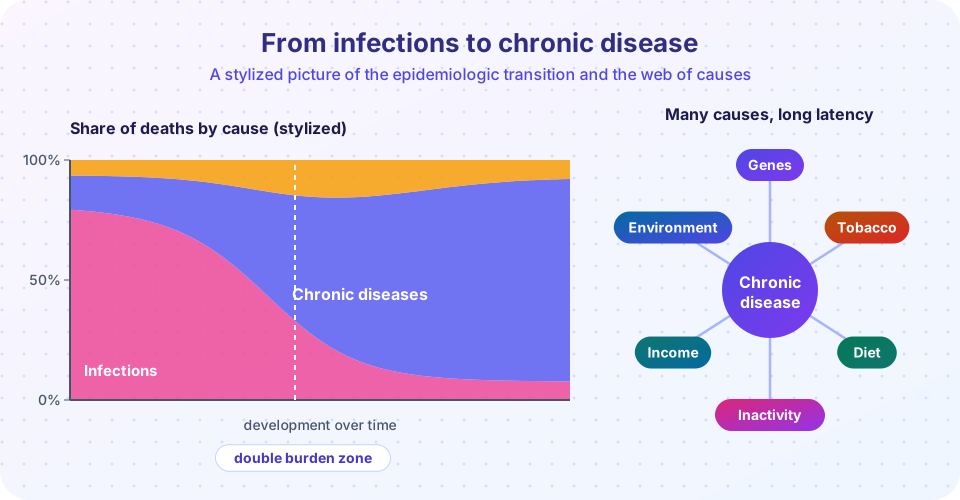
The epidemiologic transition
In 1971 Abdel Omran described the epidemiologic transition, a pattern seen as countries develop:
- The age of pestilence and famine: high death rates from infection and malnutrition, low life expectancy.
- The age of receding pandemics: better nutrition, sanitation and medicine reduce infectious deaths; life expectancy rises.
- The age of degenerative and man-made diseases: people live long enough to develop chronic diseases, and exposures such as tobacco, processed foods and inactivity add risk.
Later authors proposed further stages (delayed degenerative diseases, reemerging infections, and the persistent inequality between and within countries). Many low-income countries now face a double burden: infectious diseases and chronic diseases at the same time. The model describes a general pattern and is not a law: transitions differ in speed and order between countries.
Why chronic diseases are different
- Multifactorial causation. Instead of one necessary cause (a pathogen), there is a web of causes: genes, behavior, environment, social conditions. Brian MacMahon's "web of causation" (1960) captured this view. A pattern called sufficient-component causes (Rothman's pie model) says that a disease occurs when a complete set of component causes is present, and that a component may belong to several sets.
- Long latency. Time passes between exposure and disease, from years to decades. Asbestos exposure and mesothelioma are separated by 20-50 years. This makes causal studies harder: exposure measured today may not reflect the relevant period.
- Gradual development. Many diseases begin with changes (rising blood pressure, plaque in arteries, abnormal cells) long before symptoms. That creates a role for screening and early treatment.
- Not contagious, but socially patterned. Risk factors cluster in social groups and spread through culture, marketing and the built environment, in ways that resemble transmission without a microbe.
- Continuous risk factors. Blood pressure, cholesterol and body weight are continuous measures with risk that rises smoothly. There is no sharp line between "healthy" and "sick".
Risk factors and the Framingham Heart Study
The modern study of chronic disease began with large cohorts. In 1948 the Framingham Heart Study began following residents of Framingham, Massachusetts, to learn what predicts heart disease. Its investigators introduced the term risk factor in a 1961 report, showing that high blood pressure, high cholesterol and smoking predicted heart disease. The study continues across generations and led to risk scores that estimate a person's chance of cardiovascular disease.
A global example is the INTERHEART case-control study (reported in 2004) across 52 countries. It found that a small number of modifiable risk factors (including smoking, abnormal lipids, hypertension, diabetes, abdominal obesity, psychosocial factors, low fruit and vegetable intake, lack of physical activity and alcohol patterns) accounted for the large majority of the population-attributable risk of a first heart attack, around 90%. The result suggested that the same few risk factors matter across cultures.
A life-course view
Risk does not begin in adulthood. The life-course approach looks at how exposures from before birth through old age accumulate. David Barker's work in the 1980s and 1990s linked low birth weight to later heart disease in England, which led to the idea of developmental origins: early nutrition and growth may program later risk. Reasons are debated (confounding by social class has been a concern), and the idea has been refined, but the principle that early life matters is widely accepted. Life-course thinking is also why prevention starts at childhood, with school meals, tobacco controls and safe places to be active.
Why the same few risk factors keep appearing
Tobacco use, high blood pressure, unhealthy diet, physical inactivity, harmful alcohol use, excess body weight, high blood sugar and abnormal blood lipids appear again and again in studies of heart disease, stroke, cancer, diabetes and lung disease. That is because they act through shared biological pathways (inflammation, vessel damage, insulin resistance) and because they are themselves driven by common social and commercial forces: the price and marketing of tobacco, ultra-processed foods and sugary drinks, the layout of cities that makes walking hard, and the stress of insecure work. Prevention aimed at these common causes can therefore reduce several diseases at once, which is one reason chronic disease control is so closely tied to policy.
What each lesson covers
Chapter 7 at a glance
Many causes, long latency
Prevention has levels
| Lesson | You will learn |
|---|---|
| Risk and burden | Absolute and relative risk, attributable fractions, number needed to treat and DALYs. |
| Screening and diagnostic tests | Sensitivity, specificity, predictive values and the biases of screening. |
| Prevention strategies | Levels of prevention, Rose's population and high-risk strategies, and the prevention paradox. |
| Chapter review | A one-page summary and ten questions. |
Key terms
Non-communicable disease (NCD): a disease that is not passed from person to person, typically long-lasting.
Risk factor: an attribute or exposure that is associated with an increased probability of disease.
Latency: the delay between exposure and clinical disease.
Epidemiologic transition: the shift in leading causes of death from infection to chronic disease as societies develop.
Life-course epidemiology: the study of how exposures across life affect later health.
Common misconceptions
"Chronic diseases are just a problem of rich countries." Most NCD deaths now occur in low- and middle-income countries.
"A risk factor is a cause." Some risk factors are causes, some are markers. Chapter 5's tools help to tell the difference.
"If it runs in the family it is purely genetic." Families share genes but also diet, habits, income and environment.
Try it
First, a stylized picture of the epidemiologic transition. The curves are invented to show the shape of the pattern and are not data from any country.
Press Run (or Ctrl + Enter) to see the result here.
Program input · what you'd type while the program runs
Type the answers before you press Run, one per line. Each time the program reads a line (with input()), it gets the next line from this box.
Second, a toy demonstration of multifactorial risk. Each risk factor multiplies a baseline risk by an illustrative factor. The numbers are invented, the tool does not estimate anyone's real risk, and it is not medical advice.
Check your understanding
Quick check · 4 questions
of 4 answered You scored / 4 · perfect!
-
1. Which pattern did Omran describe in 1971?
The epidemiologic transition describes how leading causes of death change with development. -
2. What is latency in chronic disease epidemiology?
For many chronic diseases it spans years or decades. -
3. Which description of chronic disease causation is most accurate?
The web of causation and sufficient-component models reflect multiple contributing causes. -
4. In which setting do most NCD deaths now occur?
Most NCD deaths occur in low- and middle-income countries because they hold most of the world's population.
Summary
- NCDs cause most deaths worldwide and the burden is greatest in low- and middle-income countries.
- The epidemiologic transition describes the move from infectious to chronic causes of death.
- Chronic diseases have multiple causes, long latency and continuous risk factors.
- Cohorts like Framingham and case-control studies like INTERHEART identified the main modifiable risk factors.
- Life-course thinking shows why prevention begins early.
Next: Risk and burden
Track your progress
Create a free account to tick off lessons and pick up where you left off on any device.
of Public Health and Epidemiology lessons completed