


















Lesson 27 of 46 · Infectious Disease Epidemiology
Infectious Disease Epidemiology: Chapter Overview
Chapter 6 overview: the epidemiologic triad, the chain of infection, modes of transmission, incubation and infectious periods, and what each lesson in the chapter covers.
Infectious diseases differ from most other health problems in one important way: cases cause more cases. If you reduce the number of smokers, each ex-smoker's risk falls. If you reduce the number of people infected with measles, you lower the risk of everyone around them, even people who never met an infected person. That feedback loop explains why outbreaks grow explosively, why vaccination protects people who are not vaccinated, and why a few days of delay can matter enormously.
This overview gives you the vocabulary and the mental model for the whole chapter: the chain of infection, the epidemiologic triad, and the timing words (incubation, latent and infectious periods) that determine how fast a disease spreads.
The epidemiologic triad
Epidemiologists describe infectious disease as the interaction of three things:
- Agent: the microbe (virus, bacterium, parasite, fungus or prion) and its properties: infectivity, pathogenicity, virulence.
- Host: the person (or animal) who may become infected, with their age, immunity, nutrition and behavior.
- Environment: everything that brings agent and host together, including climate, crowding, water, sanitation and health services.
A disease occurs when all three align. For malaria that means Plasmodium parasites, a person without immunity and an environment with Anopheles mosquitoes. Prevention can target any corner: treat the agent, immunize the host, drain the mosquito breeding site.
The chain of infection
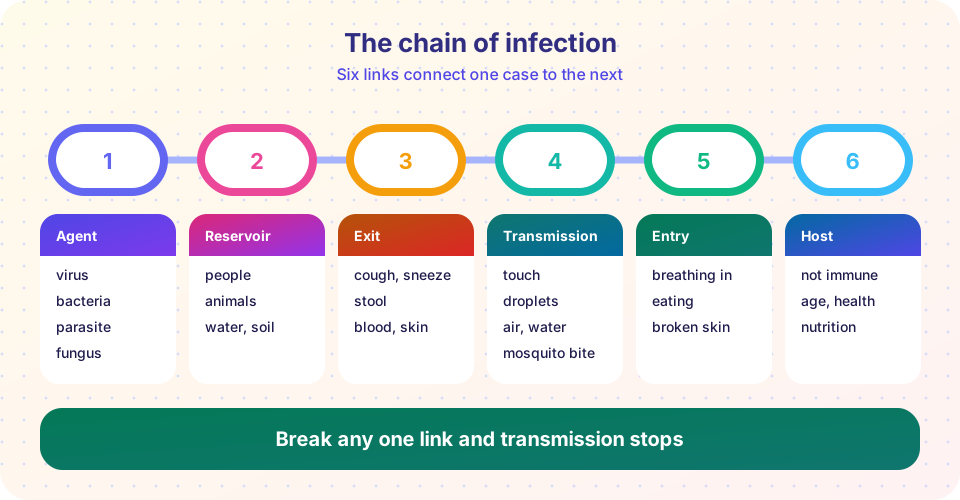
Six links connect one infected person to the next.
- Infectious agent. The pathogen itself.
- Reservoir. Where the agent normally lives and multiplies: humans (measles), animals (rabies, which makes it a zoonosis) or the environment (Legionella in water systems).
- Portal of exit. How the agent leaves: respiratory secretions, feces, blood, skin lesions.
- Mode of transmission. How it travels (below).
- Portal of entry. How it gets in: inhalation, ingestion, broken skin, mucous membranes.
- Susceptible host. Someone who can be infected, because they lack immunity.
Control measures break links. Handwashing and sanitation interrupt fecal-oral transmission. Masks and ventilation reduce airborne spread. Isolation removes the person from the chain. Vaccines change the final link by making hosts non-susceptible.
Modes of transmission
| Mode | How it works | Examples |
|---|---|---|
| Direct contact | Touching, kissing, sexual contact, or contact with droplets from a nearby person | Gonorrhea, influenza at close range |
| Indirect contact | Through a contaminated object (fomite) | Norovirus on surfaces |
| Droplet | Large respiratory droplets travel a short distance (about 1-2 meters) | Many respiratory infections |
| Airborne | Tiny particles remain suspended and travel farther | Measles, tuberculosis |
| Vehicle | Contaminated water, food or blood | Cholera, hepatitis A |
| Vector-borne | Carried by an insect or other animal | Malaria, dengue |
| Vertical | From parent to child during pregnancy or birth | Syphilis, HIV, rubella |
Real diseases may use several routes, and the boundary between "droplet" and "airborne" is blurred: infectious particles come in a continuous range of sizes.
The timeline of an infection
After exposure, a person passes through several phases. Their lengths determine how quickly an outbreak grows and which control measures can work.
- Latent period: time from infection until the person becomes infectious.
- Incubation period: time from infection until symptoms appear.
- Infectious period: time during which the person can transmit.
- Serial interval: time between symptom onset in one case and symptom onset in the person they infected.
If people become infectious before symptoms, as with measles (infectious a few days before the rash) and with COVID-19, isolating people only when they feel ill misses early transmission. If transmission happens only after symptoms, as in the 2003 SARS outbreak where infectiousness peaked when people were already quite sick, case isolation and contact tracing work especially well.
Sub-clinical infection and the iceberg
Many infections cause no symptoms or mild ones. For poliovirus, only a small minority of infections, often cited as roughly 1 in 200, lead to paralysis, while the rest are silent. These hidden cases form the base of the "iceberg": clinicians see the tip, but the base drives transmission. Surveillance systems that count only symptomatic, medically attended cases therefore understate infection, sometimes by a large factor.
How we know: surveillance
Control depends on knowing what is happening. Public health surveillance is the ongoing, systematic collection, analysis and sharing of health data so that action can follow. Several systems work together:
- Notifiable disease reporting: doctors and laboratories must report certain diseases (measles, tuberculosis, cholera) to the health authority, which compiles national counts.
- Sentinel surveillance: a selected set of clinics or hospitals reports in detail, giving trends without the cost of counting everything.
- Syndromic surveillance: monitoring symptoms such as fever or diarrhea in emergency visits, pharmacy sales or calls to health lines, to detect unusual patterns before diagnoses are confirmed.
- Laboratory and genomic surveillance: sequencing pathogens to identify strains, link cases and track new variants.
- Environmental surveillance: testing wastewater for pathogens, which can show community trends without relying on individuals seeking care.
Every system has strengths and blind spots: reports lag, mild cases are missed, and testing patterns change over time, so trends in case counts can reflect changes in testing as much as changes in infection. Epidemiologists therefore look at several sources together.
What each lesson covers
Chapter 6 at a glance
Break the chain
Timing is everything
| Lesson | You will learn |
|---|---|
| R0 and SIR models | The basic reproduction number, how epidemics grow and slow, the SIR equations and the herd immunity threshold. |
| Outbreak investigation | Snow and cholera, the steps of an investigation, epidemic curves and attack rates. |
| Vaccines and herd immunity | Vaccine efficacy and effectiveness, coverage targets, smallpox eradication and vaccine safety. |
| Chapter review | A one-page summary and ten questions. |
Key terms
Pathogen: an organism that causes disease.
Reservoir: the habitat where an infectious agent normally lives and multiplies.
Zoonosis: an infection that passes from animals to humans.
Fomite: an inanimate object that carries infectious particles.
Endemic, epidemic, pandemic: constantly present, above the expected level, and spread across several countries or continents.
Common misconceptions
"Droplet and airborne spread are two completely separate categories." They overlap: respiratory particles span a continuous range of sizes, and what matters is distance, ventilation and time.
"If someone has no symptoms they cannot spread infection." Many infections are transmissible before symptoms or without symptoms.
"A pathogen must always cause disease." Many infections are sub-clinical.
Try it
The first demonstration is a tiny agent-based model of an infection moving through a population. It is a teaching toy, not a forecast. Change the contact rate and see how outbreak size changes.
The second demonstration compares incubation and infectious periods for a few diseases using round, illustrative values.
Press Run (or Ctrl + Enter) to see the result here.
Program input · what you'd type while the program runs
Type the answers before you press Run, one per line. Each time the program reads a line (with input()), it gets the next line from this box.
Check your understanding
Quick check · 4 questions
of 4 answered You scored / 4 · perfect!
-
1. Which link of the chain of infection does a vaccine mainly affect?
Vaccines reduce the number of susceptible people, breaking the last link. -
2. A disease that normally lives in animals and sometimes infects people is called:
Zoonoses pass from animals to humans, for example rabies. -
3. What is the serial interval?
The serial interval links successive cases in a chain of transmission. -
4. Why is pre-symptomatic transmission challenging for control?
Isolating only symptomatic people misses the early transmissions.
Summary
- Infectious diseases are special because cases create more cases.
- The epidemiologic triad (agent, host, environment) and the six-link chain of infection show where to intervene.
- Transmission modes include contact, droplet, airborne, vehicle, vector-borne and vertical, and the categories overlap.
- Incubation, latent and infectious periods and the serial interval determine how outbreaks unfold.
Next: R0 and SIR models
Track your progress
Create a free account to tick off lessons and pick up where you left off on any device.
of Public Health and Epidemiology lessons completed