


















Lesson 35 of 46 · Chronic Disease and Prevention
Prevention Strategies: Levels, Rose and the Prevention Paradox
Primordial, primary, secondary and tertiary prevention, Geoffrey Rose's high-risk versus population strategies, the prevention paradox and the policy tools used in public health.
Treating disease is necessary, but preventing it is usually cheaper and kinder. Public health therefore asks a different question from clinical medicine: not only "how do I help this patient?" but "why did this patient get sick, and why now?" The answer often lies in the surrounding population: its diets, its air, its roads, its prices and its laws.
This lesson introduces the classic levels of prevention, then Geoffrey Rose's influential argument about two strategies for prevention. His work explains why shifting the whole population a little can matter more than treating those at the highest risk.
What you will learn
- Define primordial, primary, secondary and tertiary prevention with examples.
- Explain Rose's high-risk and population strategies and compare their strengths.
- Describe the prevention paradox.
- Identify the policy tools from education to regulation and their trade-offs.
Key terms
Primary prevention: stopping disease before it occurs (vaccines, tobacco control, healthy food policy).
Secondary prevention: detecting disease early and treating it to stop progression (screening).
Tertiary prevention: reducing the impact of established disease (rehabilitation, disease management).
Population strategy: shifting the distribution of a risk factor in the whole population.
High-risk strategy: identifying and treating individuals at highest risk.
The levels of prevention
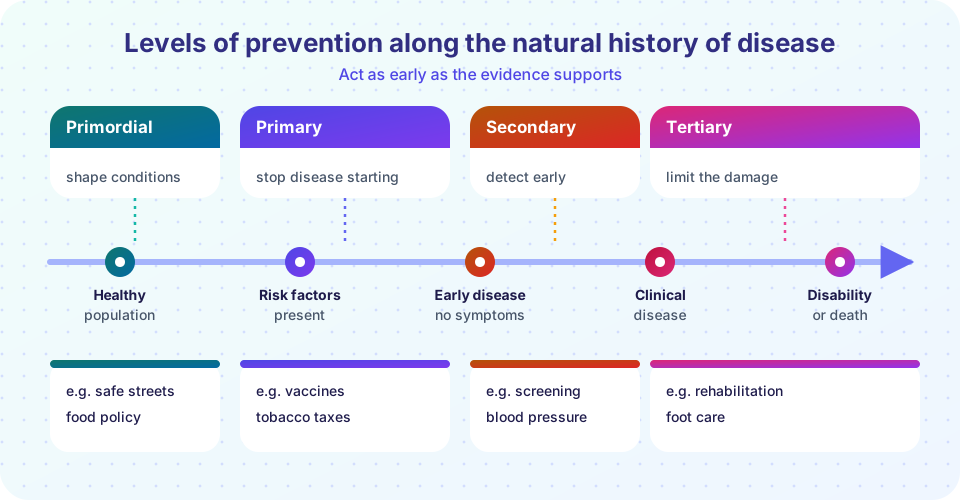
Prevention is classified by when it acts in the natural history of a disease.
- Primordial prevention acts on the underlying conditions that give rise to risk factors, before risk factors appear: for instance policies that make healthy food affordable, safe places to walk and cycle, or urban planning that reduces air pollution. It aims to stop the risk factors from emerging at all.
- Primary prevention removes or reduces exposure or increases resistance in people who are healthy: vaccination, smoking cessation programs, helmet laws, folic acid fortification of flour (which reduces neural tube defects), water fluoridation to prevent dental caries.
- Secondary prevention detects disease in the early, often symptom-free stage and treats it, with the aim of curing the disease or slowing progression: screening for cervical or colorectal cancer, blood-pressure checks, newborn screening.
- Tertiary prevention limits disability and complications in people who already have the disease: cardiac rehabilitation, stroke rehabilitation, foot care for people with diabetes, structured self-management.
Some authors also describe quaternary prevention: protecting people from overmedicalization, that is, from unnecessary tests and treatments, an idea connected to the overdiagnosis problem from the previous lesson.
The categories overlap. Treating high blood pressure in someone without symptoms is secondary prevention of heart disease, but primary prevention of stroke. What matters is the idea: act as early as evidence supports.
Rose's two strategies
Geoffrey Rose, a British epidemiologist, made a distinction in his 1985 paper "Sick individuals and sick populations" and later in his book The Strategy of Preventive Medicine (1992). Consider blood pressure. Doctors define "hypertension" with a cut-off, but blood pressure is a continuous measure, distributed across the population in a bell shape. Risk of stroke and heart disease increases smoothly with blood pressure, with no safe threshold in the usual range: large pooled analyses suggest that, roughly, 20 mmHg higher systolic pressure is associated with a doubling in vascular death risk across a wide range in middle age.
The high-risk strategy
Find people at the top of the distribution and treat them: screen for hypertension and prescribe medication, or run a program for those with high cholesterol. Its strengths:
- It is appropriate for the individual: patient and clinician understand why they are doing it.
- It motivates people and professionals.
- It uses resources on those who stand to benefit most per person, and a favorable risk-benefit ratio for those treated.
Its weaknesses, from Rose's argument:
- It is palliative and temporary: it does not address why the population has a high-risk distribution, and new people will keep arriving in the high-risk group.
- It needs screening, which has costs and harms.
- It is behaviorally inappropriate if the problem is the population's general lifestyle.
- It has a limited potential: because most cases occur among people who are not in the highest-risk group, it prevents only a minority of all cases.
The population strategy
Shift the whole distribution: reduce average salt intake, reduce smoking prevalence, change the food supply. Strengths:
- It is radical: it tackles causes.
- It has large potential for the whole population.
- It is behaviorally appropriate, because it changes norms and environments.
Weaknesses:
- Each individual gains a small benefit, so motivation is low (the prevention paradox).
- The benefit-to-risk ratio for the individual may be poor, and rare side effects matter more when millions are exposed.
- It needs political action and sometimes limits individual choice.
The prevention paradox
Rose pointed out that "a preventive measure which brings large benefits to the community offers little to each participating individual." Many more cases come from the many people at moderate risk than from the few at very high risk, simply because there are many more of them. Eliminating the risk of the top group would remove only a fraction of cases, while reducing everyone's risk slightly could remove more. Yet each person in the second group sees little personal reward, which is why population measures often meet resistance.
For example, a small decrease in average systolic pressure across a population (for example 2 mmHg, achievable through modest salt reduction) is estimated by researchers to cause a meaningful decline in stroke and heart disease deaths. The simulation below illustrates how.
Tools of public health action
Public health uses a range of tools, from least to most intrusive. The Nuffield Council on Bioethics (2007) described a "ladder of interventions": do nothing or monitor; provide information; enable choice (for instance cycling lanes); guide choices through changing the default; guide choices through incentives and disincentives (taxes); restrict choice; eliminate choice (bans). The higher the rung, the stronger the justification needed.
Evidence suggests that interventions that change the environment or default (food reformulation, taxes, regulation, smoke-free laws) tend to reach everyone and reduce inequalities, whereas information-only campaigns tend to benefit better-off groups more. Notable examples include the North Karelia Project in Finland, begun in 1972, which combined community action and food-industry changes and was followed by a large fall in cardiovascular mortality; the bans on industrial trans fats started in Denmark in 2003; and tobacco control packages that combine taxes, smoke-free laws, advertising bans, warnings and cessation support.
Common misconceptions
"Prevention always saves money." Some prevention is cost-saving, some is cost-effective, some is not. Costs and benefits must be assessed case by case (chapter 8).
"Population measures are paternalistic and individual treatment is not." Both involve judgments about autonomy and evidence. The question is how much benefit, how much intrusion and who decides.
"Only people at high risk need prevention." Most cases arise among people at moderate risk.
"Individuals choose their risk factors freely, so policy is irrelevant." Diets, smoking and activity are strongly shaped by prices, marketing and the built environment.
Try it
First, sort examples into levels of prevention. It is a quick self-test with instant feedback.
Second, a simulation of Rose's argument. It uses a normal distribution of systolic blood pressure and the approximation that risk doubles for every 20 mmHg. It compares treating the highest-risk group with a small shift of the entire distribution. The numbers are illustrative assumptions.
Press Run (or Ctrl + Enter) to see the result here.
Program input · what you'd type while the program runs
Type the answers before you press Run, one per line. Each time the program reads a line (with input()), it gets the next line from this box.
Check your understanding
Quick check · 5 questions
of 5 answered You scored / 5 · perfect!
-
1. Folic acid fortification of flour to prevent neural tube defects is an example of:
It prevents the condition from occurring in healthy people. -
2. What is the prevention paradox?
Rose observed that population-wide measures give each person only a small expected benefit. -
3. Why does the high-risk strategy prevent only a limited share of all cases?
Moderate risk times many people adds up to more cases than very high risk times few people. -
4. Cardiac rehabilitation after a heart attack is:
It limits the effects of established disease. -
5. Which intervention is typically LEAST likely to widen health inequalities?
Environmental measures reach everyone and do not depend on individual agency.
Summary
- Prevention levels (primordial, primary, secondary, tertiary) describe when action occurs in the natural history of disease.
- Rose contrasted the high-risk strategy (targeted, individually appropriate, limited impact) with the population strategy (radical, large potential, small individual benefit).
- The prevention paradox arises because most cases come from the many people at moderate risk.
- Policy tools range from information to bans, and environmental measures tend to be more equitable than information alone.
Track your progress
Create a free account to tick off lessons and pick up where you left off on any device.
of Public Health and Epidemiology lessons completed