


















Lesson 19 of 46 · Study Designs
Case-control studies: starting from the outcome and looking back
Learn how case-control studies compare people with and without a disease, how to choose controls, why the odds ratio estimates risk ratio for rare diseases, and how recall bias arises.
Imagine that a pediatric hospital sees eight young women with a very rare vaginal cancer that was previously almost unknown in that age group. A cohort study would need to follow tens of thousands of women for decades to find a handful of cases. A cleverer approach is to begin with the cases, find a few women of similar age without the cancer, and ask all of them about their mothers' pregnancies. This is the logic of the case-control study: start with the outcome and look backward for differences in exposure.
This is exactly how, in 1971, researchers linked a rare cancer to the synthetic hormone diethylstilbestrol (DES), taken by the women's mothers during pregnancy. In this lesson you will learn the design, how to choose cases and controls well, why the odds ratio is the natural measure, and the main bias that threatens these studies.
What you will learn
- How a case-control study is designed and why it suits rare diseases.
- How to choose cases and, above all, controls.
- How to compute and interpret the odds ratio.
- Recall bias and other threats.
Key terms
- Case: a person who has the disease (by a clear definition) at the start of the study.
- Control: a person without the disease, chosen to represent the population that produced the cases.
- Odds ratio: the odds of exposure among cases divided by the odds of exposure among controls.
- Matching: selecting controls to resemble cases on factors such as age and sex.
- Recall bias: differences in the accuracy or completeness of remembered exposure between cases and controls.
The design in five steps
- Define and identify cases. Use a precise definition (clinical criteria, laboratory results, dates). Prefer incident (newly diagnosed) cases over prevalent ones, so that the exposure you ask about came before the disease and is not distorted by survival.
- Select controls from the same source population, people who would have been counted as cases had they developed the disease.
- Measure past exposure in both groups using the same methods: interviews, questionnaires, medical or pharmacy records, stored blood samples, workplace records.
- Compare the odds of exposure in cases and controls with an odds ratio.
- Check for bias and confounding, and adjust, typically with logistic regression.
The direction is the reverse of a cohort study: from outcome to exposure. Because the investigator chooses how many cases and controls to study, the study does not show the proportion of the population who get ill, so risk and incidence cannot be computed, only the comparison of exposure.
Why the odds ratio?
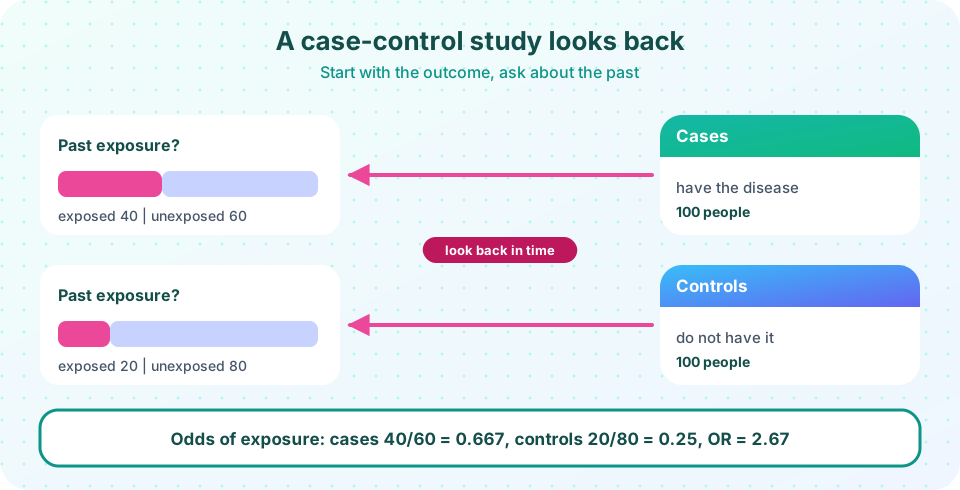
Suppose 100 cases and 100 controls are interviewed. Among the cases 40 had the exposure; among the controls 20 had it:
| Cases | Controls | |
|---|---|---|
| Exposed | 40 | 20 |
| Unexposed | 60 | 80 |
| Total | 100 | 100 |
The odds of exposure among cases are 40/60 = 0.667, among controls 20/80 = 0.25. The odds ratio is 0.667 / 0.25 = 2.67. Equivalent: OR = (a × d) / (b × c) = (40 × 80) / (20 × 60) = 3,200 / 1,200 = 2.67.
Here is the useful mathematical fact: the odds ratio of exposure given disease equals the odds ratio of disease given exposure. In other words, the OR does not change if you swap the direction of the study. Even though you sampled by outcome, the OR is a valid estimate of the OR for disease. When the disease is rare in the source population, that odds ratio is close to the risk ratio (the second demonstration below shows how they diverge for common diseases). This is the "rare disease assumption". The same logic means that a case-control study can estimate a risk ratio's equivalent with few participants: in the simulation below, only about 4,800 people are sampled out of a population of 200,000, yet the odds ratio estimates the effect of an exposure that doubles risk, and the confidence interval covers the true value.
Choosing controls: the hardest part
The controls must represent the source population of the cases: the people who, if they had developed the disease, would have been included as cases. If controls differ systematically from that population, the exposure's frequency among controls will be biased, and so will the OR. Common sources:
- Population controls: randomly selected from the community (using registries or random-digit dialing). Ideal in principle, but expensive and subject to low response rates.
- Hospital controls: patients admitted for other conditions. Convenient and similar in access to care, but their conditions may themselves be related to the exposure (for example, smokers are over-represented among patients with many diseases), which can hide a real association.
- Neighborhood or friend controls: match on social factors but may over-match on exposure (friends often share habits).
Ask: "Would this control have been identified as a case if they had developed the disease?" Do not choose controls on the basis of exposure. And use the same time frame and the same measurement methods for cases and controls.
Matching selects controls similar to cases on important confounders such as age and sex. In frequency matching the control group has the same age distribution as the cases; in individual matching each case has one or more specific matched controls, and the analysis must respect the pairs. Matching improves efficiency but cannot be applied to the exposure of interest, and over-matching (matching on something related to the exposure but not the disease) can hide a true effect.
Recall bias and other problems
Because exposure is determined after the disease occurred, how people recall the past is crucial. Recall bias arises when cases, who have been searching for an explanation of their illness, remember or report past exposures differently than healthy controls. A mother of a child with a birth defect may recall every medicine she took in pregnancy in detail, while a mother of a healthy child may not. If cases over-report exposure, the OR is inflated. The demonstration below shows the effect: with a true OR of 2.67, if just 20 percent of the truly unexposed cases falsely report exposure, the observed OR rises to about 4.3.
Ways to reduce recall bias: use objective records (pharmacy data, employment files, stored blood samples); blind interviewers to case status; use standardized questions; choose controls with another illness who also search for explanations (although this can create other problems); and ask about exposures the participants do not suspect.
Other problems: selection bias (controls not representative), temporal ambiguity (illness may change exposure, for example diet after a diagnosis), and confounding, as in any observational study. Case-control studies also cannot estimate incidence and are usually restricted to one outcome, although several exposures can be examined.
Strengths and weaknesses
Strengths: efficient for rare diseases and diseases with long latency; relatively quick and inexpensive; can examine many exposures at once; good for outbreak investigations and for generating hypotheses.
Weaknesses: susceptible to recall and selection bias; cannot directly give incidence or risk; poor for rare exposures; difficult to establish temporal order if exposure data come from memory; only one outcome per study.
Variants
In a nested case-control study, cases and controls are drawn from within an existing cohort, often using stored biological samples measured only for the selected people. It saves cost while keeping the cohort's strengths: exposure was recorded before disease, which removes recall bias. A related case-cohort design samples a random subcohort and compares all cases against it.
Some famous examples
- In 1950, Doll and Hill published a case-control study of lung cancer patients in London hospitals compared with patients without lung cancer, finding that smoking was far more frequent and heavier among the cases. Independent American work by Wynder and Graham appeared in the same year. These studies prompted Doll and Hill's British Doctors cohort.
- In 1971, Herbst, Ulfelder and Poskanzer reported eight young women with clear-cell adenocarcinoma of the vagina, together with 32 matched controls. Seven of the eight mothers of cases had taken DES during pregnancy, compared with none of the mothers of the 32 controls. Such a strong association in such a small study was enough to establish the link, and the drug was withdrawn from use in pregnancy.
Common misconceptions
"Case-control studies show the risk of disease." They cannot, because the proportion of cases is fixed by the investigator. They show the odds ratio.
"Controls should be perfectly healthy." Controls should represent the source population, including its exposures. Hospital controls with diseases related to the exposure can bias results.
"OR always equals RR." Only approximately, and only when the disease is rare. For common diseases the OR is larger than the RR.
"Matching removes all confounding." It addresses only the matched factors and may introduce problems of its own.
Try it
Press Run (or Ctrl + Enter) to see the result here.
Program input · what you'd type while the program runs
Type the answers before you press Run, one per line. Each time the program reads a line (with input()), it gets the next line from this box.
Press Run (or Ctrl + Enter) to see the result here.
Program input · what you'd type while the program runs
Type the answers before you press Run, one per line. Each time the program reads a line (with input()), it gets the next line from this box.
Check your understanding
Quick check · 6 questions
of 6 answered You scored / 6 · perfect!
-
1. In a case-control study, 60 of 100 cases and 30 of 100 controls were exposed. What is the odds ratio?
OR = (60 x 70) / (40 x 30) = 4,200 / 1,200 = 3.5. -
2. Why can a case-control study not give the incidence of disease?
The proportion of cases in the sample is set by the design, not by the population. -
3. Controls should be chosen to represent
Controls give the expected frequency of exposure in the population from which cases arose. -
4. Recall bias is most likely when
Differences in remembering and reporting between cases and controls distort the odds ratio. -
5. A case-control OR approximates the risk ratio best when
For rare diseases the odds of disease are nearly equal to the risk. -
6. A study draws cases and controls from inside an existing cohort using stored blood samples. This is a
Nested case-control studies sample cases and controls from a cohort and benefit from exposure data recorded before disease.
Summary
- A case-control study starts with cases and controls and compares their past exposure, which makes it efficient for rare diseases.
- Controls must represent the source population of the cases; matching helps but can over-match.
- The odds ratio is the measure; it approximates the risk ratio when the disease is rare.
- Recall bias, selection bias and confounding are the main threats; nested designs and objective records reduce them.
Next: Randomized trials
Track your progress
Create a free account to tick off lessons and pick up where you left off on any device.
of Public Health and Epidemiology lessons completed