


















Lesson 16 of 46 · Study Designs
Chapter 4 overview: study designs in epidemiology
Preview chapter 4: descriptive studies, cohort, case-control and randomized trials, how the designs differ in direction and strength, and a tool for choosing among them.
A measure is only as good as the study that produced it. Suppose you want to know whether a new school lunch menu lowers childhood obesity, or whether a pesticide causes cancer in farm workers. You could ask a few families, compare two towns, follow a group of children for years, or assign menus at random. Each choice is a study design, and each has strengths, weaknesses and a different cost. This chapter teaches you the main designs and, above all, how to tell which one fits a question.
What you will learn
- The structure of the family of designs: descriptive, analytic, observational, experimental.
- The three questions that pick a design.
- What the next four lessons cover and how the designs compare.
Key terms
- Observational study: the investigator observes exposure and outcome but does not assign the exposure.
- Experimental study: the investigator assigns the exposure, ideally at random.
- Descriptive study: describes patterns of disease by person, place and time.
- Analytic study: compares groups to test a hypothesis about cause.
- Hierarchy of evidence: an informal ranking of designs by their ability to avoid bias.
The designs at a glance
Describe
Observe and compare
Experiment
Judge the evidence
Three questions that pick a design
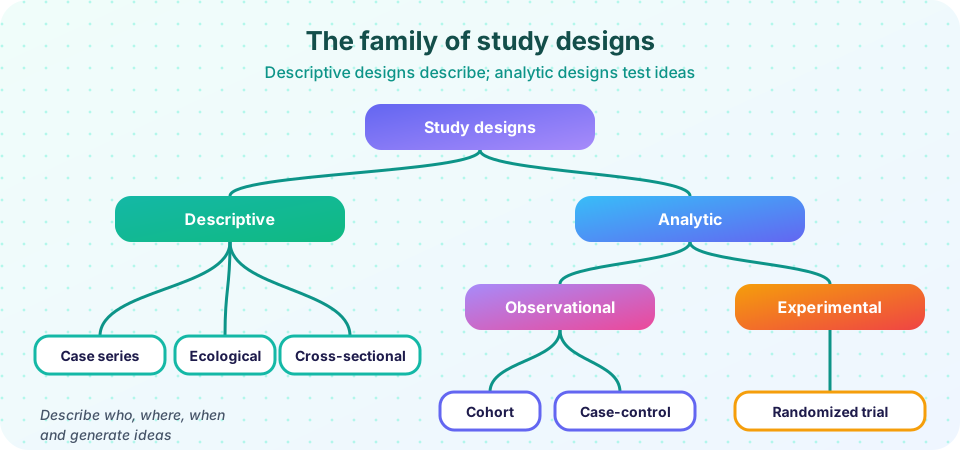
- Does the investigator assign the exposure? If yes, it is an experiment (a trial). If no, the study is observational.
- Is the study comparing groups to test a hypothesis? If it only describes patterns (who, where, when), it is descriptive. If it compares groups, it is analytic.
- What is the starting point and the direction of inquiry? A cohort study starts with exposure and looks forward to outcomes. A case-control study starts with outcome and looks backward to exposure. A cross-sectional study measures both at the same time.
Two further practical questions guide the final choice: How rare is the outcome? (rare outcomes favor case-control) and How rare is the exposure? (rare exposures favor cohort studies of the exposed). Then ask what is feasible and ethical: you cannot randomize people to smoke.
What each lesson covers
- Descriptive studies covers case reports, case series, cross-sectional surveys and ecological studies, with an outbreak example and the ecological fallacy.
- Cohort studies explains prospective and retrospective cohorts, Framingham and the British Doctors Study, person-time follow-up and loss to follow-up.
- Case-control studies explains choosing cases and controls, odds ratios, matching, and recall bias.
- Randomized trials covers randomization, blinding, allocation concealment, intention to treat, and why trials give the strongest evidence of effect.
- Chapter 4 review compares all designs and gives a ten-question quiz.
The hierarchy of evidence, with caution
You will often see a "pyramid" with systematic reviews and randomized trials at the top, cohort and case-control studies in the middle and case reports at the bottom. As a rough guide to how well a design resists bias in estimating an effect, it is useful. But it is a guide, not a law. A badly conducted trial can be worse than a careful cohort study. Some questions can only be answered with observational data: you cannot ethically assign people to a harmful exposure, and a trial of a long-term outcome may be impractical. Strong inference usually comes from a body of evidence, with several designs agreeing, a theme of chapter 5.
One question, four designs
Suppose the question is whether drinking coffee is related to bladder cancer (a purely hypothetical setup to compare designs). An ecological study compares each country's average coffee consumption with its bladder cancer rate. It is fast and uses routine data, but it cannot say whether the people who drink the coffee are the people who get the cancer. A case-control study asks patients with bladder cancer and a comparison group about their past coffee habits. Because bladder cancer is uncommon, this needs far fewer participants than a cohort, but it depends on memory and on a good choice of controls. A cohort study asks a large group about coffee now and follows them for years; it shows that coffee drinking came first, but needs huge numbers and decades of follow-up. A randomized trial of lifelong coffee would be impractical and, if coffee were harmful, unethical, although a short trial could test an effect on an intermediate marker.
No single design settles the matter. The best evidence comes from several designs pointing in the same direction, each with different weaknesses.
Try it
Check your understanding
Quick check · 3 questions
of 3 answered You scored / 3 · perfect!
-
1. What distinguishes an experimental study from an observational one?
In an experiment the investigator assigns the exposure, ideally at random; in an observational study they only observe. -
2. A study that starts with people who have a disease and looks back for past exposures is a
Case-control studies start from the outcome and look backward. -
3. Why can't we simply rely on the evidence pyramid?
Study quality and the match between design and question matter as much as the label.
Summary
- Designs are descriptive or analytic; analytic designs are observational (cohort, case-control) or experimental (trials).
- Choose by who assigns exposure, whether groups are compared, and the direction of inquiry; consider rarity, cost and ethics.
- The hierarchy of evidence is a rough guide; strong conclusions come from several designs agreeing.
Next: Descriptive studies
Track your progress
Create a free account to tick off lessons and pick up where you left off on any device.
of Public Health and Epidemiology lessons completed