


















Lesson 5 of 45 · Getting Started
Chapter 1 Review: Getting Started
Review the foundations of power electronics: switching, duty cycle, efficiency and the four converter families, with a recap table and a ten-question quiz.
You have finished the first chapter. This page pulls it together: one picture, a recap table and a longer quiz that mixes all four lessons. If any answer surprises you, go back to the linked lesson before moving on to power semiconductors.
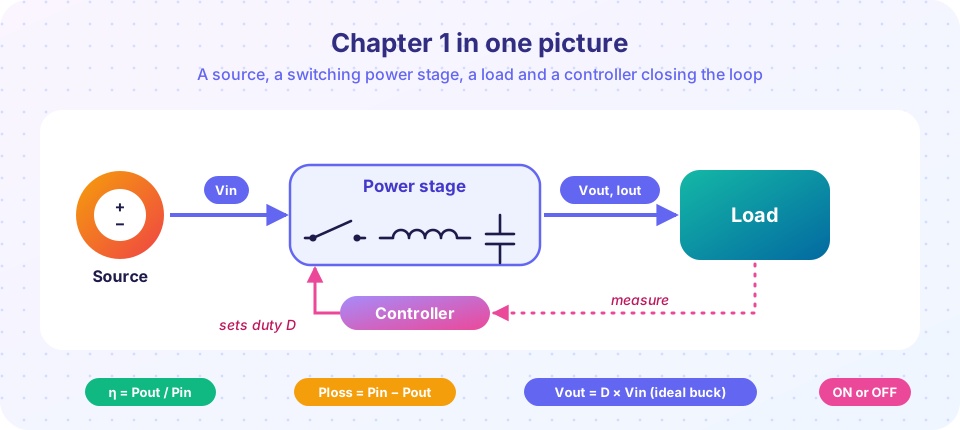
Chapter in one paragraph
A power converter uses switches that are fully on or fully off, so little power is wasted in them. A controller sets the duty cycle D, an inductor and capacitor average the pulses, and the result is a load voltage different from the source. Efficiency, η = Pout / Pin, is a budget of conduction, switching, magnetic and gate-drive losses. Every converter belongs to one of four families: rectifier, DC-DC converter, inverter or AC-AC converter.
Recap table
| Topic | Key idea | Key equation | Lesson |
|---|---|---|---|
| Why switching | Switch fully on or off to avoid dissipating V × I |
Linear η ≤ Vout/Vin |
Why converters switch |
| Duty cycle | On-time fraction sets the average | Vavg = D × Vin |
Why converters switch |
| Filtering | LC low-pass keeps the average | fc = 1/(2π√(LC)) |
Why converters switch |
| Efficiency | Output over input | Ploss = Pout (1/η − 1) |
Efficiency and losses |
| Loss groups | Conduction, switching, gate, magnetic | Psw ≈ ½ V I (tr+tf) fsw |
Efficiency and losses |
| Families | AC-DC, DC-DC, DC-AC, AC-AC | Input and output type | Converter families |
Worked review example
A buck converter makes 5 V at 2 A from 12 V and is 92% efficient. Check every number.
- Output power:
5 × 2 = 10 W. - Input power:
10 / 0.92 = 10.87 W, so the loss is0.87 W. - Ideal duty cycle:
D = 5 / 12 = 0.417. - Input current (average):
10.87 / 12 = 0.906 A. - A linear regulator would dissipate
(12 − 5) × 2 = 14 W, about 16 times more heat.
Try it
The calculator below repeats the example for any spec. It uses the ideal buck relation D = Vout / Vin and the loss formula, so you can see the heat and input current for your own numbers.
Press Run (or Ctrl + Enter) to see the result here.
Program input · what you'd type while the program runs
Type the answers before you press Run, one per line. Each time the program reads a line (with input()), it gets the next line from this box.
Check your understanding: chapter test
Quick check · 9 questions
of 9 answered You scored / 9 · perfect!
-
1. Why is the power dissipated in an ideal switch close to zero?
P = V × I and one factor is nearly zero in each state. -
2. A converter has a duty cycle of 0.3 and an ideal chopper from 20 V. What is the average output?
0.3 × 20 V = 6 V. -
3. What best describes an LC filter's job?
It is a low-pass filter with its corner frequency far below the switching frequency. -
4. A 500 W converter at 96% efficiency wastes about:
Pin = 500 / 0.96 = 520.8 W, so the loss is about 20.8 W. -
5. Which loss is directly proportional to switching frequency?
Each transition dissipates energy, so power scales with the number of transitions per second. -
6. Which family converts AC to DC?
A rectifier converts alternating to direct voltage. -
7. A MOSFET with 10 mΩ carries 20 A rms. What is its conduction loss?
P = I² R = 400 × 0.01 = 4 W. -
8. Why does a higher switching frequency allow smaller inductors?
At higher frequency the switch cycles faster, so each cycle moves less energy and a smaller inductance gives the same ripple. -
9. Which statement about efficiency is true?
Efficiency is operating-point dependent and can never exceed 100%.
Summary
- Switching converters waste little power because their switches are never in the lossy middle.
Dsets the average; LC filtering smooths it.- Efficiency is a loss budget; each percent near the top matters.
- All converters fit one of four families, and most products chain two.
Track your progress
Create a free account to tick off lessons and pick up where you left off on any device.
of Power Electronics lessons completed