


















Lesson 25 of 45 · Inverters and Motor Drives
Chapter 5 review: inverters and motor drives
Review square-wave and six-step inverters, harmonics, induction motor speed and V/f control with a recap table, a drive sizing calculator and a ten-question quiz.
You have followed an inverter from a single pair of switches to a complete variable-frequency drive. Three ideas run through every lesson: a leg connects an output to one of two rails, the pattern in which legs switch decides the output waveform, and the DC link sets the ceiling on the AC voltage you can make. This review puts the numbers in one place and walks through the sizing of a real drive.
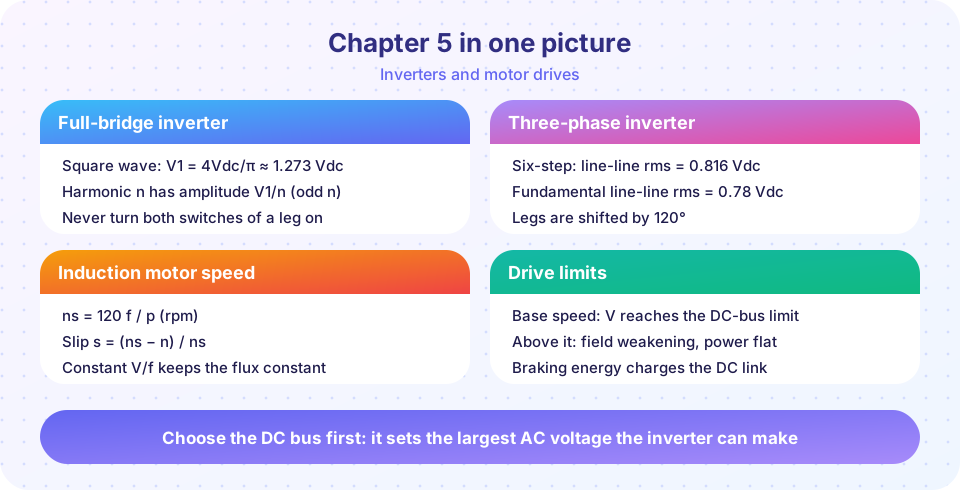
Recap table
| Topic | Key result | Lesson |
|---|---|---|
| Half bridge | output ±Vdc/2 |
Single-phase inverters |
| Full bridge, square wave | V1 = 4Vdc/π, Vn = V1/n (odd), THD 48.3 % |
same |
| Phase-shift control | V1 = (4Vdc/π)·sin(α/2); 3rd harmonic zero at α = 120° |
same |
| Dead time | prevents shoot-through; diodes carry current meanwhile | same |
| Six-step line voltage | rms 0.816 Vdc, fundamental rms 0.780 Vdc, THD 31 % |
Three-phase inverters |
| Six-step harmonics | orders 6k ± 1, amplitude 1/n |
same |
| Synchronous speed | ns = 120 f / p |
Motor drives and V/f |
| V/f control | constant V/f keeps flux constant; boost at low f |
same |
| Field weakening | above base f: torque ∝ 1/f, power constant |
same |
| Largest line voltage | 0.612 Vdc (SPWM), 0.707 Vdc (SVPWM), 0.780 Vdc (six-step fundamental) |
same and Chapter 6 |
Sizing a drive in five steps
A 7.5 kW, 400 V, 50 Hz, 4-pole induction motor has efficiency 0.90 and power factor 0.82 at full load.
- Current.
I = P / (√3 · VLL · η · cosφ) = 7500 / (1.732 × 400 × 0.90 × 0.82) = 14.7 A rms. - Peak current. The inverter switches must carry
√2 × 14.7 = 20.7 Aplus margin for overload (often 150 % for 60 s). - DC link. From 400 V mains the link is about
1.35 × 400 = 540 Vunder load (peak 566 V unloaded). SVPWM needsVdc ≥ 400 / 0.707 = 566 Vto deliver the full 400 V, so a loaded drive reaches about 95 % of rated voltage (382 V), which motors accept. - Switch rating. A DC link of 566 V plus switching overshoot calls for 1200 V devices.
- Speed. At 50 Hz the field speed is 1500 rpm; at 3 % slip the shaft runs at 1455 rpm.
The calculator below repeats these steps for any motor and any modulation method.
Try it
The first example sizes a drive from the motor data and tells you whether the DC link can supply the voltage.
Press Run (or Ctrl + Enter) to see the result here.
Program input · what you'd type while the program runs
Type the answers before you press Run, one per line. Each time the program reads a line (with input()), it gets the next line from this box.
The second example is an operating-point checker for a V/f drive: enter the speed and the torque you need, both in per unit, and it tells you whether the drive can deliver it.
Check your understanding
Quick check · 10 questions
of 10 answered You scored / 10 · perfect!
-
1. A full-bridge square-wave inverter has Vdc = 200 V. What is its fundamental rms output?
V1,rms = 0.9003 × Vdc = 180 V. -
2. Which harmonic can be removed from a full-bridge output by pulses 120° wide?
Vn ∝ sin(nα/2); for n = 3 and α = 120° this is zero. -
3. What does dead time protect against?
Both switches of a leg must never conduct together. -
4. A six-step inverter runs from Vdc = 300 V. What is the rms line-to-line voltage including harmonics?
0.8165 × 300 = 245 V; the fundamental alone is 0.7797 × 300 = 234 V. -
5. Which harmonics does the six-step line voltage contain?
Triplens cancel in line voltages and even harmonics vanish by symmetry. -
6. A 6-pole motor runs on 50 Hz. What is the synchronous speed?
120 × 50 / 6 = 1000 rpm. -
7. A 4-pole motor with slip 4 % on 60 Hz turns at
ns = 1800 rpm, n = 0.96 × 1800 = 1728 rpm. -
8. Why must voltage fall when the drive frequency is lowered below base frequency?
Flux ∝ V/f; constant voltage at low frequency would saturate the motor. -
9. What happens to the available torque above base frequency?
Voltage is capped, flux falls as 1/f, so torque falls and power stays roughly constant. -
10. A fan runs at 70 % speed. Approximately what fraction of full-speed power does it need?
Fan power scales with the cube of speed: 0.7³ = 0.343.
Summary
- A leg, a pattern and a DC link: those three decide every inverter waveform.
- Square-wave and six-step bridges are simple but harmonic-rich; their fundamentals are
4Vdc/π(single-phase, peak) and0.780 Vdc(three-phase line rms). - A motor drive keeps
V/fconstant up to base speed and field-weakens above it. - The DC link, not the switches, usually sets the voltage ceiling: check it first when sizing.
Track your progress
Create a free account to tick off lessons and pick up where you left off on any device.
of Power Electronics lessons completed