


















Lesson 42 of 45 · Projects and Practice
Practice problems: inverters, control, magnetics, thermal and applications
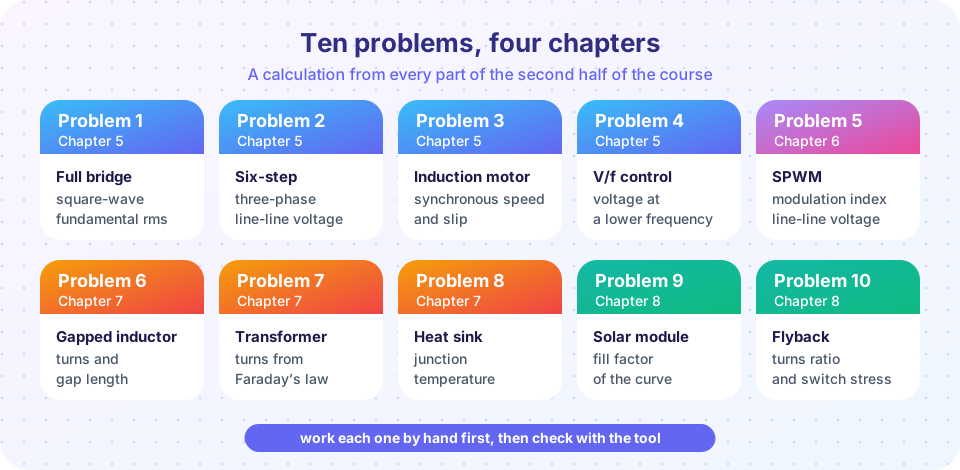
Ten worked-calculation problems from chapters 5 to 8: inverter voltages, motor speed, V/f, SPWM, inductor and transformer turns, heat sinks, solar fill factor and flyback turns ratio.
You learn power electronics by calculating. The ten problems below cover the second half of the course, one or two from each topic. Each has a single numerical answer, and you will find an answer checker and a program that prints the full solutions further down. Work each problem by hand first, with the formula from the chapter, and only then check.
What you will learn
- Choose the right formula for a given inverter, magnetics, thermal or application question.
- Carry units through a calculation and sanity-check the magnitude of the answer.
- Use code to check your hand calculations.
Key terms
Sanity check: asking whether an answer is the right size, for example whether a 5 A inductor design can have a 60 µm gap.
Per unit: expressing a quantity as a fraction of its rated value.
Tolerance: the allowed relative error when comparing two numbers; engineers rarely need better than 2 to 5 %.
The problems
Problem 1 (chapter 5). A full-bridge inverter runs from Vdc = 400 V and makes a square wave. Find the rms value of the fundamental (in volts).
Problem 2 (chapter 5). A three-phase six-step inverter runs from Vdc = 600 V. Find the rms line-to-line voltage including all harmonics (volts).
Problem 3 (chapter 5). A 4-pole induction motor runs on 60 Hz with a slip of 3 %. Find the shaft speed (rpm).
Problem 4 (chapter 5). A 400 V, 50 Hz motor is run at 20 Hz with constant V/f and no boost. Find the line voltage (volts).
Problem 5 (chapter 6). A three-phase SPWM inverter has Vdc = 48 V and ma = 0.85. Find the fundamental line-to-line rms voltage (volts).
Problem 6 (chapter 7). An inductor must have L = 22 µH at Ipk = 6 A. The core has Ae = 60 mm² and you allow Bmax = 0.25 T. Find the number of turns (round up) and then the gap length in millimetres for that number of turns. Give the gap length as your answer.
Problem 7 (chapter 7). A square-wave transformer winding sees 24 V at 200 kHz on a core with Ae = 40 mm² and Bpk = 0.08 T. Find the number of turns (round up).
Problem 8 (chapter 7). A device dissipates 5 W with θJC = 1.5, θCS = 0.4 and θSA = 6 °C/W at an ambient of 45 °C. Find the junction temperature (°C).
Problem 9 (chapter 8). A solar module has Voc = 37 V, Isc = 9 A, Vmpp = 30 V and Impp = 8.4 A. Find the fill factor.
Problem 10 (chapter 8). A CCM flyback converts 300 V DC to 20 V at a duty cycle of 0.4. Find the turns ratio Np/Ns (ignore the diode drop).
Hints
- The fundamental of a square wave of amplitude
Vdcis4Vdc/πin peak value. vab,rms = √(2/3) · Vdc.ns = 120 f / p, thenn = (1 − s)·ns.- The ratio
V/fis 8 V/Hz. VLL,1 = (√3 / (2√2)) · ma · Vdc.N = L·Ipk/(Bmax·Ae), rounded up, thenlg = µ0·N²·Ae/L.N = V / (4·f·Ae·Bpk), rounded up.Tj = Ta + P·(θJC + θCS + θSA).FF = Pmpp / (Voc·Isc)withPmpp = Vmpp·Impp.Vo = Vin·(Ns/Np)·D/(1 − D).
Do a sanity check on every answer: Problem 4's answer must be less than 400 V; Problem 9's fill factor must be between 0.6 and 0.85; Problem 8's junction temperature must exceed the ambient by P·θ.
Try it
The first example is an answer checker. Type your answer for each problem; the tool compares it with the correct value within a 2 % tolerance and tells you whether you are right.
The second example solves all ten problems with working. Read it after you have tried them: each line states the formula it uses.
Press Run (or Ctrl + Enter) to see the result here.
Program input · what you'd type while the program runs
Type the answers before you press Run, one per line. Each time the program reads a line (with input()), it gets the next line from this box.
Check your understanding
Quick check · 4 questions
of 4 answered You scored / 4 · perfect!
-
1. In Problem 6 the number of turns is 8.8, rounded up to 9. What happens to the peak flux density compared with the 0.25 T target?
Bpk = L·Ipk/(N·Ae); more turns than the exact value gives a lower flux density. -
2. Which problem is the best test of whether you remember to take the square root of 2?
The fundamental is 4Vdc/π in peak value; the rms is 1/√2 of that. -
3. In Problem 8, if the heat sink resistance doubles to 12 °C/W, what is the new junction temperature?
Tj = 45 + 5 × (1.5 + 0.4 + 12) = 114.5 °C. -
4. A good sanity check for Problem 10 is that the turns ratio should be
A 300 V input and 20 V output need many more primary turns than secondary turns.
Summary
- Each problem uses one or two formulas from chapters 5 to 8; identify the formula first, then compute.
- Round turns up, keep units, and check the size of every answer.
- Use the checker and the worked solutions to find which topics need review.
- When an answer is wrong, the usual causes are peak against rms, forgetting
√3, and mixed prefixes (µ, m, k).
Track your progress
Create a free account to tick off lessons and pick up where you left off on any device.
of Power Electronics lessons completed